
GEO (Generative Engine Optimization), A Practical Guide Updated 2026
Generative Engine Optimization (GEO) is the practice of creating and improving content so it can be clearly understood, retrieved, and potentially referenced by AI-powered search and generative engines when they generate answers to users’ questions.
Unlike traditional SEO, which mainly focuses on improving visibility and rankings in search results, GEO considers how information may appear in AI-generated answers, summaries, recommendations, and conversational search experiences.
For example, rather than only optimizing a page for the keyword “best SEO tools,” a GEO-focused approach would also provide clear comparisons, useful context, supporting evidence, and answers to related questions that users may ask.
GEO does not replace SEO. Strong technical SEO, relevant content, search intent, clear structure, credibility, and topical context still provide an important foundation.
What Is Generative Engine Optimization?
Generative Engine Optimization (GEO) is the practice of improving a website’s content, visibility, and online presence so that it has a better chance of being discovered, understood, and referenced by AI-powered search and answer systems.
Traditional Search Engine Optimization (SEO) mainly focuses on improving a website’s visibility in conventional search results. GEO extends this approach to search experiences where artificial intelligence generates a direct answer by understanding a user’s question, retrieving information from different sources, and combining that information into a response.
AI-powered platforms such as ChatGPT, Google AI Overviews, Google AI Mode, Perplexity, Claude, Microsoft Copilot, and other generative search systems can present information differently from traditional search engines. Instead of showing only a list of blue links, these systems may summarize information, compare options, explain a topic, recommend products or services, and provide links to supporting sources.
For example, a user may search:
“What are the best SEO tools for a small business?”
This creates a new opportunity for businesses and publishers. Rather than focusing only on ranking a webpage for a keyword, they can also work toward making their information useful and understandable enough to be considered by AI-driven search systems.
How GEO Differs From Traditional SEO?
GEO and SEO have different primary goals, but they are closely connected.
SEO focuses on helping webpages become visible in search engines and attract organic traffic. It involves areas such as keyword research, technical SEO, content optimization, internal linking, backlinks, structured data, and user experience.
GEO focuses more specifically on how information can be discovered, interpreted, summarized, and potentially cited or mentioned within AI-generated answers.
The two strategies should not be treated as completely separate disciplines. Strong technical SEO, useful content, clear website architecture, authoritative references, and good accessibility can support visibility in both traditional and AI-powered search environments.
Traditional SEO VS GEO
| Traditional SEO | Generative Engine Optimization |
| Focuses primarily on search engine visibility | Focuses on visibility within AI-generated answers and search experiences |
| Targets rankings for relevant queries | Targets inclusion, citation, or mention in generated responses |
| Optimizes webpages for search engines and users | Optimizes information for users and AI retrieval systems |
| Often measures rankings, clicks, and organic traffic | Can also consider citations, mentions, visibility, and AI referral traffic |
| Relies heavily on crawlability, relevance, content quality, links, and other SEO signals | Builds on these fundamentals while emphasizing clear, useful, well-supported information |
| Primarily aims to bring users to webpages | May influence the information users receive before they visit a website |
Why Is GEO Becoming Important?
The way people discover information is changing. Users increasingly ask AI systems complete questions rather than entering short keyword combinations into a traditional search box.
For example, instead of searching separately for:
- Best laptops for students
- Laptop battery life
- Laptop price
- Laptop specifications
a user may ask an AI system:
“Which laptop is best for a college student who needs long battery life and wants to stay under a specific budget?”
The system can interpret the different requirements and produce a personalized response.
This means businesses may have opportunities to reach potential customers inside the answer itself, even when the user does not immediately visit a website.
GEO therefore focuses on creating information that can contribute useful facts, explanations, comparisons, evidence, and context to these emerging search experiences.
How AI Search Systems Use Web Information
Many AI-powered search experiences can retrieve information from external sources before generating an answer. Depending on the platform and search mode, the system may identify relevant webpages, extract useful information, compare sources, and synthesize the findings into a response.
For example, a user researching a travel destination might ask:
“What is the best time to visit Japan for cherry blossoms, and which cities should be included in a one-week itinerary?”
An AI-powered search system may need information about:
- Seasonal conditions
- Popular destinations
- Travel distances
- Local attractions
- Transportation
- Opening hours
- Typical weather
- Recommended itineraries
A website that provides accurate, specific, well-organized information about these subjects can potentially become one of the sources considered by the system.
However, GEO does not guarantee that a particular website will be cited or mentioned. AI systems use their own retrieval, ranking, relevance, quality, and generation processes, and their results can change depending on the query and context.
GEO and Agentic Search
Generative search is also developing toward more agentic search experiences. In these systems, AI does more than provide an informational answer. It may help users complete multiple steps of a task by researching options, comparing information, making recommendations, or interacting with connected services.
For example, instead of asking: “What are good hotels in Paris?”, User wants to ask “Find a family-friendly hotel in Paris near major attractions within my budget.”
An agentic system may need to understand the requirements, search available information, compare different options, and potentially help complete the next step.
This development makes online visibility increasingly important because businesses may need their products, services, pricing information, policies, reviews, and other important details to be accessible and understandable to AI-driven systems.
GEO Is More Than Adding Keywords
One common misunderstanding is that GEO simply means adding more keywords or writing content specifically for AI systems. In practice, effective GEO requires a broader approach.
AI systems need information that is clear, relevant, accurate, useful, and supported by trustworthy sources.
Content can become more useful for generative search when it:
- Directly answers specific questions
- Provides factual and verifiable information
- Uses clear headings and logical structure
- Explains concepts in sufficient depth
- Includes relevant entities and relationships
- Provides original insights or data
- Uses examples where they improve understanding
- Keeps important information current
- Links to authoritative sources when appropriate
- Avoids unnecessary repetition and filler
For example, an article about Core Web Vitals should not simply repeat the term throughout the page. A stronger resource can explain what each metric measures, why it matters, how it is measured, common problems, practical solutions, and how businesses can monitor performance.
This gives both users and search systems more useful context.
The Role of Authority and Original Information
AI systems can encounter thousands of webpages covering the same subject. Simply publishing another version of information that already exists may provide little additional value.
GEO therefore overlaps with an important SEO principle: content should offer genuine value rather than simply reproduce information that is already widely available.
Original research, first-hand observations, expert analysis, unique datasets, case studies, experiments, practical examples, and updated statistics can make content more useful and distinctive.
For example, instead of publishing another generic article explaining website speed, a company could publish:
“A technical analysis of how reducing JavaScript execution time affected page interaction performance across 100 tested pages.”
Such information provides evidence and practical insight that may not be available in every competing article.
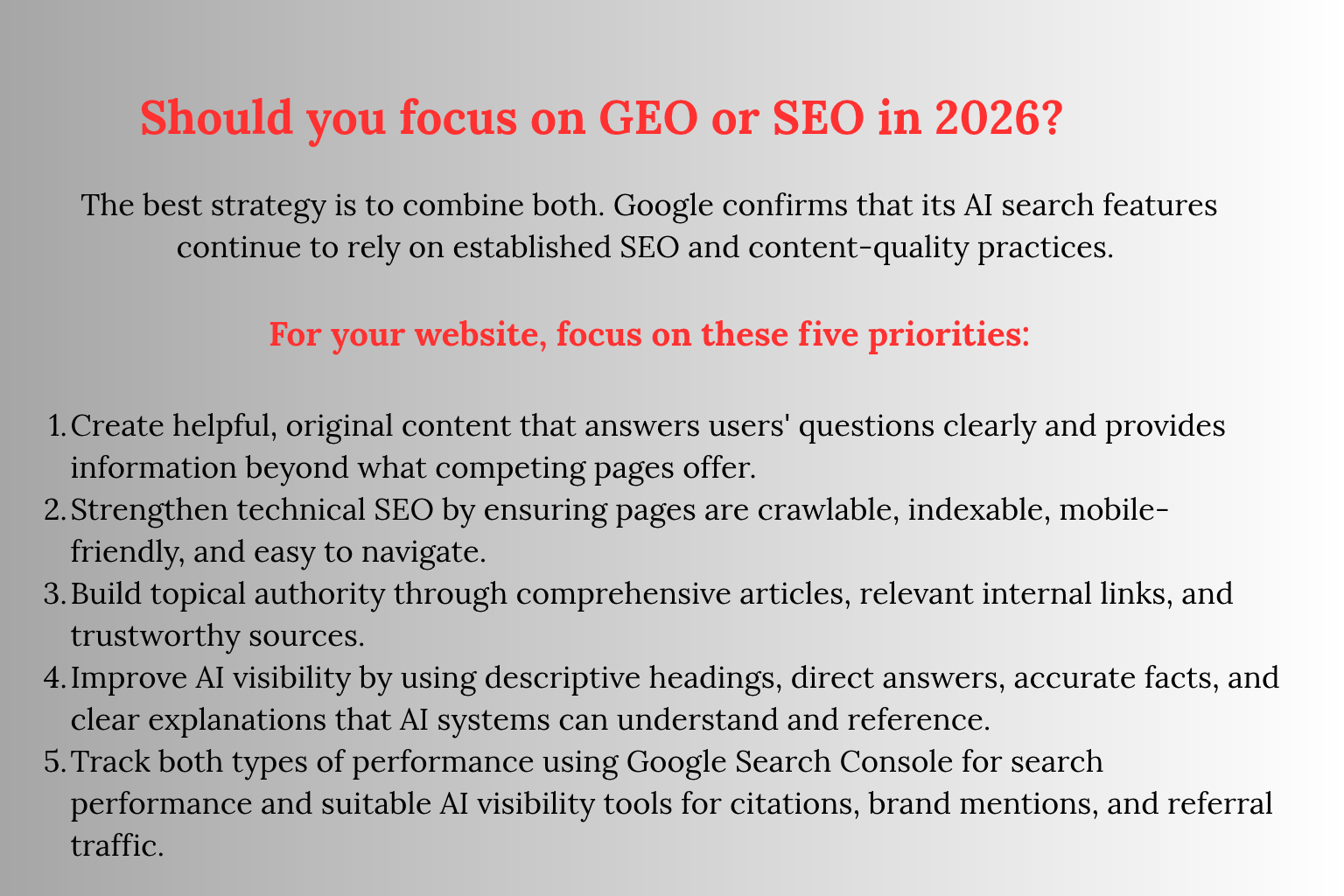
GEO Should Work Alongside SEO
GEO should not be viewed as a replacement for SEO.
A website still needs a technically accessible foundation so search engines and AI-powered systems can discover its content. Crawlability, indexability, page quality, internal linking, website architecture, structured data where appropriate, mobile usability, and overall content quality remain important.
Generative Engine Optimization Strategies
AI-generated answers have changed how users discover information, making Generative Engine Optimization (GEO) an extension of a strong SEO strategy rather than a completely separate approach.
Like SEO, GEO focuses on useful content, search intent, technical accessibility, clear structure, internal linking, and credible online mentions. By consistently covering relevant topics and providing accurate, well-organized information, brands can improve their chances of being referenced across AI-powered search experiences.
Create Comprehensive Topic Coverage
AI-powered search systems need reliable information to understand a topic, answer questions, and connect related concepts. A website that consistently covers an important subject from multiple relevant angles can provide more useful information for both traditional search and AI-driven search experiences.
Rather than publishing isolated articles for individual keywords, brands can build topic clusters around their core areas of expertise. A main topic can be supported by related pages covering questions, comparisons, practical guides, definitions, examples, and more specific subtopics.
The goal is not to publish a certain number of articles. The focus should be on creating useful, connected, and comprehensive coverage that genuinely serves the audience.
Make Content Easy to Understand
AI systems need to interpret the information available on a page before they can potentially use or reference it. Clear content structure can make that information easier for both users and search systems to understand.
Useful practices include:
- Using descriptive headings and subheadings
- Answering important questions directly
- Keeping individual sections focused on one clear subject
- Using tables, lists, and examples where they improve understanding
- Explaining industry-specific terms when necessary
- Keeping important information available as crawlable text
- Linking related pages through relevant internal links
- Avoiding unnecessary repetition and vague statements
Well-organized content also creates a better experience for people who visit a website after discovering it through search or an AI-generated answer.
Focus on Original and Valuable Information
Simply rewriting information that already exists across hundreds of websites gives an AI system little reason to distinguish one source from another.
GEO therefore benefits from content that adds something useful to the topic. This could include original research, firsthand experience, expert commentary, unique data, detailed examples, product insights, case studies, or practical explanations that are difficult to find elsewhere.
This is particularly important as AI-generated answers can combine information from multiple sources. A website needs to offer clear value rather than simply producing another version of information that is already widely available.
Build Credibility Across the Web
Brand visibility in AI search is not limited to a company’s own website. Information about a brand can also appear on industry publications, review websites, news sites, forums, business directories, professional websites, and other relevant sources.
Relevant and credible third-party mentions can contribute to how a brand is understood within its broader topic area. This is why digital PR, link building, expert contributions, brand mentions, and reputation management can remain important parts of a broader SEO and GEO strategy.
The emphasis should be on relevance and credibility rather than simply collecting a large number of links or mentions.
Strengthen Technical SEO
AI search visibility still depends heavily on basic website accessibility. If search systems cannot properly access, crawl, understand, or index a page, the content has limited opportunity to appear in search experiences.
Technical foundations should include:
- Crawlable and indexable pages
- Logical website architecture
- Strong internal linking
- Fast and usable pages
- Mobile-friendly design
- Correct canonicalization
- Proper redirects
- Accessible important content in HTML text
- Structured data that accurately represents visible page content
- Updated and accurate information
There is no special technical markup or separate file that guarantees inclusion in AI-generated answers. Strong SEO fundamentals remain the foundation.
Match Content With User Intent
AI search is often conversational and can combine several requirements within one query. A user may ask for a recommendation while also specifying a budget, location, audience, features, or preferences.
Content should therefore address the underlying intent, not just repeat the exact wording of a keyword.
Use Internal Links to Connect Related Information
Internal linking gives search engines a clearer understanding of how different pages relate to one another. It also creates a logical path between broad topics
A well-connected structure can make it easier for users and search systems to move between related information. Internal links should be placed naturally and use descriptive anchor text rather than being added simply to increase the number of links on a page.
Keep Information Accurate and Up to Date
AI-generated answers can sometimes contain outdated or incorrect information. Websites can improve their usefulness by maintaining accurate and current content, particularly when information changes frequently.
Dates, statistics, pricing, product specifications, policies, regulations, availability, and other time-sensitive details should be reviewed regularly.
Updating content should also involve improving its usefulness rather than changing the publication date without making meaningful improvements.
Think Beyond Traditional Rankings
SEO performance has traditionally been measured through rankings, impressions, clicks, organic traffic, and conversions. GEO introduces additional questions about how a brand is represented across AI-driven search experiences.
Marketers may also want to monitor:
- Whether the brand is mentioned in AI-generated answers
- Which topics or questions trigger brand references
- How competitors are represented
- Which pages or sources are associated with those answers
- Whether AI-generated traffic reaches the website
- Whether AI-driven discovery contributes to conversions or other business outcomes
However, AI visibility should not become a vanity metric. A brand appearing frequently in AI answers is valuable only when those appearances are relevant, accurate, and connected to meaningful business outcomes.
Frequently Asked Questions (FAQs)
What Is Generative Engine Optimization (GEO)?
Generative Engine Optimization (GEO) is the process of optimizing website content to improve its visibility in AI-powered search platforms such as ChatGPT, Google AI Overviews, and Perplexity. It focuses on creating helpful, well-structured, relevant, and trustworthy content that AI systems can understand, use, and potentially reference in their generated answers.
What is GEO in affiliate marketing?
GEO in affiliate marketing stands for Generative Engine Optimization. It means optimizing affiliate content so AI-powered search experiences may discover, understand, and reference it when answering users’ questions about products or services.
For affiliate marketers, the goal is to make their product recommendations, comparisons, reviews, and buying guides useful enough to potentially appear in AI-generated answers.
What is GEO vs SEO?
GEO vs. SEO: SEO (Search Engine Optimization) focuses on improving a website’s visibility in traditional search results, while GEO (Generative Engine Optimization) focuses on improving the chances of a website’s information being discovered, referenced, or mentioned in AI-generated answers.
Is GEO replacing SEO?
How Do I Learn SEO as a Beginner?
To learn SEO as a beginner, start by understanding the fundamentals of keyword research, search intent, on-page SEO, off-page SEO, technical SEO, and content optimization. Learn how search engines crawl, index, and rank webpages. Practise by creating and optimizing your own website or blog, and use tools such as Google Search Console, Google Analytics 4, and Google Keyword Planner to monitor performance and identify improvement opportunities.
What Is the Best Tool for Generative Engine Optimization?
There is no single best tool for Generative Engine Optimization (GEO). Tools such as Semrush, Ahrefs, and SE Ranking can help with keyword research, competitor analysis, and website visibility tracking. Google Search Console helps monitor search performance, while platforms such as Profound and Otterly.AI offer AI search visibility monitoring. The right tool depends on your optimization goals, budget, and reporting requirements.