What is SEO & How it Works
There are billions of searches daily in search engines; users want answers of queries, purchase options, and so on.
Lots of companies invest in SEO marketing to gain more traffic through Google and other search engines like Yahoo and Bing. Ranking on the 1st page has a higher chance of gaining more traffic, trust building and generate purchasing.
Mainly, SEO is about optimizing website content, elements, or infrastructure to improve the quality of a website, so that it can rank on any search engine. Also important for AI Systems such as ChatGPT, Copilot, DeepSeek, and so on. Website Ranking is mostly depends on these factors, which are rendering, crawling, and most importantly, indexing.
The website structure improves the chances of traffic, such as if the website is working well and manually works, they can rank in FAQ’s sections, AI answers, and so on. Its helps Google find out the information that put in your website.
In easy words for SEO, It is a process to attract organic (Unpaid) traffic by optimizing websites. In this article, we try to cover the full SEO topics so lets start
Why SEO is so important?
However, Google has its own rules or parameters, which is really important ot thier users. SEO Process helps a website to have Organic Traffic.
In easy words, we can say that, It is a process of gaining rankings in Google for more visibility. Original Content with good SEO strategies helps search engines understand the website.
In Simple words, If website does not have good seo, it will not have visibility and also ranking in Search Engines like google.
- Increases organic (free) website traffic.
- Attracts the right audience through search intent.
- Improves search engine rankings.
- Increases brand awareness and online visibility.
- Builds trust and credibility.
- Generates leads and sales without paying for every click.
- Improves user experience on mobile and desktop.
- Makes your website faster and easier to use.
- Helps search engines crawl and index your pages.
- Delivers long-term return on investment (ROI).
- Gives you a competitive advantage over other websites.
- Increases visibility in AI-powered search and answer engines.
- Builds topical authority in your niche.
- Brings visitors 24/7, even when your business is closed.
- Supports long-term business growth and online success
Different Types Of SEO
SEO having many types, which include Content SEO, Technical SEO, Authority SEO and User Experience SEO. So, Lets let’s discuss,
On Page SEO
On Page SEO is about the process of setting elements, which includes Meta tags, headings (H1, H2, H3, H4), Content, Images, links, and so on. These elements creates web page’s structure, which can enhance the Google rank SERP through high-quality elements of SEO.
The Best tools for On page SEO are Google Search Console, Yoast SEO, Rank Math, Surfer SEO, SEMrush and Answer the Public.
Organic traffic, keyword rankings, CTR are the most important KPIs for on-page optimization, and it requires 1–4 weeks.
Why On Page SEO is Important?
- Helps search engines understand your content.
- Improves rankings for relevant keywords.
- Enhances user experience and readability.
- Increases organic traffic.
- Boosts click-through rate (CTR).
- Supports higher conversions
Key Elements of On-Page SEO
| On-Page SEO Element | Definition and Best Practice |
|---|---|
| Title Tag | The title that may appear in Google search results. Write a unique, descriptive title that encourages clicks. Aim for around 50–60 characters as a general guideline. |
| Meta Description | A short summary that may appear below the title in search results. Describe the page clearly and encourage relevant clicks. Around 140–160 characters is a common guideline, not a strict limit. |
| URL Structure | The webpage address. Keep URLs short, readable, and relevant to the page topic. Example: /what-is-on-page-seo/. |
| H1 Heading | The main heading that introduces the page’s primary topic. Make it clear and relevant to the content. |
| H2 and H3 Headings | Subheadings that organize content into logical sections, improving readability and helping readers navigate the page. |
| Keyword Optimization | Use relevant keywords naturally in the content and headings where appropriate. Avoid keyword stuffing. |
| Content Quality | Create original, accurate, helpful, and well-structured content that satisfies users’ search intent. |
| Internal Links | Links to other pages on your website that help users discover related content and help search engines understand page relationships. |
| External Links | Links to relevant, trustworthy external sources that support claims or provide additional information when useful. |
| Image SEO | Optimize images using descriptive file names, appropriate compression, suitable formats, and meaningful alt text when needed. |
| Schema Markup | Structured data that helps search engines understand page content and may make the page eligible for rich results. |
Off Page SEO & their Elements
Off-Page SEO consists of activities performed outside your website to improve its authority, trust, reputation, and search engine rankings.
The main tasks are Link building, guest posting, digital PR, brand mentions, and social promotion. Web owners should create genuine Backlinks, Domain Authority, and referral traffic and it takes time at least 8 to 12 months.
Ahrefs, SEMrush and Moz are the best tools for off-page SEO.
Backlinks
A backlink is a hyperlink from another website that points to your website. Search engines treat quality backlinks as a vote of confidence, indicating that your content is valuable and trustworthy.
Anchor text
Anchor text is the clickable text used in a hyperlink. It helps users and search engines understand the topic of the linked page. Good anchor text is descriptive, natural, and relevant to the destination page.
Brand Mention
A brand mention occurs when your business, website, or brand name is referenced online, even if no hyperlink is included.
Digital PR (Public Relations)
Digital PR (Public Relations) is the process of gaining online publicity through news websites, blogs, magazines, and media outlets.
Guest posting
Guest posting is the practice of writing and publishing articles on another website within the industry.
Local Citation
A local citation is an online mention of your business’s Name, Address, and Phone Number (NAP) on business directories, local listings, or review websites.
Google Business Profile
Google Business Profile is a free business listing that allows companies to appear in Google Search and Google Maps. A complete and regularly updated profile improves local SEO and helps customers find your business more easily.
Online Reviews
Online reviews are ratings and feedback left by customers on platforms such as Google, Yelp, or industry-specific review sites. Positive reviews build trust, influence purchasing decisions, and can improve local search performance.
Influencer Outreach
Influencer outreach is the process of collaborating with industry experts, bloggers, or content creators to promote your brand, products, or content. It increases brand exposure and may generate valuable backlinks and mentions.
Content promotion
Content promotion is the process of distributing your content through social media, email newsletters, online communities, partnerships, and other marketing channels.
Technical SEO & their Elements
Technical SEO is a part of optimizing the technical elements and infrastructure of a website. The main elements are Website speed optimization, Mobile-friendliness, XML sitemap, Robots.txt, HTTPS security, etc.
This really critical part of SEO, its helps Google crawlers or spiders to crawl and index the website.
There are lots of tools to resolve technical issues such as SEMrush, Screaming frog, LightSpeed Test, and Rank Math.
Website Crawling
Crawling is the process by which search engine bots (such as Googlebot) discover and scan a website’s pages. If search engines cannot crawl website properly, content may never appear in search results.
Indexing
Indexing is the process of storing a webpage in a search engine’s database after it has been crawled. Only indexed pages are eligible to appear in search results.
XML Sitemap
An XML Sitemap is a file that lists the important pages of your website. It helps search engines discover new and updated pages.
Robots.txt
Robots.txt is a text file that tells search engine crawlers which pages or folders they are allowed or not allowed to crawl on your website.
Website speed
Website speed refers to how quickly a webpage loads for visitors. Faster websites provide a better user experience and make it easier for search engines to crawl your pages efficiently.
Core Web Vitals
Core Web Vitals are Google’s page experience metrics that measure loading performance, responsiveness, and visual strength to ensure users have a smooth browsing experience.
Mobile Friendly
Mobile-friendly websites automatically adjust their layout and content for smartphones and tablets. Since Google uses mobile-first indexing, mobile optimization is essential for SEO.
Structured data
Structured data is special code added to webpages that helps search engines understand the content more accurately. It can enable rich search results such as FAQs, reviews, recipes, and product information.
On-Page SEO vs. Off-Page SEO vs. Technical SEO
| Factor | On-Page SEO | Off-Page SEO | Technical SEO |
|---|---|---|---|
| Meaning | Improving the content and elements of a webpage. | Building your website’s reputation through activities outside your website. | Fixing website issues that affect crawling, indexing, and performance. |
| Main Focus | Content and page optimization. | Backlinks and brand reputation. | Website structure and technical performance. |
| Key Activities | Optimizing titles, headings, keywords, content, and internal links. | Building backlinks, digital PR, and promoting content. | Fixing broken links, redirects, crawl errors, and canonical issues. |
| Content | Writing useful content that answers readers’ questions. | Sharing content to reach more people and earn links. | Making sure search engines can access important content. |
| Website Speed | Making pages easy to read and use. | Not a main focus. | Improving loading speed and Core Web Vitals. |
| Backlinks | Linking to related pages on your own website. | Getting links from other relevant websites. | Checking that links and site structure work properly. |
| Useful Tools | Yoast SEO, Rank Math, Semrush. | Ahrefs, Semrush, Moz Link Explorer. | Google Search Console, PageSpeed Insights, Screaming Frog. |
| Example | Improving a blog’s title and headings. | Earning a link from another relevant website. | Fixing a broken redirect or incorrect canonical URL. |
Content SEO
In Content optimization, we need to understand website intent and also related keywords which has volume of searches at seach engine like Google. According to their keyword, The web page content needs to be clearly relevant and full of information.
SEO Content, web pages should have user-helpful and trendy content which can gain rank on google and also traffic.
Authority SEO
Trustworthiness, Credibility, and brand awareness have special eyes of search engines like Google.
Google gives rankings to those websites who has authority; the reason behind it is that they are a reliable source of information.
The level of a trusted website that has high-quality content, backlinks, and user experience is called SEO Authority.
User Experience SEO
UX (User Experience) in SEO is about how easy and fast website when user enters in it. Google offers rankings for those websites which has smoooth access becuase they satisfy their users.
In Simple Words, Its about making web pages easy to load, fast and helpful, and easily usable to the users.
Major Elements of Good UX for SEO
- Fast loading pages
- Mobile-friendly design
- Easy navigation
- Clear and readable content
- Helpful information that matches search intent
- Secure website (HTTPS)
- Buttons and links that are easy to click
- Optimized images and clean layout
Show them in a diagram.
Local SEO
Local SEO is to improve visibilty in search results and also in Google Maps. This process include Google Business Profile optimization, local citations, reviews and NAP consistency. Some of best tools are Google Business Profile, BrightLocal, Whitespark etc.
Local rankings, Calls, Directions, reviews, and so on are the KPIs of Local SEO.
E-commerce SEO
E-commerce SEO is optimizing some of elements that increase traffic and sales for online stores. Product optimization, category pages, schema markup, internal linking and image SEO are the main elements of E-commerce SEO. Web owners can use Shopify SEO Apps, Ahrefs and SEMrush tools.
Organic sales, Product rankings, and conversion rate are the achievements of Ecom SEO and it takes 2 to 6 months at least.
How does Google Search Work?
Google Search Engine is automated and works with a program known as crawlers or web spiders to explore websites regularly.
This crawler finding out pages or websites to include in indexing. Web Owner no need worry about this process; they only need to make good seo pages or website make them live.
Key Factors
- Use an organised URL structure and submit
- Use Google Helpful content for users
- Update Content Frequently
- Correct Broken URLs, Orphan Pages and Redirections
- Use Internal and External Linking
Indexing
Once the website is crawled, Search engine analize that the page is qualified to be indexed or not. Indexed web pages can appear in the search results when users type relevant queries or keywords.
- Remember, Each Page has their seed keyword and relevant keywords.
- Use Meta tags, Video SEO, and Image SEO
- Use Original and easy-to-understand content
- Optimize for AI platforms
- Use GSC for indexing issues
Ranking
After Indexing, search engines give a rank according to Content Quality, UI/UX and relevancy. All organic traffic depends on these factors.
- Write Highly Organic relavent Content
- Optimize Keywords
- Make a good score in Pagespeed Insight, Mainly, mobile responsiveness.
If your goal is to rank for “What is SEO”, writing the same article as everyone else (“What is SEO? Types of SEO, Benefits…”) is unlikely to outperform established sites.
Instead, create a topical authority article that answers the beginner’s question while gradually teaching how SEO actually works. Here’s a structure that is more comprehensive and uncommon.
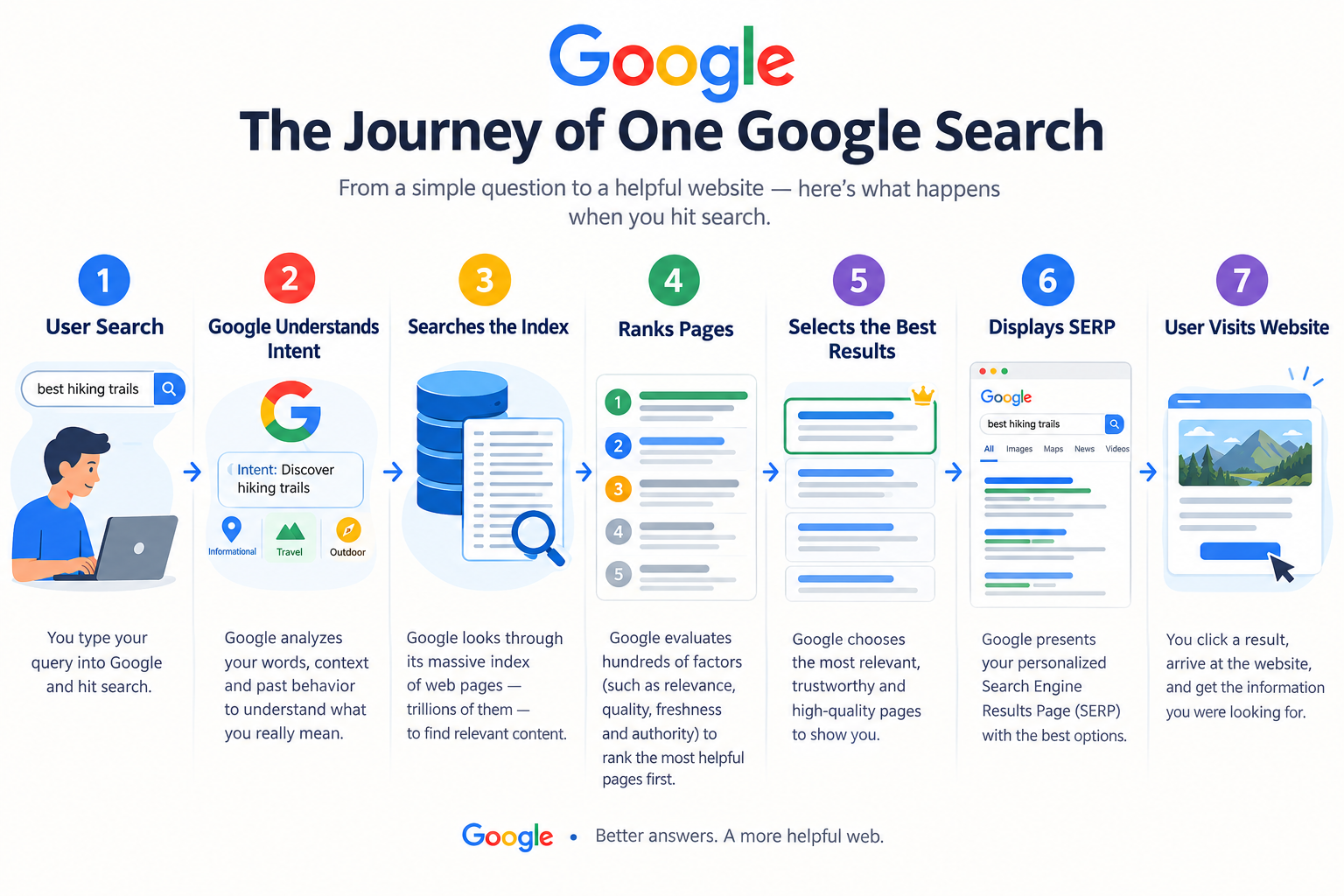
The Journey of One Google Search
The Evolution of SEO (2000–2026)
In Past 25 Years, Handle google is really easy task the reason is that search engine only about keywords. Now, website optimization has dramatically changed; Google is clever, Uses AI, machine learning, and follows ranking signals to know the user’s intent for dealever best experience and information.
2000 Keyword Stuffing
Google totally relied on Keywords, Website repeating the exact keyword many times on pages. But the results of user experience are very bad.
Example
- Best DSLR Camera, DSLR Camera, Cheap DSLR Camera, Buy DSLR Camera…
- SEO Startegy
- Same Keywords in pages
- Hide Keywords from the background same color text
- Buying backlinks
2011 Panda Updates
Panda is for improving content quality. Google reviews many website and finds that many of them using thin, low-quality, duplicate content and only get more traffic.
Panda penalized thin content, Duplicate content, illogical and excessive ads, and content farms. This change will get Helpful content, Original Content and better UX on websites at Search Engines. Now, changed rule clearly said that website have to write for only users not just for Google.
2012 Penguin
This algorithm is designed to stop link spamming, Link farms, Over-optimized anchor text, Paid backlinks, and manipulative link building. Its focus on anchor links and link quality. Penguin gets Natural backlinks, Relevant mentions, and High-quality websites on Google.
2015 Mobile First
In 2015, smartphone usage is becoming higher; now time to optimize websites for mobiles. Google has started prioritizing mobile-friendly websites.
However, mobile-first indexing has become more primary for Google, and some websites are getting hitches. In this process, websites start to use responsive design, fast mobile pages, easy navigation, and touch-friendly layouts.
2019 BERT
BERT (Bidirectional Encoder Representations from Transformers) is for better understanding of natural words or language and intent search of users.
Rather than finding keywords google the understand the need of user through search intent. For example, a user searches for ” Can get medicine for someone at pharmacy. Now Google can comprehend the relationship between the words and not focus on keywords.
2022 Helpful Content
According to the Helpful Content Update, websites must have First-hand experience, Expert knowledge, Complete answers, Original insights and user-helpful content.
Now Google discourages AI-generated spam, Thin affiliate pages, Clickbait and Rewritten articles with little value.
2024 AI Search
AI-powered search experiences with enhancements that describe information and give answers directly on Google. This is new trend of AI-generated summaries in search, More conversational search, Multi-step questions and Voice/image search growth.
Web owners starts working on a clear structure, authoritative information, strong expertise, and easy-to-understand content for AI Systems.
2026 Search Experience & AI
This time is the new turning point for SEO, Modern SEO is no longer about just ranking or gaining traffic on google.
The entire search experience is changed after AI, with signals like trust and user experience. It focuses on Search intent, User experience (UX), Topical authority, Expertise and trust, Fast websites, Helpful, original content, AI-friendly structure and Multimedia (images, videos, FAQs).
Now SEO is about full and perfect answer, not about the just page optimization.
Search Engine Optimization advice
| Year | Major Update | Focus |
| 2000 | Keyword Stuffing Era | Keywords over quality |
| 2011 | Panda | High-quality content |
| 2012 | Penguin | Natural backlinks |
| 2015 | Mobile-First Focus | Mobile-friendly websites |
| 2019 | BERT | Search intent & natural language |
| 2022 | Helpful Content | People-first content |
| 2024 | AI Search | AI-powered search experiences |
| 2026 | Search Experience & AI | User satisfaction, authority, and AI-ready content |
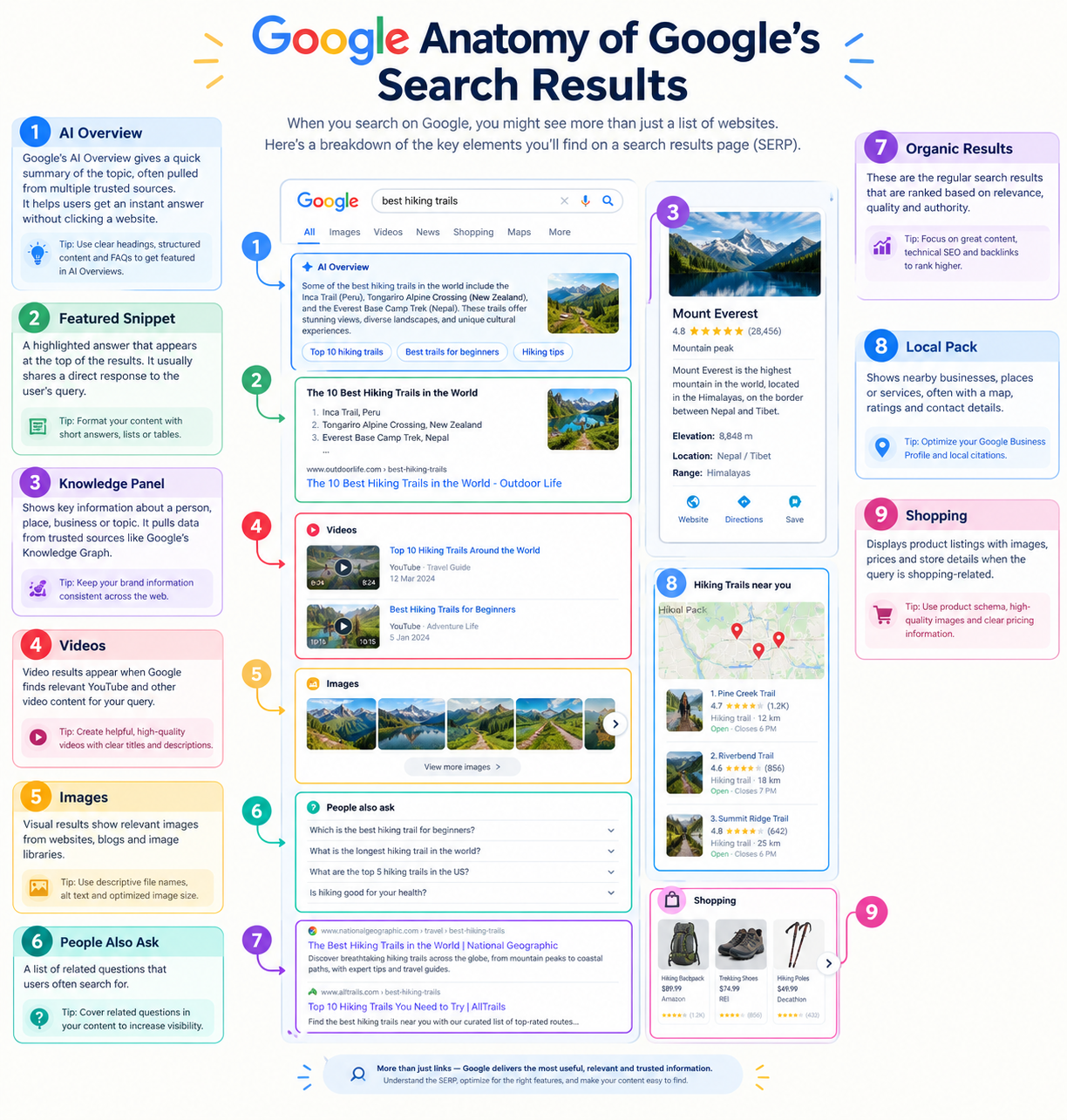
Anatomy of Google’s Search Results
What Makes Google Trust a Website?
Experience Expertise Authoritativeness Trustworthiness (E-E-A-T)
Google’s E-E-A-T (Experience, Expertise, Authoritativeness, and Trustworthiness) is not a ranking algorithm by itself. Instead, it is a framework used in Google’s Search Quality Rater Guidelines to describe what high-quality content looks like.
Does Google Use Human Reviewers? Yes—but only to evaluate Google’s search results, not to manually rank your website.
Google has Search Quality Raters (real people) who:
- Review sample search results.
- Check whether the results follow Google’s quality guidelines.
- Rate pages based on E-E-A-T and other quality factors.
How Google Evaluates E-E-A-T at Scale
Google’s ranking systems use many signals that may indicate E-E-A-T, such as:
- High-quality, original content.
- Author information and credentials.
- Reputable backlinks and mentions.
- Positive website reputation.
- HTTPS security.
- Accurate and regularly updated information.
- Good user experience.
Website age
Yes, Domain/Website age is matters when a website does some important work, like updated & high-quality content, Strong backlinks, Brand awareness, User Trust, and topical authority. In the other hand, only website age is not the only ranking factor for Google.
Old domain always ranking is a big myth in SEO. The reality is that older websites invest more time to gain trust and authority.
Content freshness
Those website who updated their pages and maintain the trends in website, they mostly rank. Content Freshness is a Google ranking factor that allows pages to rank for their up to dated according to reliable sources.
Backlinks
Most SEO people confuse that it is the main way to gain trust through billions of backlinks, and some of them buy online backlinks. A website does not need so many backlinks to gain trust. Quality and relevant backlinks is the need of the website to gain domain authority. New web owners should have to create guest posting is the best way to gain authority.
Brand searches
A brand search When user searches that includes the name of a brand, business, website, product, or particular person. For a company, brand searches are most important to create brand awareness, trust, CTR, and encourage repeat visitors.
For Example
- Nike Shoes
- Sharukh Khan
- Mintra
User satisfaction
User satisfaction means how happy and satisfied visitors are after using the website. Search query intent is most important; mostly in User satisfaction, they come for information. So web page content is like an easy and perfect full answer.
Websites don’t interrupt user satisfaction through so many ads, slides, or slow loading speed and confusing tone or language. Instead, use a mobile-friendly structure, helpful content, easy navigation, and a helpful tone and language.
SEO vs Google Ads
| Feature | SEO (Search Engine Optimization) | Google Ads (Pay-Per-Click) |
| Definition | Improves a website’s visibility in organic (free) search results. | Displays paid advertisements at the top or bottom of search results. |
| Traffic Type | Organic (Unpaid) | Paid |
| Cost Per Click | No cost for each click | Pay for every click (PPC) |
| Initial Investment | Content, SEO tools, and optimization | Advertising budget |
| Time to See Results | Usually 3–6 months | Minutes to hours after launching a campaign |
| How Long Results Last | Can last months or years with updates | Stops immediately when the budget ends |
| Trust Level | Generally higher because users know the results are earned | Some users skip ads and prefer organic results |
| Best For | Long-term growth and brand authority | Instant traffic, sales, and promotions |
| Click-Through Rate (CTR) | Often higher for top organic rankings | Varies based on ad quality and competition |
| Scalability | Growth depends on content quality and authority | Easy to scale by increasing budget |
| Competition | Compete with content quality, relevance, and authority | Compete through bidding and Quality Score |
| Targeting Options | Based on keywords and search intent | Keywords, location, device, audience, age, interests, and more |
| Content Requirement | Requires regular, helpful content | Landing pages are important, but ongoing content isn’t always required |
| Maintenance | Continuous optimization and updates | Requires budget monitoring and campaign optimization |
| ROI Timeline | Higher long-term ROI | Faster short-term ROI if campaigns are optimized |
| Brand Building | Strongly improves brand authority over time | Increases brand visibility while campaigns are active |
| Ideal Use Cases | Blogs, service websites, evergreen content, education | Product launches, seasonal offers, lead generation, e-commerce |
| Performance Stops When | Rarely; rankings may remain even if work slows | Immediately when ad spending stops |
| Main Success Factors | Helpful content, E-E-A-T, backlinks, technical SEO | Quality Score, bidding strategy, ad relevance, landing page experience |
| Main KPI | Organic traffic, rankings, conversions | Clicks, CPC, conversions, ROAS |
SEO vs Social Media
| Comparison | SEO | Social Media |
| Traffic Ownership | Visitors come from search engines and can return through your website. You own the content on your site. | Traffic depends on social media platforms and their algorithms. Reach can change anytime. |
| Audience Intent | Users actively search for information, products, or services with a clear purpose. | Users mainly browse for entertainment, updates, or inspiration. Purchase intent is usually lower. |
| Content Longevity | Content can generate traffic for months or even years if it stays relevant. | Most posts lose visibility within hours or days unless they go viral. |
| Conversion Rate | Generally higher because users are already looking for a solution. | Often lower because users are not always ready to buy or take action. |
| Best For | Long-term organic growth, leads, and evergreen traffic. | Brand awareness, community engagement, and real-time interaction. |
SEO vs AI Search (ChatGPT, Gemini, Perplexity)
In the new era of AI like ChatGPT, Gemini & Perplexity, now the searches are no longer limited to Google. AI-powered search tools such as ChatGPT, Gemini, and Perplexity can answer questions directly with perfect details. This changes having options to create more traffic through optimize LLMs languages.
| Comparison | Traditional Search | AI Search |
| How It Works | Shows a list of web pages ranked by relevance. | Generates a direct answer using multiple sources. |
| User Action | Users choose and click a website. | Users often get the answer without visiting a website. |
| Main Goal | Help users find the best webpage. | Help users get the best answer quickly. |
| Traffic Flow | More clicks go to websites. | Fewer clicks, but higher-value visits when cited. |
| Search Experience | Link-first experience. | Answer-first experience. |
| Examples | Google Search, Bing Search | ChatGPT, Gemini, Perplexity |
Generative Engine Optimization (GEO)
GEO concentrates on conversational clarity, EEAT, topic depth, Trendy content, and structured data rather then focus on Keywords, tags, and Backlinks. GEO is a process to increase your website’s visibility in AI-generated responses.
Answer Engine Optimization (AEO) is a practice of content framing that increases AI Searches. The easy read and Answers of queries having more chancees to rank for LLMs languages.
Answer Engine Optimization (AEO) focuses on creating content that provides direct, concise answers to users’ questions so it can appear in answer-focused experiences such as AI assistants, featured snippets, and voice search.
For creating more AEO optimized page include Use FAQ sections, Data structure (Schema Markup) and Organize content with clear headings.
How AI Is Changing SEO
Content created by AI Tools like ChatGPT is called AI content. Before adding AI content make sure about fact verifications. Its goood to avoid publishing unedited AI-generated text and use AI for research, outlines, and drafting.
AI Overview
The query result that shows in Google search results, knowns as AI Overview. To get this needs Answer questions clearly, descriptive headings. Also, Write factual & well-organized content and Build trust through E-E-A-T.
AI Search Assistants
AI Search Assistants like ChatGPT, Gemini, and Perplexity are providing directly and give citations for source websites. For AI Search Assistants, use conversational content, include FAQs, explain concepts clearly, and cover topics comprehensively.
Entity SEO
An entity is a unique, identifiable thing that search engines can understand. Instead of only understanding the keyword ,” search engines determine whether you mean:
Person: Elon Musk
Company: Google
Place: Delhi
Product: iPhone 17
Topic: Search Engine Optimization
Semantic SEO
Semantic SEO focuses on the meaning of content rather than repeating the same keyword. Its like if you are making Travvel blog on “Best Places to go in Delhi. Making page with full information like places, location, timings rather then focussing oon keywords. Semmentic SEO is like full infrommation about topics.
Vector Search
AI Uses Vector Search for understanding meaning of query and finding same contex, its not about keywords or word matching in searches.
For example: How can I make my website appear higher on Google? and the article shows How to Improve Website Rankings.
Best tip: write naturally, cover related subtopics, and focus on answering user questions completely.
A Beginner’s SEO Roadmap
This roadmap is designed for beginners who want to learn SEO step by step.
| Timeline | Focus | What You’ll Learn | Goal |
| Week 1 – Build Your Foundation | Understand how search engines work | Learn SEO basics, crawling, indexing, ranking, search intent, and keyword research. | Understand the fundamentals of SEO. |
| Week 2 – Optimize Your First Website | Apply On-Page SEO | Write SEO-friendly content, optimize titles and meta descriptions, use headings, internal links, and images. | Publish your first optimized pages. |
| Month 1 – Strengthen Your Website | Technical & Content SEO | Improve website speed, mobile usability, XML sitemap, robots.txt, fix indexing issues, and create a content plan. | Build a technically healthy website with consistent content. |
| Month 3 – Build Authority | Off-Page SEO & Analytics | Learn link building, digital PR, Google Search Console, Google Analytics, monitor rankings, and improve existing content. | Increase trust, authority, and organic traffic. |
| Month 6 – Become an SEO Strategist | Advanced SEO & AI Search | Learn Semantic SEO, Entity SEO, E-E-A-T, AI Search, GEO, AEO, topic clusters, and long-term content strategy. | Create a scalable SEO strategy that performs in both Google Search and AI-powered search. |
How to Perform a Complete SEO Audit
A complete SEO audit is the process of checking a website to identify SEO issues that may affect its search engine rankings, organic traffic, and overall performance. It involves reviewing technical SEO, on-page SEO, off-page SEO, content quality, and AI search visibility to find problems and opportunities for improvement.
Gather Essential SEO Tools
Before starting an SEO audit, collect the tools needed to analyze your website’s performance and identify issues. Use Google Search Console to check indexing, search performance, and crawling issues.
Use Semrush, Ahrefs, or Screaming Frog to find broken links, duplicate content, and technical problems. You can also use Google PageSpeed Insights and GTmetrix to measure website speed and Core Web Vitals.
Check Technical SEO
Review your website’s technical health to ensure search engines can access, crawl, and index your pages properly. Check robots.txt, XML sitemaps, noindex tags, 404 errors, redirect chains, and HTTPS security.
Also, test your website’s loading speed, mobile usability, and Core Web Vitals. Compress large images and remove unnecessary scripts to improve website performance.
Audit On-Page SEO and Content
Check the content and HTML elements of your website to ensure every page is properly optimized. Review title tags, meta descriptions, heading structure (H1, H2, and H3), URLs, image alt text, and internal links.
Identify thin, outdated, or duplicate content and pages competing for the same keywords. Also, make sure your content matches search intent, answers users’ questions, and includes relevant long-tail and conversational keywords.
Review Off-Page SEO and Backlinks
Analyze your website’s backlink profile to understand its authority and link-building performance. Check the number of referring domains, backlink quality, link relevance, and potentially harmful links.
Identify opportunities to earn relevant backlinks from trusted websites. For local businesses, also review your Google Business Profile, business name, address, phone number (NAP) consistency, and customer reviews.
Check AI Search and LLM Visibility
Review how your website and brand appear across AI-powered search platforms, including Google AI Overviews, ChatGPT Search, and Perplexity. Check whether these platforms mention, cite, or recommend website as a source.
Also, review your structured data, schema markup, entity information, and content clarity to help search engines and AI systems understand your website.
Prioritize and Fix SEO Issues
After completing the audit, prepare a list of all identified SEO issues and prioritize them according to their impact and the effort required to fix them. Start with critical problems, such as indexing errors, server issues, broken pages, and crawlability problems.
Then address on-page issues, missing metadata, content gaps, page speed, and backlink opportunities. Regularly monitor your website using Google Search Console, Google Analytics 4, and SEO tools to measure improvements.
Common SEO Myths
Many SEO myths have been repeated for years. Here are some of the most common misconceptions and reality check.
SEO is dead.
No, SEO is evolving, not disappearing. Now SEO’s needs to optimize AI both traditional search engines and AI-powered search experiences.
Backlinks are enough to rank.
No, Backlinks are enough to rank. It can help build authority and trust but other ranking signals helpful content, technical SEO, Web Core Vitals and EEAT are most important to rank.
Google penalizes AI content
Google doesn’t penalize content just because AI helped create it. Low-quality, spammy, or misleading content can perform poorly regardless of how it was written.
Best Free SEO Tools
- Google Search Console
- Google Analytics
- Google Trends
- Keyword Planner
- PageSpeed Insights
- Bing Webmaster Tools
SEO Glossary
An SEO Glossary is a collection of important SEO terms and their simple definitions, arranged in alphabetical order (A–Z). It helps beginners quickly understand SEO vocabulary without searching for each term separately.
| Term | Simple Explanation |
| Algorithm | The system search engines use to rank web pages. |
| Alt Text | A description of an image that helps search engines and screen readers understand it. |
| Anchor Text | The clickable text in a hyperlink. |
| Authority | The trust and credibility of a website or page. |
| Backlink | A link from another website pointing to your website. |
| Black Hat SEO | SEO techniques that violate search engine guidelines. |
| Bounce Rate | The percentage of visitors who leave after viewing only one page. |
| Broken Link | A link that leads to a missing or unavailable page. |
| Canonical URL | The preferred version of a webpage used to avoid duplicate content issues. |
| Citations | Online mentions of a business’s name, address, and phone number (important for Local SEO). |
| Click-Through Rate (CTR) | The percentage of people who click your result after seeing it. |
| Content Marketing | Creating valuable content to attract and engage an audience. |
| Conversion | When a visitor completes a desired action, such as buying or signing up. |
| Core Web Vitals | Google’s page experience metrics for loading speed, responsiveness, and visual stability. |
| Crawling | The process of search engines discovering web pages. |
| Crawl Budget | The number of pages a search engine is likely to crawl on your site within a given time. |
| Disavow Tool | A Google tool used to tell Google to ignore certain backlinks. |
| Domain Authority (DA) | A third-party metric that estimates a website’s authority. It is not a Google ranking factor. |
| Duplicate Content | Similar or identical content appearing on multiple URLs. |
| E-E-A-T | Experience, Expertise, Authoritativeness, and Trustworthiness—Google’s framework for evaluating content quality. |
| Entity SEO | Optimizing content around real-world people, places, organizations, products, and concepts. |
| Featured Snippet | A highlighted answer that appears at the top of some search results. |
| Google Business Profile | Google’s business listing used for Local SEO. |
| Google Search Console | A free Google tool for monitoring website performance in search. |
| Heading Tags (H1–H6) | HTML headings that organize content and improve readability. |
| Indexing | Adding a webpage to a search engine’s index so it can appear in search results. |
| Internal Link | A link from one page on your website to another page on the same website. |
| Keyword | A word or phrase people type into a search engine. |
| Keyword Cannibalization | When multiple pages on the same website compete for the same keyword. |
| Keyword Density | The frequency of a keyword in content. It should remain natural. |
| Landing Page | A page designed to encourage a specific action, such as a purchase or signup. |
| Link Building | Earning quality backlinks from other websites. |
| Local SEO | Optimizing a website to appear in local search results. |
| Long-Tail Keyword | A longer, more specific search phrase with lower competition. |
| Meta Description | A brief summary displayed below the page title in search results. |
| Meta Title (Title Tag) | The clickable title shown in search engine results. |
| Mobile-First Indexing | Google primarily uses the mobile version of a page for indexing and ranking. |
| Nofollow Link | A link that tells search engines not to pass ranking value. |
| On-Page SEO | Optimizing content and HTML elements on individual web pages. |
| Off-Page SEO | Actions taken outside your website to improve authority, such as earning backlinks. |
| Organic Traffic | Visitors who arrive from unpaid search results. |
| Orphan Page | A page with no internal links pointing to it. |
| Page Speed | The time it takes for a webpage to load. |
| Page Authority (PA) | A third-party metric predicting the ranking potential of a single page. |
| Ranking | The position of a webpage in search engine results. |
| Redirect (301) | A permanent redirect from one URL to another. |
| Robots.txt | A file that tells search engine crawlers which pages they may or may not access. |
| Schema Markup | Structured data that helps search engines understand page content and enables rich results. |
| Search Intent | The reason behind a user’s search query. |
| Semantic SEO | Optimizing content based on meaning, context, and related topics rather than exact keywords. |
| SERP | Search Engine Results Page. |
| Sitemap (XML Sitemap) | A file listing important pages to help search engines discover and crawl them. |
| Technical SEO | Optimizing a website’s technical setup for crawling, indexing, and performance. |
| Topical Authority | Demonstrating deep expertise by covering a subject comprehensively. |
| Transactional Intent | A search where the user is ready to take action, such as buying or booking. |
| User Experience (UX) | The overall experience visitors have while using a website. |
| User Intent | Another term for search intent—the purpose behind a search. |
| Vector Search | AI-based search that matches content by meaning instead of exact keywords. |
| Voice Search | Searching by speaking to a device instead of typing. |
| White Hat SEO | SEO practices that follow search engine guidelines. |
| XML Sitemap | A structured file that helps search engines find and index important pages. |
Frequently Asked Questions
Is SEO free?
Yes, SEO itself is free because there is no fee for Google to appear in organic search results.
Can I learn SEO in 30 days?
Yes, you can learn the basics of SEO in 30 days, including keywords, on-page SEO, technical SEO, and search intent.
Does AI replace SEO?
No. AI does not replace SEO—it changes how SEO is done. AI can help with research, content creation, and optimization, but human expertise is still needed for strategy, originality, fact-checking, and understanding user needs.
Is coding required for SEO?
No, basic SEO does not require coding. You can perform keyword research, optimize content, and improve on-page SEO without programming knowledge. But yes basic knowledge of HTML, CSS, and JavaScript can be helpful for technical SEO.
- How long does SEO take?
SEO is a long-term strategy. Most websites start seeing noticeable improvements within 3 to 6 months, while highly competitive industries may take 6 to 12 months or longer to achieve strong rankings.
Can beginners do SEO?
Absolutely. SEO is beginner-friendly if you start with the fundamentals. Learning search intent, keyword research, content optimization, and basic technical SEO provides a strong foundation.
- Is SEO a good career?
- What is the difference between SEO and SEM?
Why this structure stands out for SEO?
This approach goes beyond simply defining SEO. It teaches readers how search engines work, how users search, how Google evaluates websites, how AI is changing search, and how to get started with a practical roadmap. Covering the topic from multiple angles increases topical depth, improves opportunities for internal linking, and aligns well with modern search intent and semantic SEO.
For a site like JigSky or a new SEO blog, this kind of comprehensive “pillar page” has a much stronger chance of building authority than a standard “What Is SEO?” article.
What Happens in 0.5 Seconds After You Search?
When someone enters a query in the search bar of google annd press search, a process of events happens in just half a second. The search engine processes millions of web pages, understands intent and gives you the perfect result.
When someone enters a query in the search bar of google annd press search, a process of events happens in just half a second. The search engine processes millions of web pages, understands intent and gives you the perfect result.
What factors google rely for give websites Ranking?
Google allots ranking in SERp according to main signal like
- Search intent match
- Helpful content
- Topical authority
- User experience
- Page experience
- High-quality backlinks
- Spam detection
- Display SERp
- Google Shows some of basic interface
- Organic search results
- AI-generated summaries (for eligible queries)
- Featured snippets
- Images
- Videos
- Shopping results
- Maps
- FAQs
| Main Topic | Published Articles |
|---|---|
| SEO Fundamentals | What Is SEO and How It Works What Is Organic Traffic? |
| On-Page SEO | What Is On-Page SEO? |
| Content SEO | Content Optimization What Is Topical Authority? |
| Search Intent | What Is Search Intent? |
| Semantic SEO | Semantic SEO |
| AI Search Optimization | Answer Engine Optimization Generative Engine Optimization |
3 Comments