
Content Optimization: Key Strategies & AI Visibility
Content optimization is the process of improving new or existing content so it is more useful to readers, easier for search engines to understand, and better aligned with search intent.
The goal goes beyond rankings. Well-optimized content can help attract the right audience, answer their questions, improve engagement, build trust, and support business goals such as leads, signups, and sales.
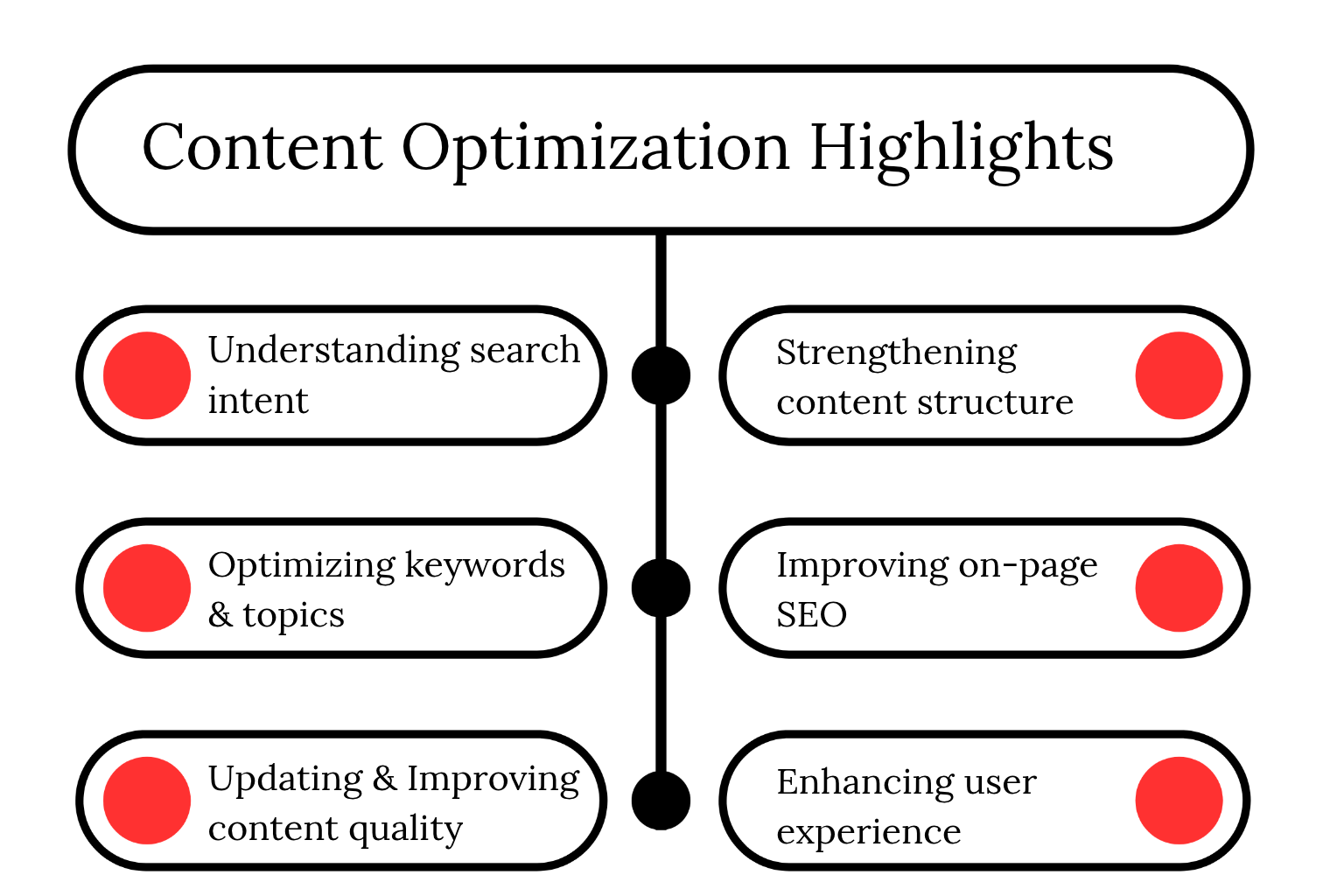
Content optimization can involve keyword and topic research, improving content structure and readability, strengthening on-page SEO, adding original insights and useful examples, updating outdated information, improving internal linking, and optimizing images and other page elements where appropriate.
Here are more detailed Information about content optimization.
What Is Content Optimization?
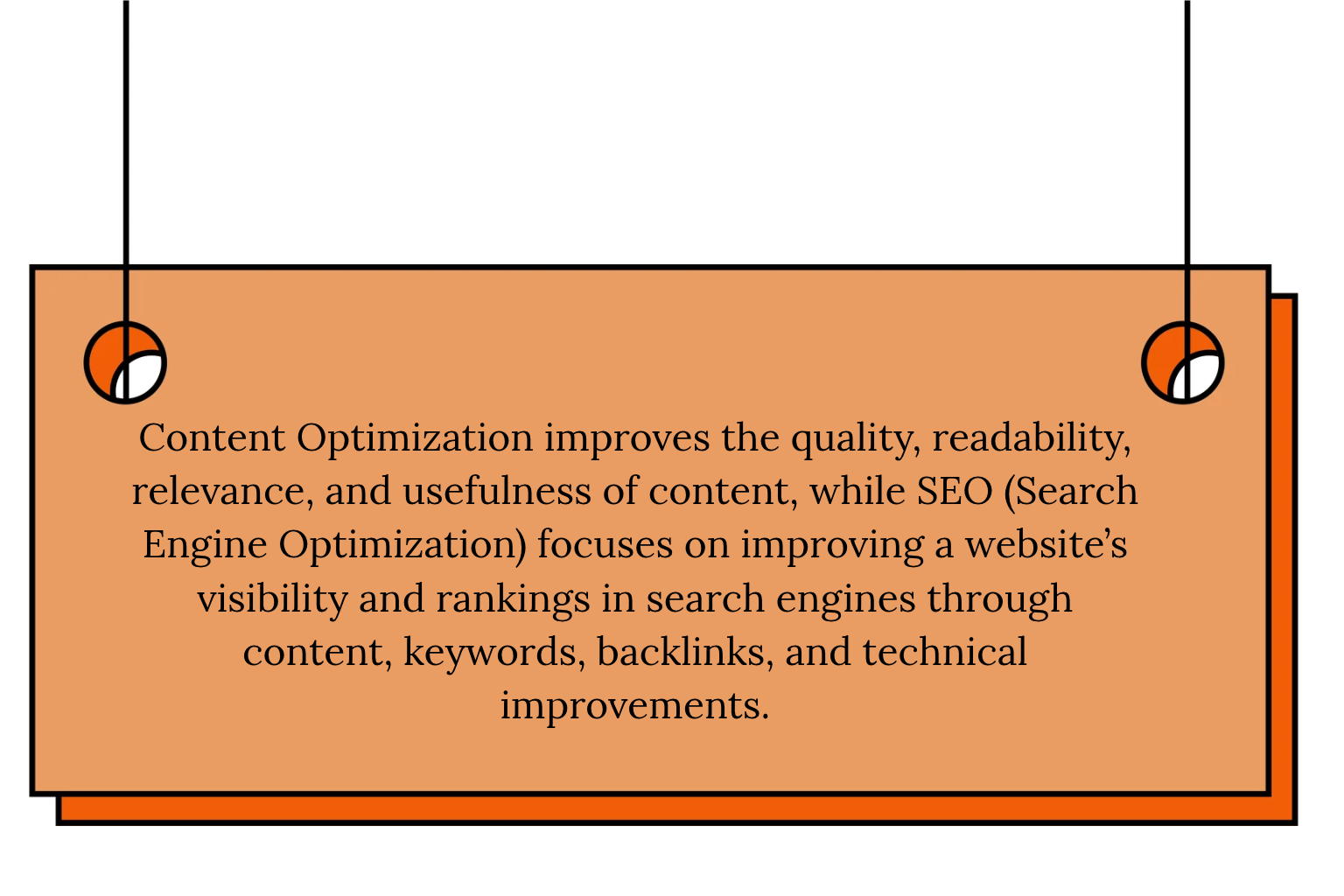
In simple terms, Content optimization is the process of improving content for search engines. This can include website pages, blog posts, landing pages, product pages, guides, and other digital assets.
The goal of content optimization is not simply to add more keywords. It is about making content more relevant, useful, accurate, easy to understand, and aligned with search intent. When content clearly satisfies what users are looking for, it has a better opportunity to attract organic search traffic and keep visitors engaged.
Why Is Content Optimization Important?
Content marketing helps businesses build visibility and trust by publishing useful information around their industry, products, services, and customers’ needs. However, even high-quality content may receive little traffic if it does not match what people are searching for or if search engines cannot easily understand its purpose.
Content optimization helps close this gap. It can involve:
-
Create content that matches what users actually want to find.
-
Use relevant keywords naturally while covering important subtopics and related concepts.
-
Include accurate information, original insights, examples, data, and practical advice.
-
Use clear headings, short paragraphs, bullet points, and images to make content easier to read and scan.
-
Refresh outdated statistics, examples, links, recommendations, and information to maintain accuracy and relevance.
-
Optimize title tags, meta descriptions, URLs, images, headings, and internal links where appropriate.
-
Make content mobile-friendly, accessible, fast-loading, and easy to navigate.
For example, a career education business can optimize articles about job interviews, career skills, or certifications to reach people searching for this information. If readers find the content useful, they may explore the website further and eventually become customers. This allows content optimization to support both SEO and the customer journey.
What Is the Difference Between Content Optimization and SEO?
Content optimization and SEO are closely related, but they are not exactly the same. SEO (Search Engine Optimization) is the broader process of improving a website’s overall visibility and ability to rank in search results. It covers technical, on-page, content, and off-page factors that can affect how search engines crawl, understand, and evaluate a website.
Content optimization is one part of SEO that focuses specifically on improving the quality, relevance, structure, and usefulness of a page’s content. It involves understanding search intent, using relevant keywords naturally, covering important subtopics, improving readability, updating outdated information, and making sure the content fully answers the user’s query.
For example, SEO may involve improving page speed, mobile usability, URLs, internal links, image optimization, structured data, and backlinks. Content optimization focuses more on what the page says and how effectively it satisfies the searcher.
Content Optimization Vs SEO?
Content optimization and SEO are closely related, but they are not exactly the same. SEO (Search Engine Optimization) is the broader process of improving a website’s overall visibility and ability to rank in search results. It covers technical, on-page, content, and off-page factors that can affect how search engines crawl, understand, and evaluate a website.
Content optimization is one part of SEO that focuses specifically on improving the quality, relevance, structure, and usefulness of a page’s content. It also understanding search intent, using relevant keywords naturally, covering important subtopics, improving readability, updating outdated information, and making sure the content fully answers the user’s query.
For example, SEO may involve improving page speed, mobile usability, URLs, internal links, image optimization, structured data, and backlinks. Content optimization focuses more on what the page says and how effectively it satisfies the searcher.
Difference between SEO and Content Optimization
| SEO | Content Optimization |
| Broad website optimization strategy | Focuses mainly on content quality and relevance |
| Includes technical, on-page, and off-page SEO | Primarily supports on-page SEO |
| Covers crawling, indexing, site structure, links, performance, etc. | Covers search intent, topics, keywords, readability, freshness, and usefulness |
| Can involve activities outside the website | Mainly improves content and page elements |
How to Optimize Content for SEO
Optimizing content for SEO is more than adding keywords to a page. The goal is to make your content relevant, useful, easy to understand, and aligned with what users are searching for, while also helping search engines understand the topic and purpose of the page.
Understand to Match Search Intent of Users
Before creating or optimizing content, understand what users expect to find when they search for a particular query. If a web page does not satisfy the searcher’s main need, it may struggle to perform well because search engines aim to provide results that are relevant and useful for the query.
A practical way to understand search intent is to study the pages currently ranking for target keyword. Look at the three key aspects of search intent: content type, content format, and content angle.
Content Type
Identify the type of pages that dominate the search results. These could include blog posts, product pages, category pages, landing pages, comparison pages, or guides.
If most results for a keyword are detailed blog posts, creating a product page for the same query may not match what users are looking for.
Content Format
Next, look at how the information is presented. Common formats include how-to guides, step-by-step tutorials, listicles, reviews, comparisons, and case studies.
For example, if the first page is mainly filled with “best tools” listicles, a similar list-based format may better satisfy the search intent than a general article.
Content Angle
The content angle is the specific value or perspective that makes the top-ranking pages appealing to searchers. It could focus on factors such as beginner-friendly advice, low-cost solutions, latest information, practical examples, or specific use cases.
Content does not need to copy competitors. Instead, identify the common expectations across the top results and then provide a more useful, accurate, or distinctive version.
How to Use Search Intent
Suppose you are targeting the keyword “SEO statistics.” If the search results are mostly recent blog posts presented as lists of statistics, the dominant intent is likely a blog-post content type, listicle format, and freshness-focused angle.
Your page should therefore follow the basic expectations of the SERP while adding something valuable of its own, such as updated data, better organization, original analysis, or clearer explanations.
Publish Original Content With Real Value
High-quality SEO content should be created primarily to help the reader, not simply to target keywords. Search engines increasingly aim to surface content that provides useful, reliable, and relevant information rather than pages created mainly to attract search traffic.
Start by understanding your audience, their questions, problems, and search intent. Then create content that answers those needs clearly and provides information they can actually use.
Yes—these points are strong. I’d make them more concise and natural for your SEO article while keeping the depth:
Make Every Piece of Content Useful and Meaningful
- Prioritize people over search engines: Create content to genuinely inform, educate, or solve a problem rather than manipulate rankings.
- Demonstrate first-hand experience: Add original insights, real examples, case studies, research, or data that provide value beyond what is already available.
- Satisfy search intent: Understand what users are looking for and provide clear, complete answers that address their needs.
- Add a unique perspective: Share expert opinions, practical recommendations, or your own approach instead of simply repeating information from other websites.
- Keep content accurate and useful: Support important claims with reliable information and update content when facts, trends, or user needs change.
- Use AI responsibly: AI can assist with research, ideas, or outlines, but the final content should demonstrate human expertise, originality, accuracy, and genuine value.
Practical Ways to Create Better Content
- Research real questions from customers, forums, reviews, and support queries.
- Identify gaps in existing search results and provide more useful answers.
- Include examples, statistics, expert insights, or original research where relevant.
- Organize information clearly with descriptive headings, short paragraphs, and useful visuals.
- Review and update older content to keep it accurate and relevant.
Research Relevant Keywords & Use Naturally
Although search engine algorithms have become increasingly sophisticated, keywords still help search engines understand the topic and relevance of a page. Start with keyword research to identify the terms audience is actually searching for and choose keywords that match your content, business, and search intent.
Use primary keyword naturally throughout the content, particularly in important areas such as the title, main heading, introduction, subheadings, and body copy where relevant. Avoid forcing keywords into every section, as excessive or unnatural repetition can make content difficult to read.
In this optimization process also include related keywords, synonyms, and variations that naturally occur when discussing the topic. For example, if primary keyword is “artificial intelligence,” also use terms such as “AI,” “AI technology,” “machine learning,” and other contextually relevant concepts where appropriate.
Use Content Structure
A clear content structure makes your page easier for both readers and search engines to understand. Break your content into logical sections so users can quickly scan the page and find the information they need.
Use H1, H2, and H3 headings to organize the main topic and supporting sections. You can also use bullet points, numbered lists, short paragraphs, bold text, and italics to highlight important information and improve readability.
On-Page SEO Checklist for Content Optimization
On-page SEO improves search performance by optimizing individual pages so search engines can understand the topic and users can easily find, read, and act on the information they need. It covers page-level elements such as headings, content structure, links, URLs, and metadata.
Practical On-Page SEO Checklist
- Title Tag: Write a clear, keyword-relevant title.
- Meta Description: Summarize the page and encourage clicks.
- H1: Clearly state the main topic.
- H2s & H3s: Organize content into logical sections.
- URL Slug: Keep it short, readable, and descriptive.
- Internal Links: Link to relevant pages using descriptive anchor text.
- Image Alt Text: Describe important images accurately.
- Content Structure: Use short paragraphs, lists, and tables for readability.
- Search Intent: Match the content to the user’s search purpose.
- Content Relevance: Cover important subtopics and related questions naturally.
Cover the Topic Comprehensively-Identify Missing Subtopics and Content Gaps
A key part of content optimization is finding subtopics, questions, and information that web content does not cover but searchers may expect to find. Comparing web page with top-ranking results can reveal gaps and help identify ways to make content more useful and comprehensive.
Instead of manually reviewing multiple competitor pages, tools can help analyze the search results and highlight areas where web content may need improvement.
Focus Areas
- Search intent: Understand the intent behind the SERP and ensure your content matches what searchers are looking for.
- Content depth: Identify whether your page provides enough useful information to cover the topic properly.
- Topical coverage: Find related subtopics, concepts, or questions that may be missing from your content.
Optimize Visual Content
Optimizing images and videos can improve page speed, accessibility, user experience, and search visibility. Properly optimized visuals also give search engines more context about what your content contains.
Use these visual optimization tactics:
- Add descriptive alt text
- Compress images and videos
- Use descriptive file names
- Add captions when useful
- Provide video transcripts when relevant
- Use modern, responsive image formats
Optimize Your Page for SERP Features
Optimizing for SERP features can help your content appear in enhanced search results beyond the standard blue links. These may include AI Overviews, featured snippets, People Also Ask, image packs, video results, review snippets, and local packs.
To optimize effectively:
- Check the SERP: Search your target keyword and identify which features appear.
- Match the format: If results favor lists, tables, videos, or short answers, structure your content accordingly when appropriate.
- Answer questions directly: Provide a clear answer near the beginning of the relevant section.
- Use question-based headings: Create H2s and H3s around common questions users search for.
- Optimize visuals: Use relevant images or videos with descriptive file names, alt text, and captions.
- Support important claims: Use reliable sources, data, examples, or expert information where appropriate.
- Keep content well structured: Clear headings, concise answers, lists, and tables make important information easier to understand and extract.
The goal is not to force your content into every SERP feature, but to format and improve it in ways that best satisfy the search intent and the type of result Google displays.
Strengthen Internal Linking & External Linking
Adding relevant internal and external links can improve content usability and help Google better understand the context of your pages.
Internal links connect one page on one website to another. They help readers discover related content, navigate your site more easily, and find additional information without having to search for it. Internal linking also helps search engines discover pages and understand how different topics and pages are connected.
External links point to relevant pages on other websites. Linking to trustworthy, authoritative sources can provide additional context, support factual claims, and give readers useful resources for further information. When external links are relevant to your topic, they can also help establish the context of your content.
Best Practices for Linking
- Link to pages that are genuinely relevant to the topic.
- Use descriptive anchor text so readers understand what they will find.
- Link important pages from relevant, high-value content.
- Avoid adding links simply to increase the number of links on a page.
- Check internal and external links regularly for broken or outdated destinations.
- Use authoritative external sources when supporting statistics, research, or important claims.
Measure and Improve
Monitor rankings, organic traffic, impressions, clicks, engagement, and conversions. Use the data to identify pages that need better coverage, stronger optimization, or regular updates.
Content Optimization Tools
Use a combination of SEO, keyword research, content, and analytics tools to improve and monitor your content:
- Google Search Console – Track rankings, clicks, impressions, and search queries.
- Google Analytics 4 – Measure organic traffic, engagement, and conversions.
- Google Keyword Planner – Find keyword ideas and search demand.
- Google Trends – Identify trending and seasonal topics.
- Ahrefs – Keyword, competitor, content, and backlink research.
- Semrush – Keyword research, content optimization, competitor analysis, and tracking.
- Moz Pro – Keyword research, on-page optimization, and site analysis.
- Screaming Frog – Find technical and on-page content issues.
- Surfer – Optimize content based on search-result data.
- Clearscope – Improve topical coverage and content relevance.
- Frase – Content research, optimization, and AI-assisted writing.
- Grammarly – Improve grammar, clarity, and readability.
- Yoast SEO – On-page SEO checks and content optimization in WordPress.
- Rank Math – On-page SEO, schema, and keyword optimization.
- Jasper – AI-assisted content planning and creation.
- Copyscape – Check content for plagiarism or duplicate text.
How to Optimize Content for AI Systems
Optimizing content for AI systems means making important information clear, well-structured, easy to understand, and easy to retrieve or summarize. This approach is often referred to as Generative Engine Optimization (GEO).
Optimize for AI Prompts
AI users mostly ask longer and more specific questions than they would type into a traditional era of google or search engine. Creating content that directly answers these detailed questions can improve its chances of being discovered, summarized, or cited by AI-powered search systems.
For example, instead of searching for “organic farming tips,” a user might ask an AI tool, “What are the best organic farming tips for beginners growing vegetables in a small backyard?”
To identify useful AI prompts:
- Use first-party data: Review customer questions, surveys, support tickets, and searches.
- Find recurring questions: Identify common problems, comparisons, and use cases.
- Answer directly: Provide clear, complete answers without filler.
- Use question-based headings: Reflect how users naturally ask questions.
- Add relevant context: Include supporting information needed for a complete answer.
- Stay focused: Target prompts closely related to the page topic.
Use Structured Comparison Tables to Support AI Citations
Structured comparison tables organize important information in a consistent format, making it easier for readers and AI systems to identify, compare, and summarize key facts. They are particularly useful when users need to evaluate multiple products, services, tools, plans, or alternatives.
To make comparison tables more useful:
- Clear headings: Make each column easy to understand.
- Consistent criteria: Compare the same factors for every option.
- Concise cells: Keep information short and specific.
- Useful details: Include factors that help users make decisions.
- Accurate information: Use reliable, verifiable data.
- Add context: Explain key differences before or after the table.
- Clear takeaway: Summarize the main conclusion.
- Keep it updated: Refresh changing details such as pricing and features.
Make Entities Clear and Consistent
Entity clarity means clearly identifying the specific people, brands, products, tools, organizations, places, and concepts discussed in content. Using precise names gives search engines and AI systems better context about what page is actually referring to.
Avoid vague terms such as “the company,” “this tool,” or “the device” when a specific name would make the meaning clearer. Consistent and specific naming also helps readers understand your content and reduces ambiguity between similar entities.
What actually makes content credible, not just listing E-E-A-T signals. Google’s current guidance emphasizes unique, useful, people-first content and real experience, and its newer guidance for generative AI features explicitly says to focus on unique, useful content rather than “AI/GEO hacks.” (Google for Developers)
How to Optimize Content for Higher Credibility
Credibility is a key part of creating content that people can trust. A credible page should make it clear who created the content, where the information came from, why the author is qualified to discuss the topic, and whether the information is accurate and up to date.
For SEO, credibility should not be treated as a checklist of signals to manipulate rankings. Instead, focus on demonstrating genuine experience, expertise, authority, and trustworthiness (E-E-A-T) through the content itself and the website behind it.
1. Demonstrate First-Hand Experience
First-hand experience can make content more useful and authenticated, Rather than repeating general information found across other websites, explain what you actually observed, tested, used, or learned.
Depending on the topic, try this::
- Original examples and case studies
- Personal or professional experiences
- Product testing or demonstrations
- Original research and observations
- Screenshots, photos, or other supporting evidence
- Practical lessons and recommendations
For example, a product review becomes more credible when the reviewer explains how the product was tested, what worked, what did not, and who it is suitable for rather than simply repeating the manufacturer’s specifications.
2. Show Who Created the Content
Readers should be able to understand who is responsible for the information. Add a clear author name and author bio, particularly for topics that require specialist knowledge.
An author profile can include:
- Relevant qualifications or certifications
- Professional experience
- Areas of expertise
- Industry experience
- Links to relevant professional profiles or published work
3. Support Claims With Reliable Sources
Important claims should be supported by information readers can verify. Link to primary sources, official documentation, research papers, government data, recognized organizations, or other authoritative references when appropriate.
Avoid relying heavily on anonymous blogs, low-quality directories, or sources that make unsupported claims.
For example, if an article includes statistics, research findings, health recommendations, or industry data, link directly to the source so readers can check the information themselves.
4. Add Original Information
Credible content should provide something beyond a rewritten version of the top-ranking pages. Google specifically encourages publishers to create unique content that adds useful information beyond what is already widely available.
Try to add original value through:
- New research or surveys
- Expert interviews
- Unique data
- First-hand testing
- Original photographs
- Case studies
- Expert commentary
- Detailed comparisons
- Practical examples
5. Keep Information Accurate & Trendy
Outdated information can quickly reduce a page’s usefulness and credibility. Review important content regularly and update information when necessary.
Check:
- Statistics and research
- Prices and specifications
- Product or service information
- Links and references
- Laws, regulations, and policies
- Screenshots and examples
- Recommendations and rankings
Do not change the publication date simply to make an old article appear fresh. Update the content when there is a genuine reason to do so.
6. Be Transparent About Sources and Methods
When website content includes research, testing, comparisons, surveys, or recommendations, explain how reached conclusions.
For example, if you rank several products, explain the criteria you used. If you conducted a survey, mention the sample size and methodology where relevant. If you tested a product, describe what was tested and under what conditions.
This gives readers enough context to evaluate your conclusions instead of simply asking them to trust your claims.
7. Build Website-Level Trust
Content credibility is not limited to individual articles. The overall website should also provide clear information about the organization behind the content.
Important trust elements can include:
- About Us page
- Author pages
- Contact information
- Editorial or content policy
- Privacy policy and terms
- Clear sponsorship or affiliate disclosures
- Source and citation practices
- Secure HTTPS connection
These elements help readers understand who operates the website and how its content is produced.
8. Avoid Mass-Produced, Low-Value Content
Publishing large quantities of similar articles simply to target more keywords can weaken the overall quality of a website. Google explicitly treats scaled content created primarily to manipulate rankings, including AI-generated content without sufficient added value, as a form of spam.
AI can assist with research, brainstorming, or drafting, but the final content should have human oversight, accurate information, meaningful editing, and genuine value.
How to Optimize Content for Conversions
Content optimization should not stop at rankings and traffic. Conversion optimization turns visitors into meaningful business outcomes, such as newsletter signups, product purchases, demo requests, downloads, bookings, or contact form submissions.
The key is to connect the information users are looking for with a clear and relevant next step.
Demonstrate the Value of Product or Service
Show readers how product or service solves a real problem instead of simply describing its features. Practical examples, use cases, screenshots, demonstrations, and step-by-step workflows can help users understand the value more quickly.
For example, a software company can show how its tool helps users complete a specific task, while a service business can explain how its process solves a common customer problem.
To demonstrate value effectively:
- Focus on the problem and outcome, not just features.
- Use relevant examples, screenshots, demonstrations, or case studies.
- Explain how the product or service fits into the user’s situation.
- Address common objections or limitations honestly.
- Place product mentions only where they naturally support the topic.
Avoid turning informational content into a sales pitch. Useful demonstrations are more persuasive when they genuinely help readers accomplish their goals.
Add Social Proof to Build Trust
Social proof shows that real customers, experts, or organizations have benefited from your product or service. It can reduce uncertainty and give readers more confidence before taking action.
Useful forms of social proof include:
- Customer testimonials
- Reviews and ratings
- Case studies
- Success stories
- Expert opinions
- Customer numbers or results, when they can be verified
- Recognized certifications, awards, or partnerships
Make social proof specific whenever possible. In simple terms don’t use product is simply “great,” show what problem it solved and what result the customer achieved.
Authentic reviews and case studies can also provide additional context about a brand for users and AI-powered systems when those sources are publicly available and trustworthy.
Use CTAs That Match the User Journey
A call to action (CTA) tells readers what to do next, such as “Start a Free Trial,” “Download the Guide,” “Request a Quote,” or “Contact Us.”
The best CTA depends on the user’s intent and stage in the buying journey. Someone reading an introductory guide may prefer a free resource, while someone comparing solutions may be ready for a demo or product page.
Effective CTAs should:
- Be specific: Clearly explain the next action.
- Highlight the benefit: Tell users what they will gain.
- Match search intent: Offer a next step that naturally follows the content.
- Use clear language: Avoid vague phrases such as “Click Here.”
- Be easy to find: Place CTAs where they are useful without interrupting the reading experience.
- Test different versions: Compare CTA wording, placement, and design to identify what performs better.
Tools for Conversion Optimization
You can use analytics and testing tools to understand how visitors interact with your content and identify opportunities to improve conversions:
- Google Analytics 4: Track conversions, user journeys, and engagement.
- Google Search Console: Identify pages and queries bringing organic traffic.
- Microsoft Clarity: Analyze sessions, heatmaps, and user behavior.
- Hotjar: Study heatmaps, recordings, surveys, and feedback.
- VWO: Run A/B tests and conversion experiments.
- Optimizely: Test page variations and personalization strategies.
- Crazy Egg: Analyze clicks, scrolling, and page interaction.
Product Content Optimization (PCO)
Use descriptive product titles that include the brand and important product details. Add high-quality images with relevant alt text, keep prices and stock information accurate, and provide complete details for product variations. Regularly review product page performance using tools such as Google Search Console and analytics platforms to identify areas for improvement.
In easy words, product content optimization helps businesses improve product visibility, provide a better shopping experience, and increase the chances of converting visitors into customers.
How to Measure Content Optimization Results?
The measurement of content optimization is about comparing how a page performed before and after an update. This helps determine whether changes improved visibility, user engagement, content quality, AI visibility, and business outcomes.
Start by identifying the primary purpose of the page. Different pages need different success metrics. A blog post may focus on organic traffic, search visibility, engagement, and newsletter signups, while a product or service page may focus more on qualified leads, purchases, or demo requests.
Content Optimization Measurement Framework
| Area | Key Metrics | What It Tells You | Useful Tools |
| Organic Search | Impressions, clicks, CTR, average position, keyword rankings, organic sessions | Whether the page is gaining search visibility and attracting clicks | Google Search Console, Ahrefs, SEMrush |
| User Engagement | Engagement rate, average engagement time, scroll depth, pages per session, returning visitors | Whether visitors are finding the content useful and engaging with it | Google Analytics 4, Microsoft Clarity, Hotjar |
| Conversions | CTA clicks, signups, downloads, leads, demo requests, purchases, conversion rate | Whether content is contributing to business goals | GA4, CRM, HubSpot, Salesforce |
| Content Quality | Content depth, unanswered queries, outdated information, broken links, readability | Whether the page remains useful, complete, accurate, and easy to consume | Screaming Frog, content audit tools, manual review |
| Internal Linking | Internal links, clicks to related pages, assisted conversions | Whether users and search engines can discover related content effectively | Google Analytics 4, Screaming Frog, Search Console |
| AI Visibility | AI mentions, citations, prompt visibility, share of voice, brand sentiment | Whether AI-powered search systems discover, reference, and describe your content or brand | AI visibility and monitoring platforms |
| Technical Performance | Core Web Vitals, page speed, mobile usability, indexing issues | Whether technical problems are affecting usability and search performance | Google Search Console, PageSpeed Insights, Screaming Frog |
| Business Impact | Revenue, qualified leads, assisted conversions, customer acquisition | Whether content optimization is producing measurable business value | GA4, CRM, BI tools |
Compare Performance Before and After Updates
Do not judge an optimization based on a single metric. Compare performance across a consistent period before and after the update.
For example:
| Metric | Before Update | After Update | Change |
| Organic clicks | 1,200 | 1,650 | +37.5% |
| Impressions | 42,000 | 55,000 | +31% |
| CTR | 2.9% | 3.0% | +0.1 pp |
| Average position | 11.4 | 8.7 | Improved |
| Conversion rate | 1.8% | 2.4% | +0.6 pp |
| Leads | 22 | 34 | +54.5% |
Track AI Visibility Carefully
AI visibility should be treated as an additional measurement area rather than a replacement for traditional SEO metrics. Track whether relevant AI systems mention, cite, or accurately describe your content or brand for important prompts.
Because AI-generated results can vary by query, platform, user context, location, and time, monitor trends across multiple relevant prompts rather than treating a single AI response as a definitive result.
Review Results Regularly
Review high-value pages regularly, especially when traffic, rankings, conversions, search intent, industry information, or user expectations change.
The ultimate goal is not simply to increase traffic. Successful content optimization improves the quality of the traffic, the user experience, search and AI visibility, and the business results generated by the page.
FAQS
The 5 pillars of content strategy are the key elements that help businesses plan, create, publish, and manage effective content to achieve their marketing goals.
2. Content Planning: Define content goals, choose relevant topics, perform keyword research, and create a content calendar.
3. Content Creation: Develop high-quality, original, informative, and engaging content that matches user intent.
4. Content Distribution: Publish and promote content through relevant channels, such as websites, social media, email, and other digital platforms.
5. Content Measurement and Optimization: Track content performance using metrics such as organic traffic, engagement, conversions, and rankings. Use these insights to improve existing content and future strategies.