Search Intent: Importance, Types & Optimization
Search Intent, also known as User Intent, is the main purpose behind a person’s search query. It explains what users want to find, understand, compare, or accomplish when they search online.
SEO helps improve a website’s visibility in search engines and attract relevant organic traffic. However, successful SEO requires more than targeting keywords. It also involves understanding Search Intent and creating content that matches users’ expectations.
When content satisfies Search Intent, it can attract relevant visitors, improve user experience, and encourage actions such as purchasing products, subscribing to newsletters, or exploring other pages.
This guide explains the types of Search Intent and how to optimize content to match users’ needs.
What search intent really means
Search intent is about understanding the need or goal behind a search query.
For example, the keyword “SEO” is broad and could mean that someone wants a definition, a beginner’s guide, an SEO tool, or a professional service. In contrast, “how to improve website SEO” clearly suggests that the user wants practical instructions.
Understanding this difference is important because the same keyword can have different meanings depending on the user’s needs and context. Search engines analyze these signals and the results users tend to find useful to determine which types of pages best satisfy a query.
Why the Query Alone Doesn’t Tell the Whole Story
A search query shows what a person typed, but it does not always reveal what they actually want to accomplish. A short or broad keyword can represent several different needs depending on the user’s situation.
For example, someone searching for “SEO tools” could be looking for:
- A list of the best SEO tools
- Free SEO tools
- A comparison between different platforms
- Reviews and recommendations
- Pricing information
- A specific SEO tool they already know about
The words “SEO tools” remain the same, but the user’s underlying purpose can be different. This is why SEO professionals should not determine search intent from the keyword alone.
To understand the likely intent, analyze the search results, content formats, related searches, People Also Ask questions, and the context surrounding the query. The pages consistently ranking for a query can provide strong clues about what search engines believe users are looking for.
How Intent Connects Keywords, Content & User Expectations
Search intent acts as the link between what users search for, the content create, and what they expect to find. A keyword tells the topic of the search, while intent helps understand the user’s goal behind that keyword.
This understanding should be guide the type, format, depth, and direction of web content.
Why Matching Search Intent Matters More Than Inserting Keywords
Matching search intent matters because search engines aim to provide results that satisfy what users are actually looking for, not pages that simply repeat keywords.
Keywords show the topic of a search, while intent reveals the user’s goal. For example, someone searching “best SEO tools” likely wants comparisons and recommendations—not a page that simply defines SEO tools.
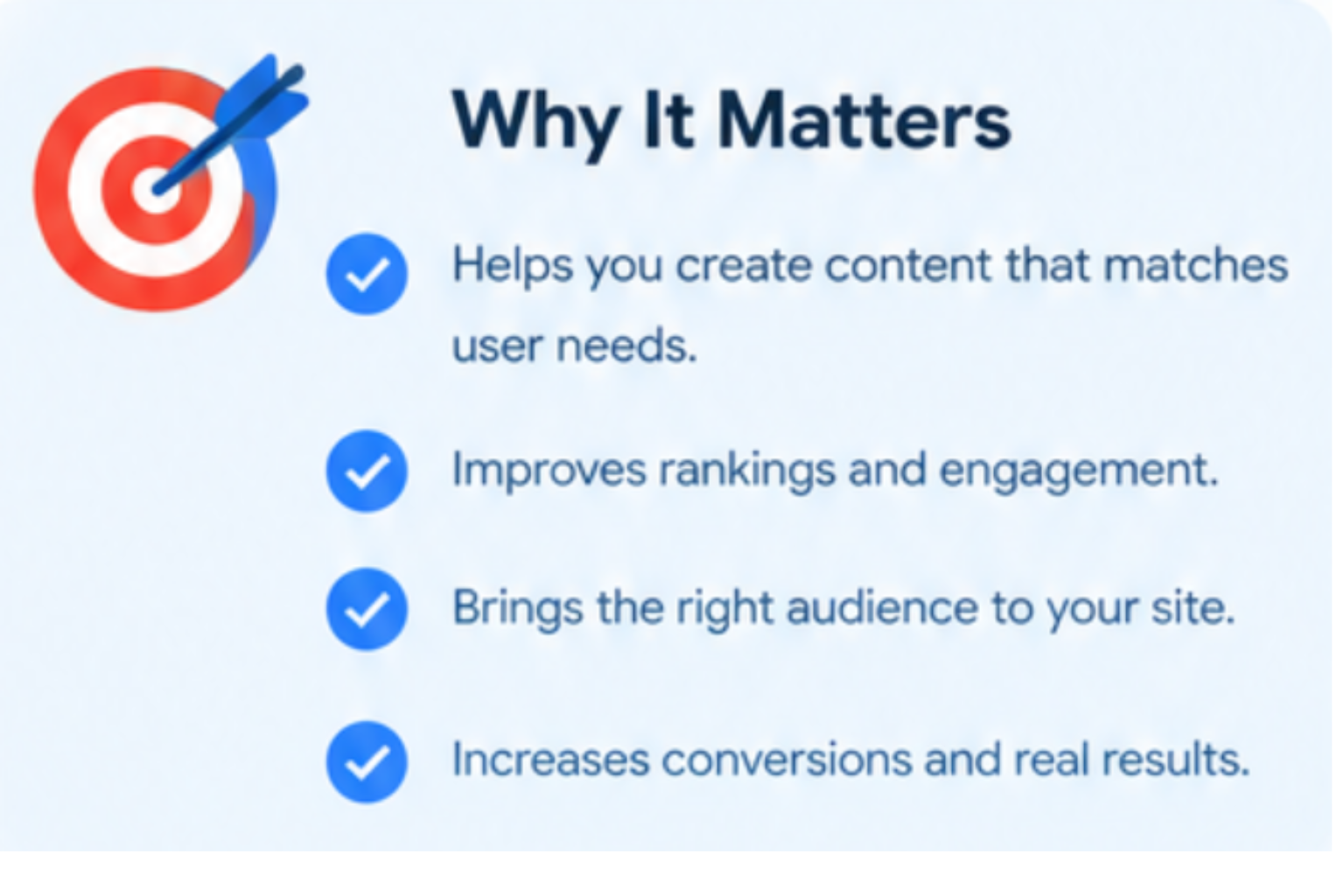
Matching intent helps you:
- Create more relevant and useful content.
- Choose the right content type and format.
- Improve the user experience.
- Attract more qualified traffic.
- Support conversions with relevant next steps.
- Avoid unnatural keyword stuffing.
Search Intent Explained: What Is a User Really Looking For?
Modern search systems have moved beyond simple keyword matching. They use context, language understanding, relationships between concepts, and search patterns to better interpret what a query means.
This is closely related to semantic search, because it covers topics and authoritativeness.
Search Query vs. Search Intent
A search query is the exact words a user types into a search engine. Search intent is the reason or goal behind those words.
| Search Query | Search Intent |
| “what is technical SEO” | Learn about technical SEO |
| “best SEO tools” | Compare and choose an SEO tool |
| “Ahrefs login” | Find the Ahrefs login page |
| “buy running shoes online” | Purchase running shoes |
The Needs Behind Search Intent
Search Intent begins with an underlying consumer need. People search because they want an answer, need to solve a problem, want to compare options, or are ready to take action.
Search queries provide clues about these needs. The words people use and the questions they ask help marketers and SEO professionals understand what users expect from search results and create content that meets those expectations.
Consumer needs can be functional, emotional, or social. Users may search to gain knowledge, find solutions, reduce uncertainty, compare choices, or discover something new. These needs influence the type of information they seek and the actions they take.
How Context Changes Search Intent
Search intent is not always determined by the words in a query alone. Context can change what a search means and what the user expects to find. Context includes factors such as the user’s situation, previous searches, location, timing, device, and the type of information currently being sought.
For example, the query “apple” could refer to the fruit, the technology company, a product, or even a stock. The word itself does not provide enough information to determine the user’s goal. Additional context helps search systems understand which meaning is most relevant.
How Context Can Shift Intent
- User’s goal: Context helps determine what the user actually wants from a query.
- Previous searches: Earlier searches can provide clues about the user’s current intent.
- Time and location: A query may have different intent depending on when and where it is searched.
- User expectations: Context influences whether users expect an explanation, comparison, local result, or product page.
Why the Same Keyword Have Different Intent?
The same keyword can represent different needs because search intent depends on the user’s goal, context, and stage in the decision-making process. A keyword alone does not always reveal exactly what the searcher wants.
- Different goals: The same term can have multiple meanings. For example, “apple” could refer to the fruit, the technology company, a product, or a recipe.
- Different stages: Someone searching “running shoes” may be researching brands, comparing models, checking reviews, or preparing to buy.
- Changing intent: Search intent can shift as trends, products, markets, and user behavior change over time.
- Different specificity: Broad keywords usually have less obvious intent, while longer, more specific queries provide stronger clues about the user’s needs.
The Four Core Search Intent Patterns
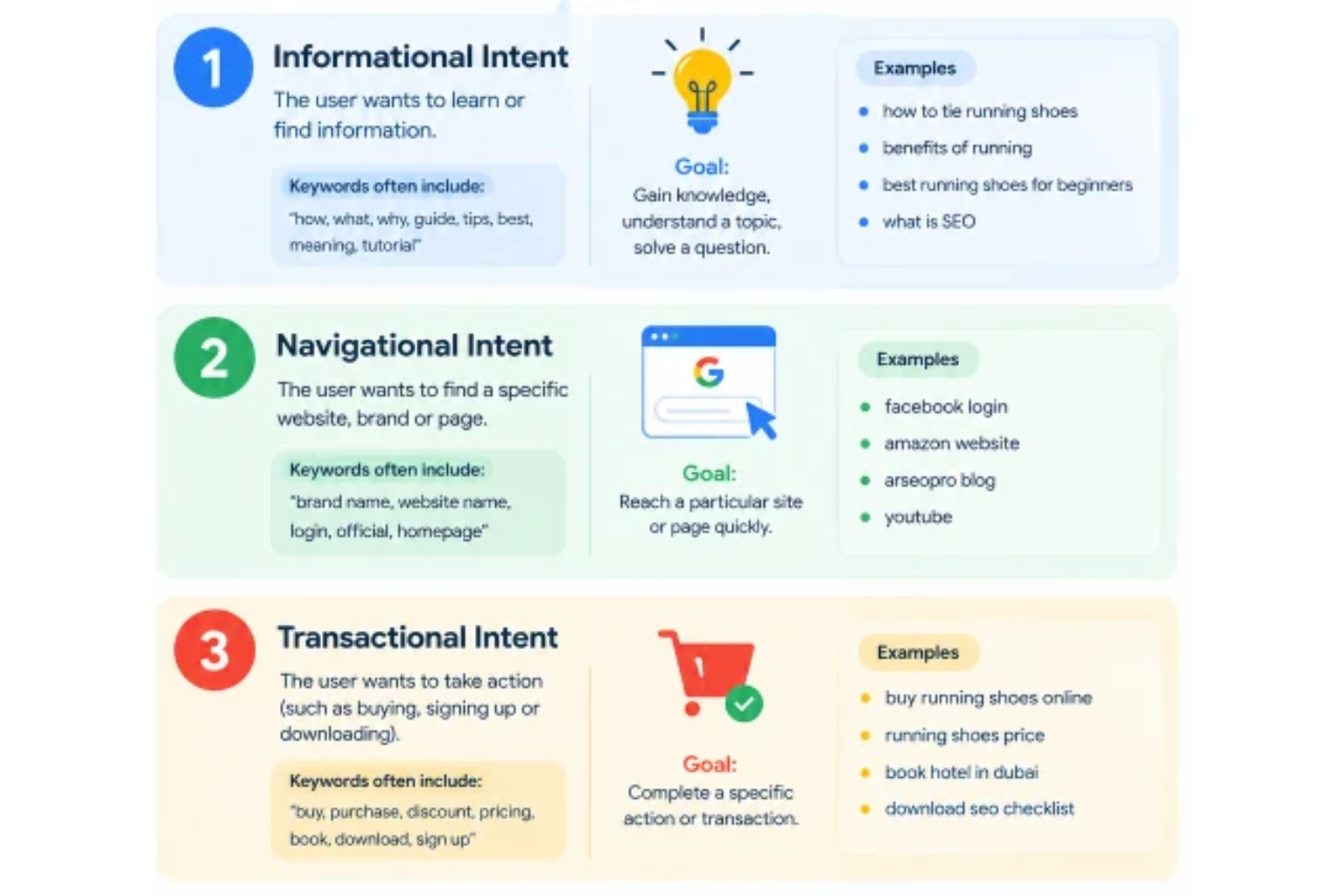
informational, navigational, commercial, and transactional are the main user intent types or patterns, these can help to categories the users, so lets learn.
- Informational Intent: The user wants to learn, understand a topic, or find an answer.
Example: “How to make pasta” - Navigational Intent: The user needs to find a specific website, brand, or webpage.
Example: “Amazon” - Commercial Intent: The user is researching, comparing, or evaluating options before making a purchase.
Example: “Best budget Android Phones” - Transactional Intent: The user is ready to take action, such as buying, booking, subscribing, or downloading something.
Example: “Buy iPhone 17”
Search Intent Is More Than Four Categories
The four main types of search intent are a useful foundation, but real searches can include additional intent signals. These signals help explain where the user is, what they need, and what action they may want to take.
These additional intent signals can appear within the four core categories:
- Local Intent: The user wants information, products, or services in a specific location.
Example: “best restaurants near me” - Freshness Intent: The user needs recent or up-to-date information.
Example: “latest Google algorithm update” - Comparison Intent: The user wants to compare two or more options before deciding.
Example: “Lenovo Leptops vs Dell Leptops” - Problem-Solving Intent: The user is trying to fix a specific issue or overcome a challenge.
Example: “how to fix slow website redirections” - Visit-in-Person Intent: The user wants to visit a physical location or business.
Example: “mobile shops near me” - Brand-Specific Intent: The user is specifically looking for a particular brand, company, product, or service.
Example: “Nike running shoes”
Read the SERP to Decode Search Intent
The search engine results page (SERP) provides strong clues about what Google believes users are looking for. Instead of relying only on the keyword, examine the pages, formats, and SERP features that appear for the query.
Look for These SERP Signals
Dominant Page Types:
Check whether most results are blog posts, product pages, category pages, landing pages, or videos. The dominant type often indicates the expected search intent.
Content Formats:
Check recent ranking pages, Understand the strategies they use guides, lists, comparisons, tutorials, reviews, or other formats. Match own content format to what users are already finding useful.
Featured Snippets:
A featured snippet can indicate that Google sees the query as answer-focused, particularly for questions and informational searches.
People Also Ask:
These questions reveal related concerns users commonly have and can help identify important subtopics to cover.
Videos and Images
Prominent video or image results may indicate that users want visual explanations, demonstrations, or inspiration.
Shopping Results
Product listings, shopping features, and prices are strong signals that the query has commercial or transactional intent.
Local Results
Maps, local businesses, addresses, reviews, and opening hours suggest that users are looking for a nearby business or physical location.
Freshness of Ranking Pages
If recent articles and frequently updated pages dominate the SERP, the query may require current information rather than evergreen content.
Not Possible that search intent is understandable from the keyword alone. For catching intent need to study the SERP to understand what type of content Google is currently presenting for that query, then identify how your content can satisfy the same need more effectively.
The 3 Layers of Search Intent
Search intent is not only about identifying whether a query is informational, commercial, or transactional. To understand what users truly expect, look at three layers: content type, content format, and content angle.
Content Type: What Kind of Page Does the User Need?
Content type refers to the overall page or resource that best satisfies the search.
Common content types include: Blog post, Product page, Category page, Landing page, Detailed guide, Service page and Comparison page
For example, a search such as “buy running shoes” is more likely to require a product or category page than a general informational article.
Content Format: How Should the Information Be Presented?
Format describes how the content should be structured to meet the user’s expectations.
Common formats include: Listicles, Tutorials, Step-by-step guides, Comparisons, Reviews, Checklists, Case studies and FAQs
For example, “best Ipads for students” may be better served by a comparison or ranked list than a general article about laptops.
Content Angle: What Specific Perspective Does the User Want?
The angle is the specific focus or perspective that makes the content relevant to the searcher.
Examples include: Beginner-friendly, Latest or updated information, Budget-friendly options, Expert recommendations, Best for a specific audience or Advanced strategies
For example, “best budget laptops for college students” has a clear angle: affordable laptops specifically suited to college students.
How to Identify Search Intent for Any Keyword
Identifying search intent helps you understand what users expect to find when they search for a particular keyword. Instead of guessing what a keyword means, use a combination of SERP analysis, query language, and keyword research tools.
1. Analyze the SERP
The search engine results page (SERP) is one of the most reliable places to identify intent because the results show what Google is currently considering relevant for that query.
Follow these steps:
- Search the keyword on Google.
- Examine the top-ranking results.
- Look for common themes in titles and descriptions.
- Identify the dominant page types, such as blogs, product pages, category pages, or landing pages.
- Check SERP features such as featured snippets, People Also Ask, videos, images, shopping results, or local listings.
- Review several top-ranking pages to understand their structure, depth, and topics covered.
If most results are detailed guides, the query is likely informational. If product and category pages dominate, it may have commercial or transactional intent.
2. Study the Query’s Language
The wording of a keyword can provide important clues about what the searcher wants.
Look for intent-related terms such as:
- What / Why → Usually informational
- How → Learning or problem-solving
- Best → Commercial research
- Affordable / Cheap → Price-focused research
- Buy / Order → Transactional
- Login / Official → Navigational
- Near me → Local intent
Even small changes in wording can change the expected content. “Ingredients for dog food” may suggest someone wants to make dog food, while “dog food ingredients” may indicate they want to understand what commercial dog food contains.
3. Identify the Dominant Intent
After analyzing the SERP and query language, determine which intent is strongest:
- Informational
- Navigational
- Commercial
- Transactional
Some keywords can have mixed intent, so look for the dominant pattern rather than forcing every query into one category.
4. Analyze Page Types and Formats
Look at what kind of pages and content formats appear most frequently.
For example:
- Blog posts → Informational
- How-to guides → Informational/problem-solving
- Comparison pages → Commercial
- Product pages → Transactional
- Category pages → Commercial/transactional
- Local listings → Local intent
This helps you decide what type of content you should create.
5. Identify Recurring Topics and Questions
Review the top-ranking pages, People Also Ask questions, related searches, and headings to discover what information users repeatedly want.
These recurring topics can help you build more complete content instead of focusing only on the primary keyword.
6. Determine the Content Angle
Identify the perspective that dominates the SERP. Users may be looking for: Beginner-friendly information, Latest updates, Affordable options,
Expert recommendations
Specific audience solutions
Quick or easy methods
Matching the dominant angle can make your content more relevant to the searcher’s expectations.
7. Use a Keyword Research Tool
SEO tools can provide additional intent classifications and keyword data. Tools such as Semrush, google keyword planner, Answer the public, Ahref etc can help identify whether a keyword is informational, navigational, commercial, or transactional.
However, treat automated intent labels as a starting point, not a replacement for manually checking the SERP.
8. Create Content That Matches the Expectation
Once you understand the intent, create content that satisfies the user’s actual need.
Search Intent and Keyword Research: How They Work Together
Keyword research is not just about finding terms with high search volume. It also involves understanding why people search for those terms and what they expect to find.
Search intent gives meaning to keyword research. By analyzing different types of keywords and grouping them according to intent, you can choose the right topics, create more relevant content, and assign each keyword to the page that best satisfies the searcher’s needs.
Start With Primary Keywords
Primary keywords are the main terms that describe the topic of a page. They provide a starting point for understanding what users are searching for.
For example, a page about improving website performance might target “website speed optimization.” But targeting the primary keyword alone does not tell you everything users want to know. You need to examine related searches and the SERP to understand the intent behind it.
Expand With Long-Tail Keywords
Long-tail keywords are more specific search phrases that often provide stronger clues about user intent.
For example:
- “SEO tools” — broad and potentially mixed intent
- “best SEO tools for small businesses” — commercial investigation
- “how to use SEO tools” — informational
- “buy SEO software” — transactional
These variations help reveal different needs and can uncover opportunities for separate pages or supporting sections.
Use Related Searches and Questions
Related searches and question-based keywords can reveal the topics users commonly explore around a subject. Look for questions beginning with what, why, how, when, where, and which, along with related searches shown at the bottom of Google results.
These terms can help identify supporting topics, common concerns, and gaps that should be addressed in the content.
Add Semantic Terms
Semantic terms are words and concepts that are closely connected to the main topic. They help provide context and allow you to cover a subject naturally and comprehensively.
For example, content about technical SEO might naturally discuss crawling, indexing, canonical URLs, XML sitemaps, structured data, redirects, and Core Web Vitals.
The goal is not to insert related terms simply to increase keyword count. Use them when they help explain the topic and satisfy the user’s broader need.
Map Keywords to Search Intent
Once you collect your keywords, classify them according to their dominant intent:
| Keyword | Likely Intent |
| What is technical SEO? | Informational |
| Google Search Console login | Navigational |
| Best SEO tools | Commercial |
| Buy SEO software | Transactional |
This makes it easier to determine what type of content each keyword requires.
Map Keywords to the Right Pages
Keyword-to-page mapping connects keyword research with website structure. Rather then targeting every related keyword on one page, assign keywords to the pages that best match their intent.
For example, an informational keyword may belong to a blog article, while a transactional keyword may be better suited to a product or service page.
This approach helps prevent keyword cannibalization, keeps site structure organized, and ensures that each important search query has a relevant page targeting it.
Ultimately, keyword research and search intent should work together. Keyword research identifies what people search for, while search intent helps determine what they expect to find. Combining both allows you to build pages around real user needs rather than search volume alone.
How to Match Web Content With Search Intent
To match content with search intent, analyze the top-ranking SERP for your target keyword. Look for patterns in page types, content formats, topics, and SERP features to understand what users expect.
For example, “best project management software” suggests comparison intent, so users are likely looking for features, pricing, pros and cons, and recommendations rather than a basic definition.
| Search Intent | User Need | Suitable Content |
| Informational | Learn something | Guide, tutorial, explanation |
| Navigational | Find a specific destination | Brand or website page |
| Commercial | Compare options | Review, comparison, buying guide |
| Transactional | Complete an action | Product, service, signup page |
Common Search Intent Mistakes That Hurt SEO
Even well-researched keywords can underperform when the content does not match what searchers actually want. Many search intent problems come from focusing too heavily on the keyword itself instead of the search results, user expectations, and context behind the query.
Targeting Keywords Without Analyzing the SERP
Search results provide valuable clues about intent. Before creating a page, check what currently ranks for the keyword and look for patterns in page types, content formats, topics, and SERP features.
For example, if the results for “best email marketing software” are mainly comparison articles and product reviews, a basic definition of email marketing is unlikely to meet the dominant intent.
Creating the Wrong Page Type
The right keyword can still perform poorly when it is assigned to the wrong kind of page. Search engines may favor product pages, category pages, service pages, or informational articles depending on the query.
A search such as “buy office chair online” has a much stronger commercial or transactional expectation than a general article about choosing an office chair.
Mixing Informational and Commercial Intent
Informational searches usually call for useful explanations, while commercial searches often require comparisons, recommendations, pricing, or product details. A sales-focused page can feel out of place for someone simply looking for an answer.
Likewise, an educational article may not satisfy someone who is already ready to purchase.
Ignoring Local Intent
Some queries depend heavily on location. Searches such as “dentist near me” or “restaurants open now” require locally relevant information rather than a broad informational page.
Location, opening hours, reviews, directions, and business details can become important parts of the search experience.
Choosing Keywords Based Only on Search Volume
High-volume keywords are not automatically the most valuable. Broad terms often have unclear or mixed intent, while more specific queries can indicate a much stronger need.
For example, “SEO” has broad meaning, whereas “SEO audit service for small business” reveals a much more specific requirement.
Forcing Keywords Into Irrelevant Content
Keyword research should guide content, not force unrelated terms into it. Adding keywords that do not naturally support the topic can weaken relevance and make the content harder to read.
The better approach is to cover closely related concepts when they genuinely help answer the user’s question.
Copying Competitor Formats Without Adding Value
Top-ranking pages are useful for understanding search expectations, but simply reproducing their structure does not make a page competitive. The goal is to identify what users need and provide a stronger resource.
That could mean clearer explanations, better examples, fresher information, original insights, useful data, or a more complete answer.
The common thread behind these mistakes is simple: SEO content should be built around the reason behind the search, not just the keyword itself.
Search Intent in Content Optimization
Search intent should be part of every stage of content optimization. It is not enough to choose the right keyword; the page also needs to deliver the type of information users are actually looking for.
Once the intent is clear, use it to shape the page structure, content, links, and calls to action.
Build a Structure That Matches the Search
Content structure should make it easy for users to find the information they need. Start with the main question or topic, then organize supporting points in a logical order.
For an informational query, this may mean a detailed guide with clear sections. For a commercial query, users may expect comparisons, features, pricing, reviews, or buying considerations.
Use Headings to Guide the Reader
Headings should reflect the main questions and topics related to the search. A clear H1 should describe the page, while H2s and H3s can break the subject into useful sections.
Avoid adding headings only because they contain keywords. Each heading should help users understand what they will find next.
Place Keywords Naturally
Use the primary keyword where it makes sense, such as in the title, introduction, headings, and relevant parts of the body. The good practce add related terms naturally when they improve context.
The goal is not to repeat a keyword as often as possible. Search engines can understand topics through related words and concepts, so natural writing is usually more useful than keyword stuffing.
Cover the Topic, Not Just the Keyword
Good content answers the main query while also addressing important related questions. Review the SERP, People Also Ask results, related searches, and competing pages to identify useful subtopics.
For example, content about website speed optimization may also need to discuss Core Web Vitals, image optimization, caching, JavaScript, and mobile performance.
Use Internal Links With Purpose
Internal links can connect users to related content and make it easier to explore a topic. Link to pages that provide useful background, deeper explanations, or the next logical step.
Use descriptive anchor text so readers understand what they will find when they click.
Match CTAs to the User’s Intent
Calls to action should fit the user’s stage in the journey. Someone searching for basic information may respond better to a related guide, newsletter, or free resource. A user showing strong commercial or transactional intent may be ready for a demo, quote, signup, or purchase.
A CTA should support the user’s next step rather than interrupt the content with an unrelated sales message.
Keep Content Fresh When Intent Changes
Search intent can change as products, trends, technologies, and user needs evolve. Review important pages regularly and update outdated facts, examples, links, statistics, screenshots, and recommendations.
Freshness does not mean changing content without reason. Updates should make the page more accurate, useful, and aligned with what users are searching for today.
How Search Intent Changes Over Time
- Seasonal searches
- Trending topics
- Product launches
- News-driven queries
- Algorithm and market changes
- Changing user expectations
Explain why intent should be rechecked periodically, especially for important pages. (Skips)
Search Intent for AI-Powered Search
AI-powered search is changing how people search for information. Rather then typing short keywords, users are more likely to ask complete questions, add context, and continue the conversation based on the answers they receive.
This means content needs to address the meaning behind the search, not just match a few keywords.
Conversational Queries
Users can now search in a more natural, conversational way. If user searching for “SEO tools”, they might ask, “Which SEO tool is best for a small business with a limited budget?”
Content should be written clearly enough to answer these natural-language questions and the specific need behind them.
Longer and More Specific Questions
AI search makes it easier for users to ask detailed questions. These queries often reveal more about their goals, preferences, and problems.
For example, “How can a small website improve its Core Web Vitals without hiring a developer?” provides much more context than simply searching for “Core Web Vitals.”
Detailed content that addresses the specific situation can better satisfy this type of search.
Follow-Up Questions
Search is becoming more conversational. After getting an initial answer, users may ask another question to explore the topic further.
For example:
“What are the best SEO tools?”
→ “Which one is better for keyword research?”
→ “Does it work for small websites?”
Content that answers related questions and connects important subtopics can provide a more complete experience.
Multi-Step Information Needs
Some searches involve several steps rather than one simple question. A user may need to understand a topic, compare options, make a decision, and then take action.
For example, someone planning a website migration may need information about redirects, URL mapping, technical checks, indexing, and post-migration monitoring. Content that covers the process from start to finish can better address this type of intent.
Entity and Context Understanding
AI-powered search looks beyond individual keywords and considers relationships between people, brands, products, places, topics, and concepts.
Using clear names and relevant context helps both readers and search systems understand what the content is about and how different concepts relate to each other.
Structuring Answers Clearly
Clear structure becomes even more important when content may be summarized or used to answer conversational searches. Use descriptive headings, short sections, direct answers, examples, lists, and relevant supporting details.
The goal is not to write specifically for an AI system. It is to make the content clear, well-organized, and genuinely useful for the person searching.
Ultimately, optimizing for AI-powered search still comes back to the same principle: understand the user’s need and provide the clearest, most useful answer possible.
Search Intent and Semantic SEO
Search intent and semantic SEO work closely together. Search engines do not rely only on the exact words in a query. They also look at related concepts, entities, and the connections between topics to understand what a searcher is actually looking for.
A strong content strategy therefore covers the main topic along with the important concepts and questions connected to it.
Related Concepts
People rarely search for a topic using just one term. A page about technical SEO, for example, may naturally discuss crawling, indexing, redirects, canonical URLs, XML sitemaps, and structured data.
Including relevant concepts gives the content more context and allows it to address the topic from different angles.
Entities
Entities are identifiable people, businesses, products, places, organizations, or concepts. Using them clearly and consistently can make relationships between different parts of a topic easier to understand.
For example, an article about SEO tools might discuss Google Search Console, Semrush, Ahrefs, and Google Analytics rather than repeatedly using the broad term “SEO tool.”
Topic Relationships
Related topics should connect logically instead of appearing as a collection of unrelated keywords. Explain how important concepts relate to the main subject and to each other.
For example, keyword research → search intent → content creation → on-page optimization forms a clear relationship within an SEO topic.
Search Context
The same keyword can mean different things depending on the user’s situation. Context can come from the wording of the query, location, timing, previous searches, or the user’s stage in the decision process.
Understanding this context helps create content that answers the actual need rather than simply matching the keyword.
Topical Coverage
Topical coverage means addressing the important aspects of a subject thoroughly enough to satisfy the user’s need. This does not mean making a page unnecessarily long or adding every possible keyword.
Focus on the questions, concepts, examples, and supporting information that genuinely belong to the topic.
Content Clusters
Content clusters organize related pages around a central topic. A pillar page covers the broader subject, while supporting pages explore specific subtopics in greater detail.
For example, a main page about technical SEO could link to separate articles about crawling, indexing, redirects, canonical tags, and XML sitemaps.
How to Measure Whether You Matched Search Intent
Matching search intent is not something you determine by rankings alone. The real question is whether the page is attracting the right users and giving them enough value to take the next step.
Google Search Console and Google Analytics can provide useful signals for evaluating this.
Organic Clicks and Impressions
Impressions show how often a page appeared in search results, while organic clicks show how many users visited it from search.
If impressions are increasing but clicks remain low, the page may need a stronger title and meta description—or the content may not match what searchers expect.
Click-Through Rate (CTR)
CTR measures the percentage of impressions that resulted in clicks. A relevant page title and description can encourage the right users to choose your result.
However, CTR should be considered alongside rankings, query type, and SERP features rather than as a standalone measure of search-intent success.
Rankings
Track how the page performs for its target keywords and related queries. Strong rankings can indicate relevance, but ranking well does not automatically mean the page fully satisfies search intent.
Look at which queries are driving visibility, not just the position of one primary keyword.
Engagement
Once users reach the page, engagement signals can show whether the content is useful and easy to navigate. Depending on the site, this can include engaged sessions, time spent meaningfully interacting with the page, scroll depth, or other relevant actions.
The goal is to see whether visitors continue engaging with the content rather than leaving without finding what they need.
Conversions
For business-focused content, conversions are one of the most useful measures. Depending on the page, this could mean a purchase, form submission, signup, booking, download, or contact request.
A page can attract strong organic traffic but still underperform if it brings visitors who do not match the intended audience or need.
Returning Visitors
Returning visitors can indicate that a page provided enough value for users to come back. This is particularly relevant for informational content, guides, resources, and websites where users regularly return for updates or additional information.
Queries Generating Traffic
Review the actual search queries bringing users to the page. They can reveal whether the content is attracting the audience and intent you originally targeted.
For example, a page created for “how to perform an SEO audit” should ideally attract informational queries around learning and performing an audit—not mainly unrelated commercial searches.
Measure the Full Picture
No single metric can confirm that search intent has been matched. A better approach is to look at the full journey:
When these signals align with the page’s purpose, they provide stronger evidence that the content is reaching the right searchers and meeting their needs.
Search Intent Optimization Checklist
- Identify the primary search intent
- Analyze the current SERP
- Confirm the dominant content type
- Choose the appropriate content format
- Identify the expected content angle
- Cover important related questions
- Use keywords naturally
- Provide a clear answer early
- Add useful examples or evidence
- Match CTAs to user intent
- Review performance after publishing
Search intent is about understanding why someone searches and what they expect to find. A keyword may bring people to a page, but the content needs to satisfy the need behind that keyword.
Creating content around search volume alone, consider the full picture: the query, SERP, user goal, content format, context, and next step.
The strongest SEO content does more than include the right keywords. It gives users a clear, useful answer in the format they expect.
Frequently Asked Questions
What are the three C’s of search intent?
The three C’s of Search Intent help identify what users expect from search results.
-
Content Type: The type of page, such as a blog, product page, or landing page.
-
Content Format: The presentation style, such as a guide, listicle, review, or tutorial.
-
Content Angle: The unique approach, such as beginner-friendly, budget-friendly, or latest information.
What are the four main types of search intent?
The 4 Main Types of Search Intent:
-
Informational Intent: Users want to learn something or find information.
-
Navigational Intent: Users want to visit a specific website or webpage.
-
Commercial Investigation: Users research and compare products or services before making a purchase.
-
Transactional Intent: Users are ready to take an action, such as buying a product, booking a service, or signing up.
What is the 80/20 rule in SEO?
The 80/20 rule in SEO (also known as the Pareto Principle) suggests that roughly 80% of your organic traffic, rankings, and conversions may come from 20% of your SEO efforts. Instead of distributing time and budget equally across every SEO activity, focus on the high-impact tasks that deliver the greatest results and contribute to business growth.