Answer Engine Optimization, Key Strategies & SEO vs. AEO vs. ASO
Answer Engine Optimization (AEO) focuses on making a brand’s content easier for AI-powered search and answer systems to discover, understand, and potentially use when responding to user questions. Rather than focusing only on traditional search rankings, AEO considers how information is presented in AI Overviews, AI search experiences, and conversational platforms.
AI search is growing, but traditional SEO remains important. Semrush analyzed billions of visits across more than 50,000 websites and found that AI traffic grew 66% during 2025, while still representing less than 0.15% of total visits in its dataset. Organic search continued to generate more than one trillion visits, showing that AI search is growing alongside—rather than simply replacing—traditional search.
What Is AEO? (Answer Engine Optimization)
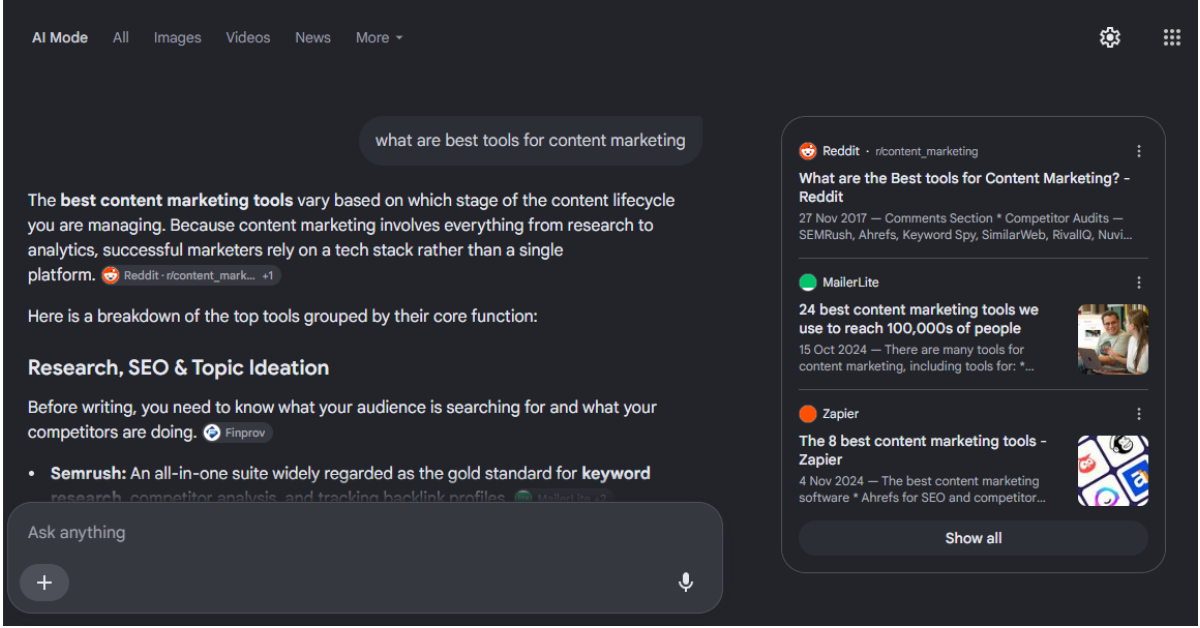
Answer Engine Optimization (AEO) is a set of digital marketing practices focused on improving a brand’s chances of being mentioned, cited, or represented in AI-generated answers. These answers can appear in experiences such as Google AI Overviews, Google AI Mode, ChatGPT, Gemini, and Perplexity, where systems retrieve and synthesize information from multiple sources to answer user questions.
Rather than focusing only on getting a webpage to rank for a traditional search query, AEO considers how clearly a brand and its content can be understood and potentially selected as a source within an AI-generated response.
I’ve also softened the ASO claims because agentic search optimization is still an emerging industry concept rather than an established, standardized optimization discipline.
Why Is Answer Engine Optimization Important?
Search has changed. It’s no longer only about blue links on a results page. Tools like ChatGPT, Perplexity, and Google’s AI Overviews and AI Mode are changing how people access information and how brands show up.
The rise of answer engines has led to a sharp increase in zero‑click searches. In many cases, users now get what they need without ever visiting a website. That means if your content isn’t optimized for those responses, you’re missing visibility.
The good news is citations drive clicks. Seer Interactive found that brands earn 120 percent more organic clicks per impression when Google’s AI Overviews cite them.
In May 2026, Google enhanced link attribution with citation chips. These are clickable link sources that preview the website name or page title, so you know what you’re clicking through to.
Those clicks are more likely to convert. Semrush found the average AI search user is 4.4 times as valuable as a traditional organic visitor, based on conversion rate. Users are doing their research in AI before they click.
Then there’s AI Mode, which has over 1 billion monthly users. While AI Overviews sit above normal search results, AI Mode offers a full-page conversational experience complete with native follow-up questions.
Even when AI Mode doesn’t send a click, AEO visibility still matters. Your brand can show up in the answer, which builds brand authority.
Voice assistants like Alexa, Siri, and Google Assistant work the same way. As generative AI gets better at scanning websites for the best answers, fewer sources show up. That means need to put out the most accurate, relevant content to garner those citations.
People expect answers fast. They don’t want to scroll through 10 links when one will do. AEO aligns your content to that expectation: Users want clear answers, fast.
The impact goes beyond organic traffic. A strong AEO strategy boosts brand visibility, strengthens trust signals, and improves discoverability across AI tools and platforms. If you’re investing in SEO but ignoring answer engine optimization, you’re missing opportunities.
What’s the Difference Between AEO and SEO?
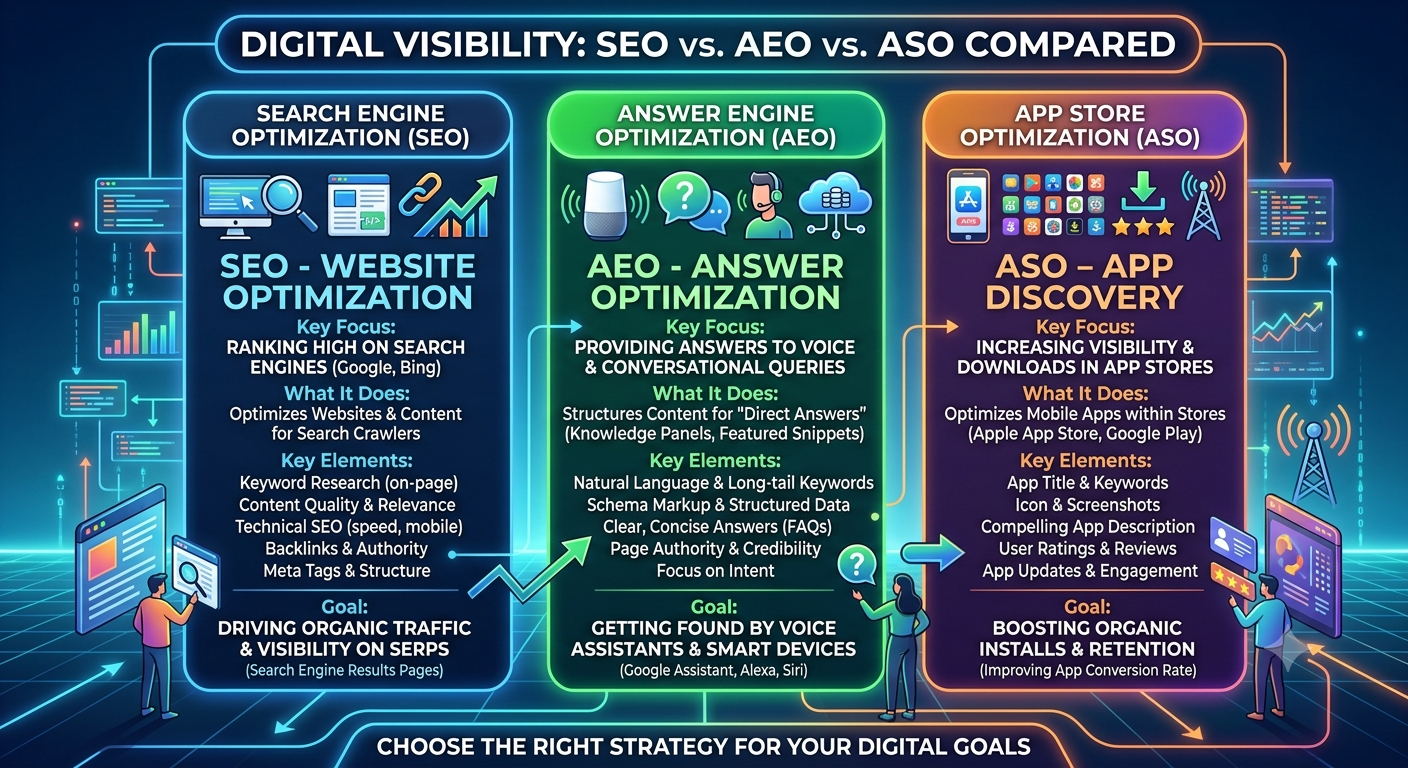
SEO, AEO, and agentic search optimization (ASO) all aim to improve how people discover and interact with a brand, but they focus on different search experiences.
Search Engine Optimization (SEO) focuses on improving visibility in traditional search results, while Answer Engine Optimization (AEO) focuses on increasing the chances of a brand or its content being referenced in AI-generated answers. Agentic Search Optimization (ASO) is an emerging concept that extends this idea toward AI systems that can go beyond answering questions and assist with multi-step tasks, recommendations, or actions.
The three approaches share many fundamentals, including useful content, technical accessibility, search intent, structured information, credibility, and a strong user experience. However, their optimization priorities and success metrics can differ.
SEO vs. AEO vs. ASO
| Aspect | SEO | AEO | ASO |
| Main Goal | Improve visibility in traditional search results | Increase the likelihood of being mentioned or cited in AI-generated answers | Improve a brand’s visibility and eligibility within AI-driven answers, recommendations, and agent-assisted actions |
| Search Environment | Traditional search results with ranked webpages | Dynamic AI-generated responses and search summaries | Multi-step AI interactions involving discovery, comparison, recommendations, and potentially actions |
| Optimization Focus | Keywords, search intent, content, links, technical SEO, and site architecture | Clear answers, topical relevance, useful content, credible sources, and brand/entity information | AEO foundations plus structured data, accurate product/service information, availability, integrations, APIs, and trust signals where relevant |
| Primary Platforms | Google Search, Bing, and other search engines | Google AI Overviews, Google AI Mode, ChatGPT, Gemini, Perplexity, and similar AI search experiences | Emerging AI-agent ecosystems, shopping and booking experiences, and platforms capable of completing or assisting with tasks |
| Typical Metrics | Rankings, impressions, CTR, organic traffic, and conversions | AI citations, brand mentions, AI visibility, referrals, and conversions | AI visibility, recommendations, inclusion in agent workflows, referrals, and completed actions such as purchases or bookings |
| Content Priority | Comprehensive content aligned with search intent | Concise, clear, trustworthy, and context-rich answers | Information that is both understandable to AI systems and actionable for users or agents |
| Technical Priority | Crawlability, indexability, site speed, internal linking, structured data, and mobile usability | Strong SEO foundations plus accessible, clearly structured information | SEO and AEO foundations plus reliable structured data, feeds, APIs, and real-time business information where applicable |
What Are AI Hallucinations And How Can You Avoid Them?
AI hallucinations occur when AI tools such as ChatGPT generate information that sounds accurate but is actually incorrect, misleading, or made up. This can happen when an AI system relies on outdated, inaccurate, misinterpreted, or low-quality information while generating an answer.
For example, a chatbot may provide incorrect medical information, recommend products that do not exist, create false statistics, or mention research that cannot be verified. AI systems can also misunderstand information from online forums, third-party websites, or other unreliable sources.
The risk can be higher when a brand has limited online authority or inconsistent information across different websites and platforms. When reliable information is difficult to verify, AI may attempt to fill the gaps, which can result in inaccurate answers about the brand.
To reduce the chances of inaccurate or hallucinated information about your business:
- Keep website and public profiles updated with accurate and consistent information
- Use schema markup and structured data to make web content easier for AI systems to understand
- Publish expert-led content supported by reliable sources and citations
- Monitor how and where your brand is mentioned across websites, platforms, and online communities
Reducing AI hallucinations is not only a technical SEO task. It also requires maintaining accurate, consistent, and trustworthy information across the web so AI systems have reliable sources to understand brand.
AI Search
AI Search is a search technology that uses artificial intelligence (AI) to understand users’ questions, find relevant information, and generate direct answers instead of showing only a list of website links.
It analyzes information from different sources, identifies useful content, and combines relevant details to provide answers in a conversational format. AI Search involves three important processes: AI Retrieval, Source Selection, and AI-Generated Answers.
1. AI Retrieval
AI Retrieval is the process of finding and collecting relevant information from different sources based on a user’s search query.
AI-powered search systems understand the meaning and context of a question rather than matching only exact keywords. They search for related information from websites, databases, and other available sources to find content that can answer the user’s question.
2. Source Selection
Source Selection is the process of identifying which information sources are relevant and useful for generating an answer.
AI search systems judging factors such as content relevance, information quality, accuracy, context, and source reliability when selecting information.
Websites that provide clear, helpful, well-structured, and trustworthy information may have a better opportunity to be selected and cited in AI-generated answers.
3. AI-Generated Answers
AI-Generated Answers are responses created by artificial intelligence using information retrieved from relevant sources. Instead of simply displaying website links, AI systems organize and summarize information into easy-to-understand answers.
These responses may include explanations, bullet points, comparisons, and links to supporting sources. Examples include answers generated by Google AI Overviews, ChatGPT Search, and Perplexity.
How These Three Processes Work Together:
-
AI Retrieval: Finds information related to the user’s question.
-
Source Selection: Identifies relevant and useful sources.
-
AI-Generated Answers: Combines the selected information to create a direct response.
Understanding these processes helps businesses create relevant, accurate, and well-organized content that AI-powered search systems can understand, retrieve, and potentially use in their generated answers.
How to Create Content for Answer Engines
To make content answer-engine ready, build on traditional SEO with a focus on clear answers, structured content, trustworthy information, and strong brand visibility. AEO includes both on-site and off-site optimization.
On-site optimization
Improve discoverability with title tags, meta descriptions, header tags, optimized URLs, image alt text, internal links, mobile-friendly design, and an XML sitemap. Connect related pages through relevant internal linking so search engines can better understand your site’s topic structure.
Create content around real user questions and search intent. Use short paragraphs, clear headings, bullet points, numbered steps, definitions, tables, and direct answers that are easy for search engines and AI systems to understand and extract.
Strengthen content with original research, statistics, studies, reports, expert opinions, case studies, examples, quotes, and reliable citations. Add relevant Schema.org markup, such as Article, Organization, LocalBusiness, Product, Event, BreadcrumbList, and FAQPage, when it accurately represents the page content.
Use helpful multimedia, including YouTube videos, original images, infographics, charts, diagrams, screenshots, and GIFs, with appropriate alt text, captions, and supporting content.
Useful AEO and SEO tools include Google Search Console, Google Analytics 4, Google Trends, Rich Results Test, Schema.org Validator, Screaming Frog, Semrush, Ahrefs, and PageSpeed Insights.
Off-site optimization
Off-site AEO focuses on building your brand’s visibility and credibility beyond your website through backlinks, business listings, reviews, social media, digital PR, brand mentions, community discussions, and third-party publications.
Maintain accurate and consistent information across AI and search platforms such as Google AI Overviews and AI Mode, ChatGPT, Microsoft Copilot, Google Gemini, Perplexity, and Claude. For local businesses, keep details consistent across Google Business Profile, Bing Places, Apple Business Connect, Yelp, TripAdvisor, and relevant industry directories.
Build visibility through LinkedIn, YouTube, Instagram, Facebook, X, Reddit, and other relevant platforms. Promote useful content through email marketing, newsletters, digital PR, partnerships, guest contributions, and advertising.
Monitor your online presence with tools such as Google Alerts, Semrush, Ahrefs, Brand24, and Mention. Encourage genuine customer reviews and respond professionally to feedback.
The goal of off-site AEO is to build a consistent and trustworthy digital footprint. When reliable sources across the web provide accurate information about a brand, its expertise, products, and services, search engines and AI systems have more context to understand and reference it.
How to Integrate AEO Using Traditional SEO Strategies?
Integrating AEO with traditional SEO strategies allows web content to perform across both conventional search results and newer AI-driven answer experiences. Rather than treating AEO as a completely separate process, organizations can build on their existing SEO foundation and make their content easier for search engines and AI systems to understand, extract, and cite.
Traditional SEO still plays an important role because search engines and AI-powered platforms often rely on signals such as content quality, relevance, authority, structured information, and website accessibility. However, AEO requires an additional focus on providing clear, direct answers to the questions users are asking.
The goal is to create content that works for both people and search technologies. To achieve this, organize pages around natural, question-based headings, provide concise answers near the beginning of each section, use descriptive subheadings, and structure important information in lists, tables, and clearly defined sections.
Structured data can also strengthen this approach. Schema markup such as Article, FAQPage, HowTo, Product, Organization, LocalBusiness, and BreadcrumbList can provide additional context about the information on a page. While structured data does not guarantee inclusion in AI-generated answers, it can help search engines understand specific entities and relationships within the content.
Content should also display credibility through accurate information, expert input, original research, and authoritative references. Sources such as government websites, universities, recognized research organizations, and established industry publications can provide stronger supporting evidence.
A practical AEO and SEO workflow can include:
- Researching keywords and conversational questions using Google Keyword Planner, Google Trends, Semrush, Ahrefs, and AnswerThePublic
- Studying Google’s People Also Ask, featured snippets, related searches, and AI-generated search results
- Creating question-based headings that match real user search behavior
- Giving concise answers before expanding into deeper explanations
- Using internal links to connect related topics and strengthen topical coverage
- Adding relevant schema markup and structured data
- Improving page speed, mobile usability, crawlability, and Core Web Vitals
- Supporting important claims with trustworthy sources
- Updating outdated information regularly
- Monitoring how content appears in both traditional search and AI-generated results
Using Visibility Analytics to Prioritize AEO Efforts
Visibility analytics tools can help organizations understand how their content and brand appear across traditional search results, AI-generated answers, conversational search platforms, and other emerging search experiences.
Traditional SEO platforms such as Google Search Console, Google Analytics 4, Semrush, Ahrefs, and Moz can provide valuable information about organic traffic, rankings, queries, backlinks, engagement, and technical performance. These metrics can reveal which pages already attract visibility and which topics may need further optimization.
For AEO specifically, newer AI visibility platforms can help monitor brand mentions and citations across systems such as Google AI Overviews, ChatGPT, Microsoft Copilot, Perplexity, and other AI search experiences. Depending on the platform, these tools may track whether a brand is mentioned, which sources are cited, what competitors appear for similar questions, and how visibility changes over time.
Examples of tools and platforms that can support this process include:
- Google Search Console – Monitor search queries, impressions, clicks, indexing, and search performance.
- Google Trends – Identify changes in search interest and discover emerging topics and questions.
- Semrush – Research keywords, competitors, content opportunities, SERP features, and increasingly AI-related visibility.
- Ahrefs – Analyze keywords, backlinks, competing pages, organic search performance, and content opportunities.
- Moz – Track rankings, keyword opportunities, links, and broader SEO performance.
- AlsoAsked – Explore related questions and understand how questions connect within Google’s People Also Ask results.
- AnswerThePublic – Discover question-based searches and conversational queries around a topic.
- SISTRIX – Analyze organic visibility, rankings, competitors, and SERP developments.
- Profound – Track how brands appear in AI-generated search and answer experiences.
- Otterly.AI – Monitor brand visibility and mentions across AI search environments.
- Peec AI – Analyze brand visibility and competitive presence across AI search platforms.
- Scrunch AI – Monitor AI search visibility, citations, and brand representation.
- BrightEdge – Combine traditional SEO intelligence with newer search and AI visibility insights for enterprise-level analysis.
These tools can help identify questions where a brand is already being referenced, topics where competitors receive more visibility, and areas where content may need stronger evidence or clearer answers.
AEO measurement should also go beyond rankings. Important indicators can include AI mentions, citations, share of visibility, branded queries, organic impressions, featured snippet appearances, People Also Ask visibility, referral traffic, conversions, and changes in visibility across different search and AI platforms.
By combining traditional SEO analytics with AI visibility monitoring, organizations can develop a broader view of how their content is discovered, understood, and referenced across the changing search ecosystem.
Getting Started With AEO
Getting started AEO by reviewing website existing content and making it easier for search engines and AI tools to understand. Follow these basic steps:
- Analyze top answers. Find the questions targeted audience is asking and check which websites appear in search and AI-generated answers. Look for common patterns in their content.
- Create answer-focused content. Organize web content with clear headings, direct answers, simple language, expert insights, and easy-to-scan sections.
- Build content visibility. Share your content through relevant websites, industry publications, and trusted platforms. Earning mentions and citations from reliable sources can strengthen your online presence.
- Measure and improve. Track your search performance, AI visibility, mentions, and citations. Use the results to update and improve your AEO strategy.
Frequently Asked Questions About AEO
What is Answer Engine Optimization?
Answer Engine Optimization (AEO) is the process of creating and organizing content so search engines and AI tools can easily understand it and use it to answer people’s questions. It focuses on providing clear answers, useful information, and content that matches what users are looking for.
What is the difference between AEO and SEO?
SEO focuses on helping a website appear higher in search results and bring more organic traffic. AEO focuses more on helping content appear in direct answers, AI-generated results, featured snippets, and other answer-based search experiences. Both can work together to improve online visibility.
Why is AEO important?
AEO is important because people are increasingly looking for quick and direct answers online. Search engines and AI platforms can now provide answers without requiring users to visit several websites. Creating clear and useful content can increase the chances of your information being understood and shown in these answer experiences.
How does AEO work?
AEO starts by understanding the questions people ask about a topic. Content is then created to answer those questions clearly and directly. Using simple headings, short answers, lists, tables, internal links, reliable sources, and structured data can make the information easier for search engines and AI systems to understand.
How do you optimize content for answer engines?
Start by finding the questions your audience is searching for. Use those questions as headings where they fit naturally and provide a direct answer near the beginning of each section. Then add useful details, examples, facts, and sources. Keep the content well organized, easy to read, accurate, and regularly updated.
Does AEO replace SEO?
No. AEO does not replace SEO. Traditional SEO is still important for crawling, indexing, rankings, website performance, keywords, links, and organic traffic. AEO adds another layer by making content easier to understand and use in direct-answer and AI search experiences.
What tools can be used for AEO?
Several SEO and AI visibility tools can help with AEO. Google Search Console and Google Trends can help find search queries and topics. Semrush, Ahrefs, Moz, AnswerThePublic, and AlsoAsked can help with keyword and question research. Tools such as Profound, Otterly.AI, Peec AI, and Scrunch AI can help track brand visibility across some AI search platforms.
How do you measure AEO?
AEO can be measured using different types of visibility and traffic data. These can include featured snippet appearances, People Also Ask results, organic impressions and clicks, branded searches, AI mentions, AI citations, referral traffic, and conversions. Tracking these metrics over time can help show how content is performing across different search experiences.
Does schema markup improve AEO?
Schema markup helps search engines understand the information and structure of a webpage. It can support AEO by giving search engines more context about the content. However, adding schema does not guarantee that a page will appear in an AI answer or search feature. It should be used together with useful, accurate, and well-structured content.
How does AEO work with AI search?
AEO and AI search are closely connected because AI search systems need to understand questions and find useful information from different sources. Content that gives clear answers, provides reliable information, and is organized well can be easier for AI systems to understand and reference. However, there is no guaranteed method for getting a website mentioned or cited by a specific AI platform.