What is On page SEO and why is it important?
OnPpage SEO is about optimizing HTML code and some main elements to improve web pages performance on Google, bing and other AI plateforms like Gemini, Chatgpt and Perplexity. In this process of optimizing Meta tags, Content, Keywords, Titles, images, etc to increase web page quality.
On-Page SEO is the foundation of every successful website. It helps search engines understand web content while ensuring visitors have a better experience. Even the best content may struggle to rank if it is not properly optimized.
For Example: Imagine someone has opened a new bookshop in a city. If there are no signboards, directions, or information about the shop, very few people will find it.
SEO works like those signboards. It helps search engines understand:
- What website is about.
- Which pages are most important.
- Who should see web content.
As a result, website has a better chance of appearing when someone searches for related information.
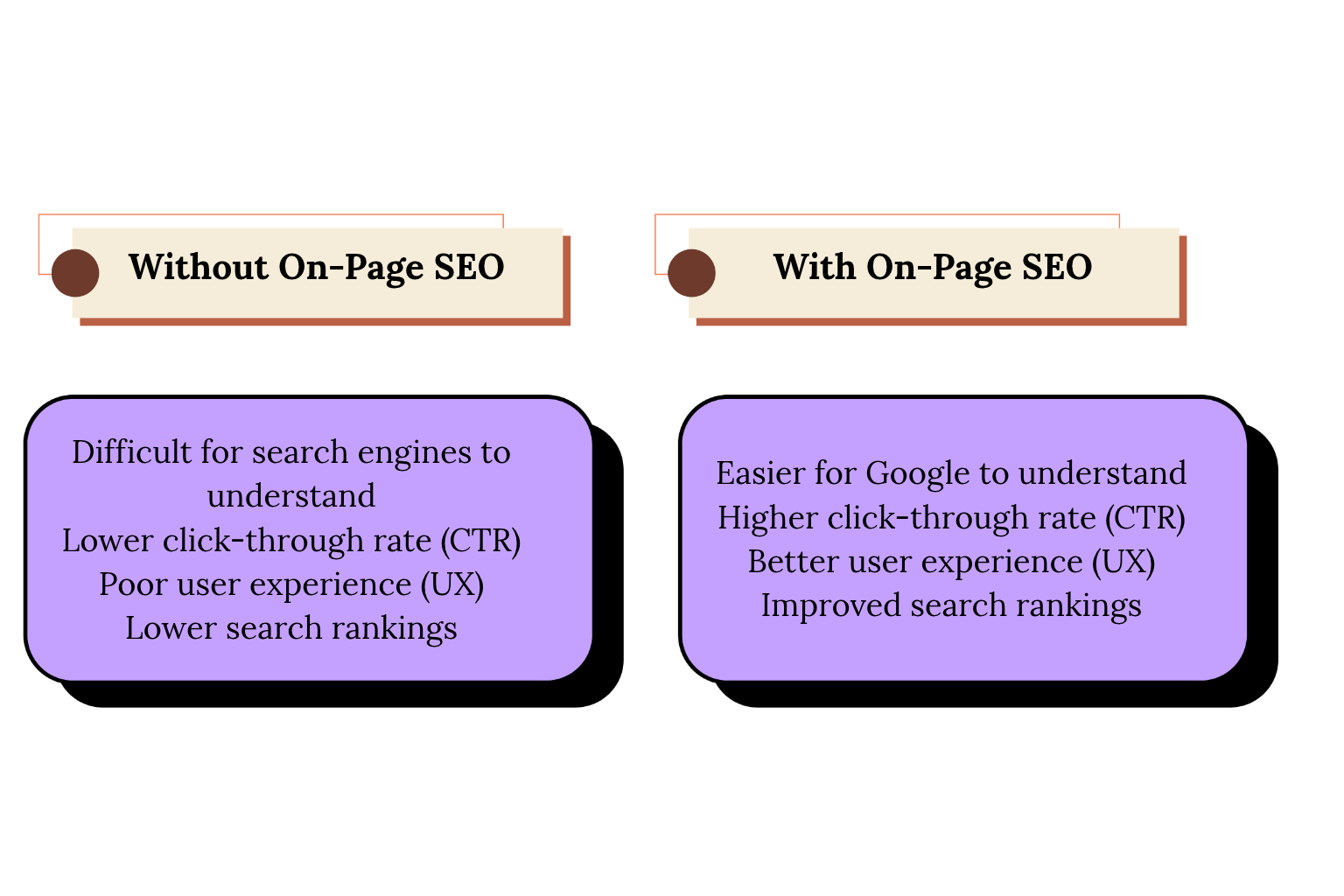
On Page SEO Includes Highlights
- Full Researched Primary Keywords
- Include LSI and long-tail keywords
- Use Competitor Analysis
- SEO Friendly Url
- Use Only One H1 tag
- Organize H2 and H3
- Use Table of Contents
- Correct Para divider
- Write user-helpful content and Original Content
- Add internal links to relevant pages
- Optimize all images before uploading and add descriptive Alt Text to every important image.
- Compress images for faster loading.
- Check Core Web Vitals performance.
- Add Schema Markup (Article, FAQ, Product, etc., if applicable).
- Write short paragraphs and use bullet points where helpful.
- Ensure HTTPS is enabled
- Fix broken links and unnecessary redirects
Why On-Page SEO Matters?
On-page SEO is an important part of search engine optimization because it helps search engines understand website content, determine its relevance to search queries, and provide a better experience to users.
By optimizing elements, website can improve their pages’ visibility in organic search results. It also helps align website content with user search intent, making it easier for visitors to find relevant and valuable information.
Improves Search Engine Understanding: Optimized title tags, heading structures, URLs, schema markup, and relevant content help search engines crawl, interpret, and understand the purpose of a webpage more effectively.
Matches Search Intent: Strategic keyword placement, relevant headings, and helpful content ensure that webpages address users’ actual search queries and provide information that matches their needs.
Provides Greater Optimization Control: Unlike off-page SEO factors such as backlinks and external brand mentions, website owners have direct control over most on-page elements, including content, title tags, meta descriptions, internal links, and URL structure.
Enhances User Experience (UX): Well-organized content, clear navigation, mobile-friendly layouts, readable formatting, and optimized page performance make it easier for visitors to find and understand information.
Supports Better Conversion Opportunities: Relevant content, clear calls to action (CTAs), and easy navigation help visitors understand a website’s offerings and encourage them to take meaningful actions, such as making a purchase, submitting a form, or requesting a service.
Strengthens AI Search Visibility: Clear content structure, descriptive headings, direct answers, and relevant contextual information make webpages easier for AI-powered search systems to interpret and potentially reference in responses generated by platforms such as ChatGPT, Perplexity, and Google AI Overviews.
On-Page SEO Matters for Google
It helps Google match user content needs and user intents from users searches and provides quality search results. On-Page SEO helps Google discover, understand, evaluate, and rank web pages accurately.
Google crawls a webpage through meta tags, headings, and content intent. A well-structured page with clean HTML, internal links, and logical navigation helps Googlebot crawl your content efficiently and add it to Google’s index.
On-Page SEO Matters For AI Search
ChatGPT, Gemini, Perplexity, and Google’s AI Overviews are AI-powered searches that focus on accurate, well-structured, and trustworthy content that best answers a user’s question rather focuses on articles or pages with keywords.
Good On-Page SEO helps AI systems understand your content and identify its main topic.
Keys to remember
- Clear Content Structure
- Search Intent Optimization
- High-Quality Content
- Entity Optimization
- Semantic SEO
- Internal Linking
- Image SEO
- Schema Markup
- Fast Loading & Mobile-Friendly Design
- E-E-A-T Signals
On-Page SEO Matters For Users
On-page SEO is not only for search engines or AI-powered searches, its aso for good user experiences. When users finds thier answer/information quickly according to their needs, navigate the website easily, and trust the content they are reading.
On-Page SEO Matters For conversions
On-page SEO is important for business conversions; it provides the right targeted audience, builds brand awareness by using matching intent, good core web vitals, and also through helpful content.
Getting the best audience is always about catching user intent and covert into quality traffic through on-page SEO.
Better User Experience is also matters, like fast loading speed, no render-blocking, mobile-friendly content, and easy-to-use websites.
High-quality and original content proves that web blog or web page has topic authority and also deep relevance. Its the big reason users trust and invest their money and personal details.
Make sure each web page has easy layout systems like understandable menus, easy-to-read text, bullet points, and other features.
The Science Behind On-Page SEO
Googlebot
Googlebot is Google’s web crawler (also called a spider or bot) that discovers new webpages and revisits existing pages to check for updates.
Crawling
Crawling is the process of discovering webpages and fetching their content for search engine processing. Googlebot follows links, checks URLs, and accesses website resources such as HTML, images, and CSS.
Reads HTML
HTML (HyperText Markup Language) structures webpage content. Google processes important elements such as title tags, meta descriptions, headings (H1, H2, H3), paragraphs, image alt text, internal links, and structured data.
Understands the Content
Google analyses webpage content to understand its main topic, search intent, relevance, quality, originality, and freshness. It also considers trust and quality signals associated with E-E-A-T (Experience, Expertise, Authoritativeness, and Trustworthiness).
Identifies Entities
Entities are identifiable people, places, organizations, products, or concepts that help Google understand the context of content.
Example: Apple can refer to Apple Inc. or the fruit, depending on the context.
Measures Page Experience
Google evaluates the overall page experience, including loading speed, Core Web Vitals, mobile-friendliness, HTTPS security, navigation, and content readability.
Ranks the Page
Google evaluates and compares relevant webpages to determine which results best satisfy a user’s search query. It considers content quality, relevance, backlinks, freshness, page experience, and other ranking signals to determine search result positions.
How Google Reads a Webpage
Many beginners think Google reads a webpage the same way humans do. In reality, Google first reads the HTML code, identifies important elements, understands relationships between words and entities, evaluates the page quality, and then decides whether the page deserves to rank.
| Step | What Google Does | Why It Matters |
| 1. Finds the Page | Discovers your page through links, XML sitemaps, or Google Search Console. | If Google can’t find your page, it can’t rank it. |
| 2. Crawls the Page | Googlebot visits and scans your webpage. | Collects information about the page. |
| 3. Reads the HTML | Analyses the page’s HTML code, including the title, headings, links, and images. | Understands the page structure. |
| 4. Understands the Content | Identifies the main topic, keywords, search intent, and content quality. | Determines what the page is about. |
| 5. Identifies Entities | Recognises people, places, brands, products, and concepts mentioned on the page. | Improves Google’s understanding of the content. |
| 6. Evaluates User Experience | Checks page speed, mobile-friendliness, HTTPS, and Core Web Vitals. | Ensures visitors have a good experience. |
| 7. Indexes the Page | Stores the page in Google’s search index if it meets quality requirements. | Makes the page eligible to appear in search results. |
| 8. Ranks the Page | Compares your page with others and decides its position in search results. | Determines where your page appears for relevant searches. |
Complete On-Page SEO Elements
The effectiveness of On-Page SEO relies on numerous web elements working in harmony. These components allow search engines to comprehend your pages while delivering a superior experience for your audience. Every factor serves a distinct role in elevating your overall search visibility.
| Element | Purpose |
|---|---|
| Title Tag | Tells search engines and users what the page is about. |
| Meta Description | Encourages users to click your page in search results. |
| URL Structure | Creates clean, descriptive, and easy-to-read URLs. |
| H1 Heading | Defines the main topic of the page. |
| H2 & H3 Headings | Organize content into logical sections. |
| High-Quality Content | Answers users’ questions with helpful and original information. |
| Search Intent Optimization | Ensures content matches what users are searching for. |
| Keyword Optimization | Helps search engines understand the page topic. |
| Semantic Keywords | Adds context by including related words and phrases. |
| Entity SEO | Helps search engines identify people, places, brands, and concepts. |
| Internal Links | Connects related pages within your website. |
| External Links | Adds credibility by linking to trusted sources. |
| Image SEO | Optimizes images for search engines and users. |
| Image Alt Text | Describes images for accessibility and search engines. |
| Schema Markup | Helps search engines understand page content and rich results. |
| Page Speed | Improves loading performance and user experience. |
| Mobile Friendliness | Ensures the page works well on mobile devices. |
| Core Web Vitals | Measures page experience, responsiveness, and stability. |
| User Experience (UX) | Makes the page easy to read, navigate, and use. |
| E-E-A-T Signals |
Builds trust through experience, expertise, authority, and trustworthiness. |
Title Tags and Meta Descriptions
The title tag acts as the interactive header displayed within SERPs. It serves as the primary signal to both users and algorithms regarding the core subject of your content.
A well-optimized meta title should ideally be around 50–60 characters. Include your primary keyword naturally, keep the title concise and descriptive, and make it compelling enough to encourage users to click on your webpage in search results.
A meta description provides a brief overview of your page beneath the search headline. While not a direct ranking signal, it is crucial for boosting click-through rates and attracting traffic.
A well-optimized meta description should ideally be around 150–160 characters, including spaces. Naturally incorporate your primary keyword and write a concise, relevant, and persuasive summary that encourages users to click through to your webpage.
Headings and Content Optimization
The H1 tag serves as your page’s main title, signifying the most important topic to Google.
Use one clear and relevant H1 heading per page that accurately describes the main topic. Include primary keyword to help search engines and users understand the page’s content.
High-Quality Content, Content remains the most vital pillar of your page, anchoring nearly every significant ranking factor.
Best Practice
- Prioritize unique and helpful information.
- Provide comprehensive, in-depth coverage.
- Keep data fresh and current.
Keywords and Search Intent
Keywords are the search terms and phrases users enter into search engines to find information, products, or services. Include your primary and related keywords naturally throughout the content, particularly in headings, introductions, and titles. Avoid excessive repetition or keyword stuffing, and focus on maintaining readability and relevance.
Semantic keywords are terms and phrases that are contextually related to your primary keyword and help search engines understand the overall meaning and depth of your content. For example, for the topic SEO, related semantic terms include Google Search, search intent, ranking factors, inbound links, and content marketing. Using these terms naturally helps create comprehensive, contextually relevant content.
Modern SEO utilizes entities to distinguish between unique people, brands, and concepts within your content.
Search intent refers to the purpose behind a user’s search query and what they actually want to find or achieve. Intent optimization focuses on creating content that directly matches users’ expectations and provides relevant answers.
Best Practice: Align your content with the user’s search intent and provide clear, direct answers near the beginning of the page.
URL Structure & Internal Linking
Organized and clean URLs simplify the discovery process for readers and crawlers alike.
For example:
example.com/on-page-seo (Good)
example.com/page?id=2456 (Bad)
Best Practice
- Ensure permalinks remain brief.
- Utilize relevant, descriptive terminology.
- Eliminate random digits or characters.
Internal Linking, This involves connecting different pages within your own website to guide users and distribute authority.
Best Practice
- Link only to contextually relevant pages.
- Use clear, descriptive anchor text.
External Links
Referencing authoritative sources provides additional context and adds credibility to your research.
Best Practice
- Cite only trustworthy, high-authority sites.
- Avoid over-linking to outside domains.
Image SEO and Alt Text
Optimizing visuals improves their search visibility while enhancing the overall page loading performance.
Best Practice
- Always compress your visual files.
- Apply descriptive names to image files.
- Select the best modern image formats.
Schema Markup and User Experience
Structured data clarifies your content for search engines, leading to more efficient processing.
Common Types
- Article Markup
- FAQ Schema
- Product Information
- Review Stars
- Breadcrumbs
Page Speed, High-speed pages reduce bounce rates and ensure visitors stay engaged with your content.
Best Practice
- Minimize image file sizes.
- Utilize browser caching.
- Minify scripts and stylesheets.
Mobile Friendliness, With the majority of queries occurring on mobile, it is essential to provide a seamless layout across all screen sizes.
Best Practice
- Implement responsive web designs.
- Optimize buttons and text for touch.
Core Web Vitals, These metrics evaluate loading speeds, interactivity, and the overall visual stability of your web experience.
Focus On
- Rapid initial loading.
- Quick user interactivity.
- Consistent visual layouts.
Superior UX motivates visitors to explore more pages and take positive actions on your site.
Best Practice
- Choose highly legible fonts.
- Break text into small paragraphs.
- Simplify the site navigation.
- Remove annoying pop-up ads.
Search Intent Mapping
| Search Intent | Best Content |
| Informational | Guide |
| Commercial | Comparison |
| Transactional | Landing Page |
EEAT in On-Page SEO
E-E-A-T stands for Experience, Expertise, Authoritativeness, and Trustworthiness. Its a work used by google to consider the quality of content, especially for topics where accuracy and reliability are important.
It’s not a direct ranking factor by itself. It helps Google’s systems assess whether your content appears reliable, helpful, and created by someone with appropriate knowledge or experience.
Why Its Important?
A well-optimized webpage should not only target keywords but also demonstrate that the information is accurate, useful, and trustworthy. Strong E-E-A-T can improve user confidence and support better long-term SEO performance.
Content Optimization Framework
Its is a full process work used to improve the quality of content and also web pages, after that, it can rank higher, satisfy users, and gain traffic.
Creating a high-ranking webpage is more than just adding keywords. A successful page is built on three essential pillars: Intent & Research, Structure & Drafting, and Technical & Performance.
Creating a high-ranking webpage is more than just adding keywords. A successful page is built on three essential pillars: Intent & Research, Structure & Drafting, and Technical & Performance. Together, these ensure your content satisfies users and is easy for search engines to understand.
Intent and Research
Intent & Research is the planning stage of On-Page SEO. Before writing any content, understand what users are searching for, why they are searching, and what information they expect to find. This helps to create content that matches search intent and answers users’ questions.
Key points to remember
- Research the primary keyword.
- Identify the user’s search intent.
- Analyse competitors.
- Find related keywords and entities.
- Discover common questions from users.
- Plan the article’s goal.
Structure and Drafting
Structure & Drafting is the process of organizing and writing your content so it is clear, easy to read, and easy for search engines to understand.
Key Activities
- Write a compelling title.
- Create one clear H1 heading.
- Organize content with H2 and H3 headings.
- Write an engaging introduction.
- Explain topics in logical sections.
- Use short paragraphs and bullet points.
- Add examples, tables, and FAQs.
- Write a strong conclusion.
Technical & Performance
Technical & Performance focuses on optimizing the technical aspects of a webpage so it loads quickly, works well on all devices, and can be easily crawled and indexed by search engines.
Key Activities
- Optimize page speed.
- Improve Core Web Vitals.
- Make the page mobile-friendly.
- Add image alt text.
- Compress images.
- Use HTTPS security.
- Add Schema Markup.
- Create SEO-friendly URLs.
- Add internal links.
- Fix broken links.
Semantic SEO
Semantic is about covering whole big topic and giving full accurate information. This type of content that helps search engines understand the meaning, context, and relationships between topics.
Semantic SEO covers related concepts, entities, user questions, and search intent to provide a complete answer, rather then using repeating the same keyword multiple times.
Now that search engines becomes modern, use Artificial Intelligence (AI) and Natural Language Processing (NLP) to understand what users mean (Intent).
Semantic SEO helps Google:
- Understand the main topic of your page.
- Recognize related concepts and entities.
- Match content to user search intent.
- Deliver more accurate search results.
- Improve content relevance for AI-powered search.
Key Elements of Semantic SEO
| Element | Purpose |
| Search Intent | Matches content to what users want to achieve. |
| Related Keywords | Adds context using closely related terms. |
| Entities | Helps Google identify people, places, brands, products, and concepts. |
| Topic Coverage | Explains the subject in depth instead of focusing on one keyword. |
| Internal Linking | Connects related pages to strengthen topical relevance. |
| Structured Headings | Organizes information clearly for users and search engines. |
| E-E-A-T | Improves content quality, credibility, and trust. |
Entity SEO
Optimizing real world people, places, organization, products, event and concepts comes under entity SEO. Modern search engines no longer rely only on keywords. They use entities and their relationships to understand content more accurately.
Entity SEO helps Google:
- Understand the real meaning of your content.
- Distinguish between similar words with different meanings.
- Connect related topics and concepts.
- Improve content relevance.
- Support AI-powered search and knowledge graphs.
On-Page SEO Checklist
- Research the primary keyword.
- Identify the search intent.
- Analyse top-ranking competitors.
- Find related (semantic) keywords.
- Identify important entities.
- Create a clear content outline.
- Write a compelling SEO title.
- Write a persuasive meta description.
- Create a short, keyword-rich URL.
- Use only one H1 heading.
- Organize content with H2 headings.
- Use H3 headings where needed.
- Write an engaging introduction.
- Answer the main question early.
- Include the primary keyword naturally.
- Use secondary keywords naturally.
- Add semantic keywords.
- Avoid keyword stuffing.
- Create original content.
- Cover the topic comprehensively.
- Match the user’s search intent.
- Demonstrate E-E-A-T.
- Add real examples or case studies.
- Include statistics or facts (where relevant).
- Add helpful images.
- Optimize image file names.
- Add descriptive image Alt Text.
- Compress images for faster loading.
- Add internal links.
- Add external links to authoritative sources.
- Use descriptive anchor text.
- Add Schema Markup (if applicable).
- Optimize for featured snippets.
- Add an FAQ section.
- Include a clear Call-to-Action (CTA).
- Improve page readability.
- Use short paragraphs.
- Use bullet points and numbered lists.
- Ensure mobile friendliness.
- Improve page speed.
- Check Core Web Vitals.
- Use HTTPS security.
- Remove broken links.
- Avoid duplicate content.
- Check spelling and grammar.
- Preview the page on desktop and mobile.
- Validate structured data.
- Submit the page to Google Search Console.
- Monitor indexing and rankings.
- Update the content regularly to keep it fresh and accurate.
On-Page SEO Analysis
On-page SEO analysis is the process of checking and improving individual web pages to help search engines understand their content and help users find relevant information. It involves reviewing elements such as title tags, meta descriptions, headings, keywords, content quality, URLs, internal links, images, and user experience. Lets learn more about On Page optimization Analysis
How to Perform an On-Page SEO Analysis
-
Check the target keyword: Identify the primary query and related search terms.
-
Review search intent: Analyze the type of information users expect to find.
-
Audit page elements: Examine the title, meta description, URL, headings, and content.
-
Evaluate content quality: Find missing information, outdated details, repetition, and opportunities to provide more value.
-
Check internal links and images: Ensure relevant pages are connected and images are optimized.
-
Review technical elements: Check canonical tags, indexing status, mobile usability, page performance, and structured data.
-
Prioritize improvements: Fix important errors first, then make changes that improve relevance and user experience.
-
Monitor performance: Use Google Search Console and other SEO tools to track impressions, clicks, search queries, and ranking changes.
Best Tools for On-Page SEO Analysis
-
Google Search Console: Monitors search performance, indexing, and search queries.
-
Screaming Frog SEO Spider: Crawls pages to identify missing titles, duplicate metadata, broken links, and other technical issues.
-
Semrush: Supports on-page audits, keyword research, and content optimization.
-
Ahrefs: Helps research keywords, competing pages, and internal or external link opportunities.
-
PageSpeed Insights: Evaluates page performance and provides optimization recommendations.
On Page SEO Myths
More Keywords = Better Ranking
Reality: Repeating the same keyword many times does not improve rankings. Modern search engines understand context, semantic keywords, and user intent.
Best Practice:
- Use keywords naturally.
- Focus on answering the user’s question.
- Include related terms instead of repeating the same phrase.
2. Myth: AI Writes Everything
Reality: AI is a powerful writing assistant, but it cannot replace human judgment, expertise, and quality control. The best content combines AI assistance with human editing, fact-checking, and unique insights.
Best Practice:
- Use AI to brainstorm and draft.
- Add your own expertise, examples, and original value.
- Review every article before publishing.
3. Myth: Meta Description Is a Ranking Factor
Reality: Google has stated that meta descriptions are not used as a direct ranking signal. Their main purpose is to encourage users to click your result in search.
Best Practice:
- Write a clear and engaging description.
- Summarize the page accurately.
- Include the primary keyword naturally when relevant.
4. Myth: Internal Links Don’t Matter
Reality: Internal links are valuable for both users and search engines. They improve navigation, help Google discover pages, strengthen topical relevance, and distribute authority across your website.
Best Practice:
- Link related pages together.
- Use descriptive anchor text.
- Add internal links where they genuinely help readers.
Frequently Ask Questions
1. What is On-Page SEO?
On-Page SEO is the process of optimizing individual web pages to improve their rankings in search engines and provide a better user experience.
2. Why is On-Page SEO important?
It helps search engines understand your content, improves user experience, increases organic traffic, and can lead to higher rankings.
3. What are the main elements of On-Page SEO?
Title tags, meta descriptions, headings, URLs, content, keywords, internal links, images, schema markup, page speed, mobile friendliness, and user experience.
4. What is the difference between On-Page SEO and Off-Page SEO?
On-Page SEO focuses on optimizing your website, while Off-Page SEO focuses on building authority through backlinks, brand mentions, and digital PR.
5. How does On-Page SEO improve rankings?
It helps Google understand your content, match search intent, and provide a better experience for users.
6. Is On-Page SEO still important in 2026?
Yes. It remains one of the most important parts of SEO because every webpage must be optimized before it can rank well.
7. What is a Title Tag?
A Title Tag is the clickable headline displayed in search results that tells users and search engines what your page is about.
8. What is a Meta Description?
A Meta Description is a short summary of a webpage shown in search results that encourages users to click.
9. What is an H1 tag?
An H1 tag is the main heading of a webpage that describes the page’s primary topic.
10. How many H1 tags should a page have?
One clear H1 heading is recommended for most webpages.
11. What is keyword optimization?
Keyword optimization means naturally using relevant keywords so search engines can understand your page’s topic.
12. What is keyword stuffing?
Keyword stuffing is the excessive use of keywords to manipulate rankings. It creates poor-quality content and should be avoided.
13. What is search intent?
Search intent is the reason behind a user’s search, such as learning, comparing, or buying something.
16. What are internal links?
Internal links connect one page of your website to another, helping users navigate and helping search engines discover content.
17. Why are internal links important?
They improve website navigation, distribute authority between pages, and strengthen topical relevance.
18. What is Image SEO?
Image SEO is optimizing images using descriptive file names, alt text, compression, and proper formats.
19. What is Alt Text?
Alt Text is a description of an image that improves accessibility and helps search engines understand image content.
20. What is Schema Markup?
Schema Markup is structured data that helps search engines better understand your content and may enable rich search results.
21. Does page speed affect SEO?
Yes. Faster pages improve user experience and are an important part of Google’s page experience evaluation.
22. Is mobile-friendly design important for SEO?
Yes. Google primarily uses the mobile version of webpages for indexing and ranking.
23. What is E-E-A-T?
E-E-A-T stands for Experience, Expertise, Authoritativeness, and Trustworthiness. It is a framework Google uses to evaluate content quality.
24. Does Google rank pages based only on keywords?
No. Google also evaluates search intent, content quality, entities, user experience, page performance, and many other signals.
25. How long does On-Page SEO take to show results?
Most websites begin seeing measurable improvements within 1–3 months, but competitive keywords may take 3–12 months or longer.
26. Can AI-generated content rank on Google?
Yes, if it is accurate, original, helpful, and satisfies user intent. Google evaluates content quality rather than whether it was written with AI assistance.
27. What are Core Web Vitals?
Core Web Vitals are metrics that measure loading performance, responsiveness, and visual stability to evaluate page experience.
28. What is the biggest On-Page SEO mistake?
Publishing thin or low-quality content that doesn’t satisfy search intent or provide enough value to users.
29. How often should I update my On-Page SEO?
Review and update important pages every 3–6 months, or sooner if the information becomes outdated or competitors improve their content.
30. What is the most important On-Page SEO factor?
There is no single most important factor. The best results come from combining high-quality content, search intent, technical optimization, user experience, E-E-A-T, and a well-structured webpage.
3 Comments