
Google AI Overviews and SEO: A Practical Guide
Google AI Overviews are AI-generated summaries that appear at the top of Google Search results to provide quick answers to users’ questions. They use Google’s Gemini AI models to gather, analyse, and summarise relevant information from multiple sources across the web.
These summaries also include links to the original websites, allowing users to explore topics and find more detailed information. Users can also explore a subject further by asking follow-up questions through Google AI Mode. Google AI Overviews are available in more than 120 countries and territories and support multiple languages.
Unlike traditional Google Search results, which primarily display a list of website links, AI Overviews present a summarised answer directly on the search results page. Google uses AI to understand the user’s query, identify relevant information, and generate a response that addresses the searcher’s needs.
For example, when someone searches “How does topical authority help SEO?”, Google may display an AI Overview explaining the concept in a few paragraphs, along with links to relevant websites where users can learn more.
When and Where Do AI Overviews Appear?
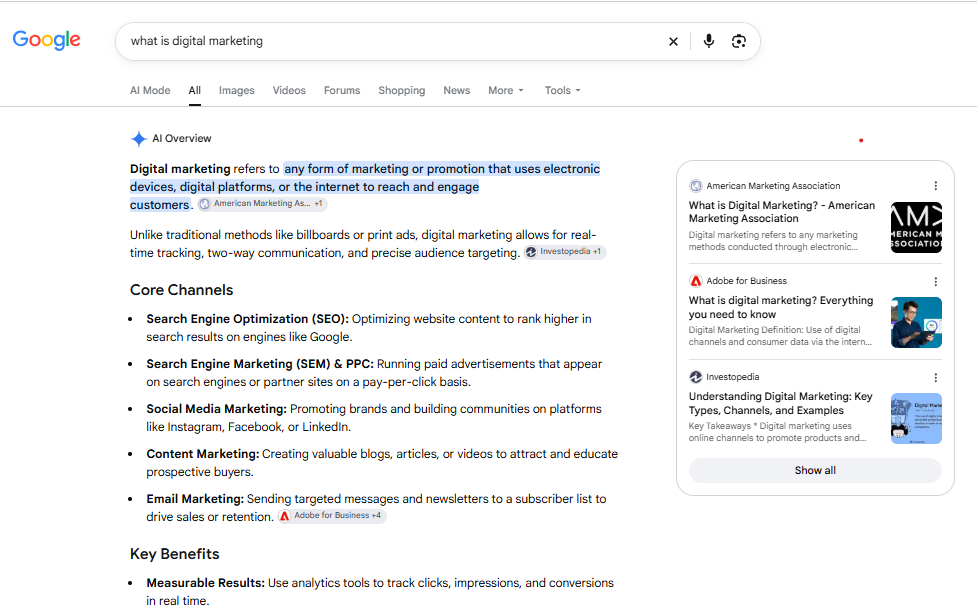
Google AI Overviews appear at the top of the search results for selected queries when Google’s systems determine that an AI-generated explanation can be useful to the user. They do not appear for every search, and their presence can vary depending on the query, language, location, device, and Google’s ongoing changes to Search.
AI Overviews are particularly useful for searches that require explanation, comparison, multiple pieces of information, or a combination of related concepts. For example, a query such as “How does topical authority improve SEO?” may benefit from a summarized explanation before the user explores individual webpages.
AI Overviews Are Not Limited to Informational Searches
AI Overviews were originally more strongly associated with informational searches, such as questions, definitions, and how-to queries. However, their presence has expanded into other types of search intent.
For example, users may encounter AI Overviews when searching for:
- What is technical SEO?
- How does semantic SEO work?
- Best SEO tools for small businesses
- SEO vs PPC
AI Overviews Can Vary by Location and Language
The availability and behavior of AI Overviews can depends across countries, languages, devices, and search experiences. Google has expanded AI-powered search features internationally, but users should not assume that the same query will produce an identical AI Overview everywhere.
This matters for international SEO because a website may receive AI Overview visibility for a particular query in one market while seeing a traditional SERP in another.
How Does Google AI Overviews Work?
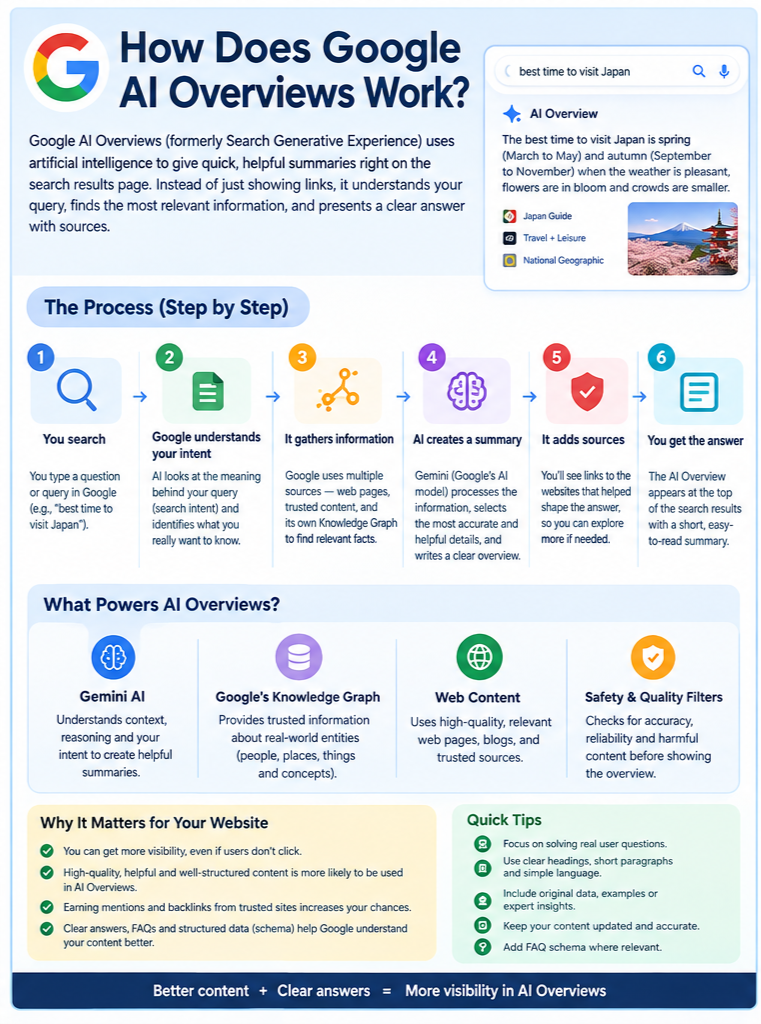
Google search and AI System works together to provide a summarise answer to the users. Instead of showing multiple blue links headings in results, Google AI work process try identify the relevant information, combine useful context, and present an AI-generated overview with attached sources links.
Optimizing content for Google AI Overviews does not require a separate SEO system or a special type of AI markup.
Google’s current guidance states that the same foundational SEO practices used for Google Search also apply to AI Overviews and AI Mode. A page must be indexed and eligible to appear in normal Google Search before it can be considered as a supporting link in these AI experiences.
Make Your Website Crawlable and Indexable
The first requirement is technical. Google must be able to discover, crawl, process, and index your content.
Check that:
- Googlebot is not blocked by robots.txt
- Important pages are indexable
- Pages return a successful HTTP status
- Important content is accessible without problematic rendering
- Internal links help Google discover important pages
- Canonical tags are correctly implemented
- Your XML sitemap contains important URLs
- No accidental noindex directives are blocking pages
Match Search Intent
Search intent is the reason behind a user’s search query—the specific information, solution, product, or action the user is looking for when they type something into a search engine.
Focus On Longtail Keywords
Longtail Keywords Optimization may be helpful for AI overview appearances, Its helps to answer users specific query.
For Example: If any one search for a longtail keyword like “Best practices for SEO” Google will show an AI Overview.
If a highly specific search query is closely related to your business, being featured in a Google AI Overview can help increase your visibility among users who are actively looking for that information.
This can bring highly relevant traffic to your website and introduce your brand to potential customers. Even when users do not click immediately, appearing as a source in an AI Overview can increase brand awareness, credibility, and the likelihood of future visits.
Helpful Content
In the new era of modern SEO, quality criteria is not simply about writing a long blogs or article or adding keywords. The content should satisfy search intent, more knowledge, provide original value, and answer the user’s needs better than a basic or repetitive page.
Key practices include:
- Understand Search Intent – Know what the user actually wants.
- Research the Topic – Use reliable and up-to-date sources.
- Cover the Topic in Depth – Explain important related concepts and questions.
- Add Original Value – Include unique examples, research, experience, data, or insights.
- Use Clear Structure – Organize content with useful headings, paragraphs, lists, and tables.
- Write Naturally – Use simple, easy-to-understand language.
- Support Important Claims – Use trustworthy sources and evidence.
- Use Internal Links – Connect relevant pages to build topical relationships.
- Keep Content Updated – Refresh outdated facts, links, and information.
- Optimize for Users and Search – Make the page readable, crawlable, mobile-friendly, and technically sound.
Good Improve the User Experience
A good user experience helps visitors find information quickly, understand the content easily, and navigate the website without frustration.
Key ways to improve UX:
- Page Speed – Make pages load quickly, especially on mobile devices.
- Use Clear Navigation – Keep menus and categories simple and easy to understand.
- Make Content Scannable – Use short paragraphs, headings, bullet points, and tables.
- Optimize for Mobile – Ensure the website works properly on smartphones and tablets.
- Use Clear CTAs – Tell users what to do next, such as Read More, Buy Now, or Contact Us.
- Improve Readability – Use suitable font sizes, spacing, and clear language.
- Add Relevant Internal Links – Help users easily discover related information.
- Avoid Intrusive Elements – Limit excessive pop-ups, ads, and distracting elements.
- Use Helpful Visuals – Add images, diagrams, videos, or charts when they improve understanding.
- Fix Broken Pages and Links – Regularly check for 404 errors and other navigation problems.
Create Quality Content
Creating high-quality content can improve a website’s chances of being considered for Google AI Overviews because Google aims to surface information that is useful, reliable, relevant, and trustworthy. However, simply writing a long article or adding more keywords does not make content high quality. The content should genuinely help users answer their questions and solve their problems.
To create content that meets these expectations, the following factors should be considered:
Accurate and Reliable Information
Content should be factually correct and based on trustworthy information. Important claims, statistics, and industry facts should be checked before publication and supported with reliable sources such as official documentation, research papers, government websites, and respected industry studies. Accuracy becomes especially important when information can influence a user’s decisions.
Original and Useful Information
Content should offer something beyond what is already available on competing pages. Original research, practical examples, expert opinions, case studies, first-hand experience, unique data, and detailed analysis can make an article more useful. Simply rewriting information from other websites may provide little additional value.
Demonstrate Real Expertise
Content becomes more trustworthy when it reflects genuine knowledge and experience. Subject-matter experts can contribute by reviewing information, providing insights, sharing practical examples, or explaining complex topics from their professional experience. Author information and appropriate references can also help readers understand where the information comes from.
Focus on User Needs
The primary purpose of content should be to help the audience. Before creating an article, the website should identify the user’s search intent, questions, concerns, and problems. The content should provide direct answers first and then offer deeper explanations, examples, and practical guidance where necessary.
Make Content Easy to Read
Even detailed information should be easy to understand. Short paragraphs, descriptive headings, bullet points, tables, examples, and relevant visuals can make content easier to scan. Complex topics should be explained in simple language without removing important technical details.
Keep Information Fresh
Information can become outdated as industries, technologies, regulations, products, and best practices change. Important pages should therefore be reviewed periodically. Outdated statistics, broken links, old examples, and inaccurate information should be replaced when necessary. Updates should improve the usefulness of the page rather than simply changing its publication date.
Provide More Than Basic Information
Strong content should answer the main question while also addressing closely related questions a user may have. For example, an article about AI Overviews can explain what they are, how they work, when they appear, how websites can optimize for them, and what factors may influence visibility. This creates a more complete resource instead of answering only one narrow question.
Follow a User-First Approach
The overall goal should not be to write content solely for search engines or AI systems. Content should first be created for people. When a page is accurate, useful, original, well-structured, easy to understand, and aligned with search intent, it has a stronger foundation for performing in both traditional search results and AI-powered search experiences.
Optimize On-Page SEO Elements
Strong on-page SEO helps search engines understand what a webpage is about and determine which searches it may be relevant for. It also makes the page easier for users to understand and navigate. When optimizing content for traditional search as well as AI-powered search features, the focus should be on creating a clear relationship between the page topic, the user’s search intent, and the information provided on the page.
Several on-page elements are particularly important:
Title Tag
The title tag tells search engines and users what the page is about. It can appear in search results and in the browser tab. A good title should clearly describe the page and naturally include the primary topic or keyword.
For example, instead of using a vague title such as “SEO Guide,” a more descriptive title could be “Technical SEO: Complete Guide for Beginners.”
Meta Description
A meta description briefly explains what users can expect from the page. Although it is not a direct Google ranking factor, a useful and relevant description can make the search result more appealing and potentially improve clicks.
It should accurately summarize the page rather than simply repeating keywords. Each important page should ideally have a unique description.
URL Slug
A URL should be short, readable, and descriptive. A clean URL helps users understand the page topic before opening it.
For example:
example.com/technical-seo-guide
is clearer than:
example.com/page?id=12345
Avoid unnecessary words, numbers, and complicated URL structures whenever possible.
Heading Structure
Use H1, H2, and H3 headings to organize the content logically. The H1 should describe the main topic, while H2 and H3 headings should divide the subject into meaningful sections.
Headings should describe what each section actually covers. Keywords can be included naturally when they fit the context, but headings should not be written simply to insert keywords.
Keywords and Related Terms
Use the main keyword naturally throughout the page, but don’t repeat it unnecessarily. Search engines can understand related words, concepts, entities, and the context surrounding a topic, so content should cover the subject naturally rather than relying on exact-match keyword repetition.
For example, an article about technical SEO may naturally discuss crawling, indexing, rendering, XML sitemaps, canonical tags, robots.txt, and website architecture.
Internal Linking
Add relevant internal links to other pages on the website. These links help users discover additional information and help search engines understand how different pages are related.
For example, an article about technical SEO could naturally link to detailed resources about crawling, indexing, Core Web Vitals, and XML sitemaps.
Image Optimization
Images should support the content rather than simply decorate the page. Use descriptive file names and relevant alt text where appropriate. Compress images to avoid unnecessary page-weight and ensure important visuals are accessible to users.
Content Readability
On-page optimization also includes the way information is presented. Use short paragraphs, descriptive headings, bullet points, tables, and clear language where they improve readability.
The goal is not to optimize every element for a search engine in isolation. The goal is to create a page where search engines can clearly understand the topic and users can easily find and understand the information they need.
Build Relevant Backlinks and Brand Mentions
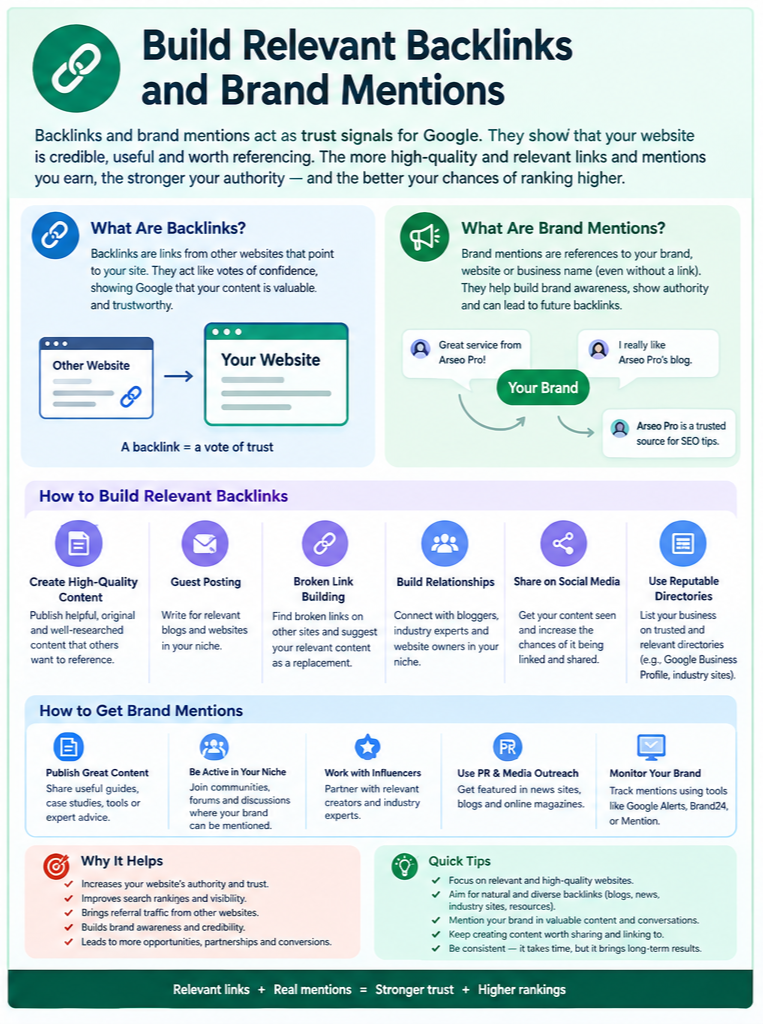
Building relevant backlinks and brand mentions can strengthen a website’s credibility and help search engines understand its reputation within a particular subject or industry. Backlinks are links from other websites pointing to a webpage, while brand mentions occur when a business, website, product, or author is discussed online, even when no direct link is included.
Earn Relevant Backlinks
The priority should be on earning high-quality and relevant backlinks, rather than simply collecting a large number of links. A link from a trusted website within the same industry or topic can be more meaningful than many links from unrelated or low-quality websites.
Useful ways to earn backlinks include:
- Publishing original research and data
- Creating useful industry studies or reports
- Producing detailed guides and resources
- Contributing expert insights to reputable publications
- Digital PR and journalist outreach
- Creating original statistics or surveys
- Developing useful tools, calculators, or resources
- Building relationships with relevant industry websites
For example, an SEO website that publishes an original study about search behavior may naturally attract links from marketing publications, researchers, and other SEO websites.
Build Brand Mentions
Brand mentions can help increase online visibility and recognition. A website can earn mentions through interviews, expert contributions, industry discussions, podcasts, news coverage, events, social media discussions, and other relevant online platforms.
The goal should be to build a consistent presence across websites and platforms that are genuinely relevant to the brand’s subject area.
Focus on Relevance and Trust
However, not every backlink or mention provides the same value. Links from unrelated, spammy, or low-quality websites should not be pursued simply to increase link numbers. A stronger approach is to build relationships with relevant, reputable, and trustworthy sources.
Consistent mentions and references from credible sources can help establish a website as a recognizable participant within its industry.
Avoid Manipulative Link Building
Buying large numbers of backlinks, participating in link schemes, using automated link networks, or creating links solely to manipulate rankings can create SEO risks. Link building should focus on earning genuine references because the content is useful, rather than manufacturing links.
Combine Backlinks With Strong Content
Backlinks work best when they support an already useful website. High-quality content gives other websites a reason to reference and link to the source.
How to Build Brand Mentions
Brand mentions are created when other websites, publications, social platforms, communities, or people talk about a brand online. They can happen naturally when a business consistently publishes useful content and provides valuable products or services. However, businesses can also actively create opportunities for more mentions by building relationships with relevant publishers, experts, and online communities.
A strong brand-mention strategy focuses on earning attention rather than simply asking for mentions. When a brand provides original information, expert knowledge, useful data, or something genuinely interesting to discuss, other websites have a stronger reason to reference it.
Key strategies include:
- Publish Original Research – Share surveys, studies, statistics, and unique data that others can reference.
- Share Expert Insights – Contribute useful opinions to journalists, industry publications, and expert roundups.
- Be Active Online – Participate genuinely in relevant social media platforms, forums, and communities.
- Partner With Other Brands – Create joint content, webinars, studies, or campaigns with complementary businesses.
- Create Shareable Content – Publish guides, case studies, tools, reports, and original resources worth mentioning.
- Encourage Reviews – Customer reviews, testimonials, and stories can naturally increase brand visibility.
- Monitor Brand Mentions – Track where the brand is mentioned and identify opportunities for relevant links or further exposure.
Frequently Asked Questions About Google AI Overviews
What are Google AI Overviews?
Google AI Overviews are AI-generated summaries that can appear in Google Search for certain queries. They provide a quick explanation of a topic and may include links to webpages that support or expand on the information.
How are AI Overviews different from traditional Google search results?
Traditional search results primarily show a list of webpages, while an AI Overview can summarize information from multiple sources into a conversational response. Users can still access supporting webpages and continue their search through the regular results.
Do AI Overviews appear for every Google search?
No. AI Overviews do not appear for every query. Their availability can vary depending on the search query, language, location, device, and Google’s search systems.
Can a website rank in an AI Overview without ranking first on Google?
Yes. Being the top organic result is not a requirement for every webpage that appears as a supporting source in an AI Overview. However, the page generally needs to be indexed and eligible to appear in Google Search.
How can SEO help a website appear in AI Overviews?
Strong SEO fundamentals can improve a website’s eligibility for search visibility. Important areas include crawlability, indexability, search intent, useful content, clear page structure, internal linking, and relevant authority signals.
Is there a special schema markup for Google AI Overviews?
There is no special AI Overview schema that guarantees visibility. Website owners should continue using appropriate technical SEO practices and structured data where it accurately describes the content on the page.
Do long-tail keywords help with AI Overview visibility?
Long-tail keywords can help a page address specific questions and search intents more precisely. However, using long-tail keywords does not guarantee an AI Overview or inclusion as a source.
Does appearing in an AI Overview increase website traffic?
It can increase visibility and may lead to additional visits, but traffic is not guaranteed. The impact depends on the query, the information shown in the AI Overview, user intent, and whether users choose to visit the supporting webpage.
Can AI-generated content rank in Google AI Overviews?
AI-generated content can appear in search when it meets Google’s quality and spam policies. However, using AI alone does not provide a ranking advantage. Content should be accurate, useful, original, and created primarily to help users.
What type of content is more useful for AI-powered search?
Content that directly satisfies search intent, provides accurate information, explains concepts clearly, and adds original value can be useful for AI-powered search. Practical examples, first-hand experience, original research, data, and expert insights can make content more valuable.
Does E-E-A-T affect visibility in AI Overviews?
E-E-A-T—Experience, Expertise, Authoritativeness, and Trustworthiness—is part of Google’s broader approach to evaluating quality. It is not a separate AI Overview ranking factor or a specific optimization technique, but demonstrating credibility can strengthen the overall quality of a website.
How do I check whether my website appears in AI Overviews?
You can monitor your Google Search visibility and search specific queries related to your website. Search results can vary by location, language, device, and time, so a single manual search does not provide a complete picture of AI Overview visibility.
Can optimizing for AI Overviews replace traditional SEO?
No. AI Overview optimization should not replace traditional SEO. Technical SEO, helpful content, search intent, internal linking, website usability, and relevant authority signals remain important foundations for search visibility.
Should I create separate content specifically for AI Overviews?
Usually, there is no need to create a separate version of a page specifically for AI Overviews. A better approach is to improve the existing content so it clearly answers user questions, provides useful context, and follows strong SEO fundamentals.
How can I improve my chances of being cited in AI-powered search?
Focus on creating content that is genuinely useful, accurate, well-structured, and distinctive. Strengthen the page’s technical accessibility, answer important user questions directly, support claims with reliable sources, and add information that competitors do not provide.
4 Comments