What Is Off-Page SEO?
Off-page SEO covers the work process of outside for website to improve its reputation, authority, and ability to rank in search results.
On-page SEO is mainly about what happens on website— content, keywords, internal links, headings, site structure, and technical setup. Off-page SEO is different. It focuses on how your website is talked about, referenced, and connected to the wider web.
The biggest part of off-page SEO is earning backlinks. When a relevant and trustworthy website links to one of web pages, it can act as a signal that web content is useful or credible. But not every backlink has the same value. A link from an authoritative website in the same industry can be far more useful than dozens of unrelated or low-quality links.
Off-page SEO can also involve:
- Digital PR: Getting website brand, research, experts, or content featured by online publications.
- Brand mentions: Encouraging people to talk about business or website, even when they do not always include a link.
- Guest contributions: Publishing useful content on relevant websites to build exposure and relationships.
- Content promotion: Getting your best content in front of publishers, communities, influencers, and people who may naturally reference it.
- Social media: Sharing content and building an audience that can increase its reach and the chances of earning natural mentions and links.
- Online reputation: Building positive reviews, discussions, and references around your brand.
- Local citations: Keeping business information consistent across relevant directories and local platforms.
The important point is that off-page SEO is not simply a process of collecting as many backlinks as possible. Relevance, quality, context, and the reputation of the source matter. Buying links, creating artificial link networks, or repeatedly placing links on unrelated websites can create risks instead of building long-term authority.
A better approach is to create something worth referencing and then build relationships and visibility around it. Useful research, original data, expert opinions, genuinely helpful resources, and strong digital PR can all give other websites a reason to mention or link to your content.
Think of it this way: on-page SEO explains what your website offers, while off-page SEO helps build the reputation that supports its credibility across the web.
This version should feel more natural and less formulaic, while still being professional enough for an SEO-focused website.
Here’s a more natural, detailed rewrite in the same format. I’ve also added a comparison table because it makes the difference much easier to understand.
On-Page SEO vs. Off-Page SEO
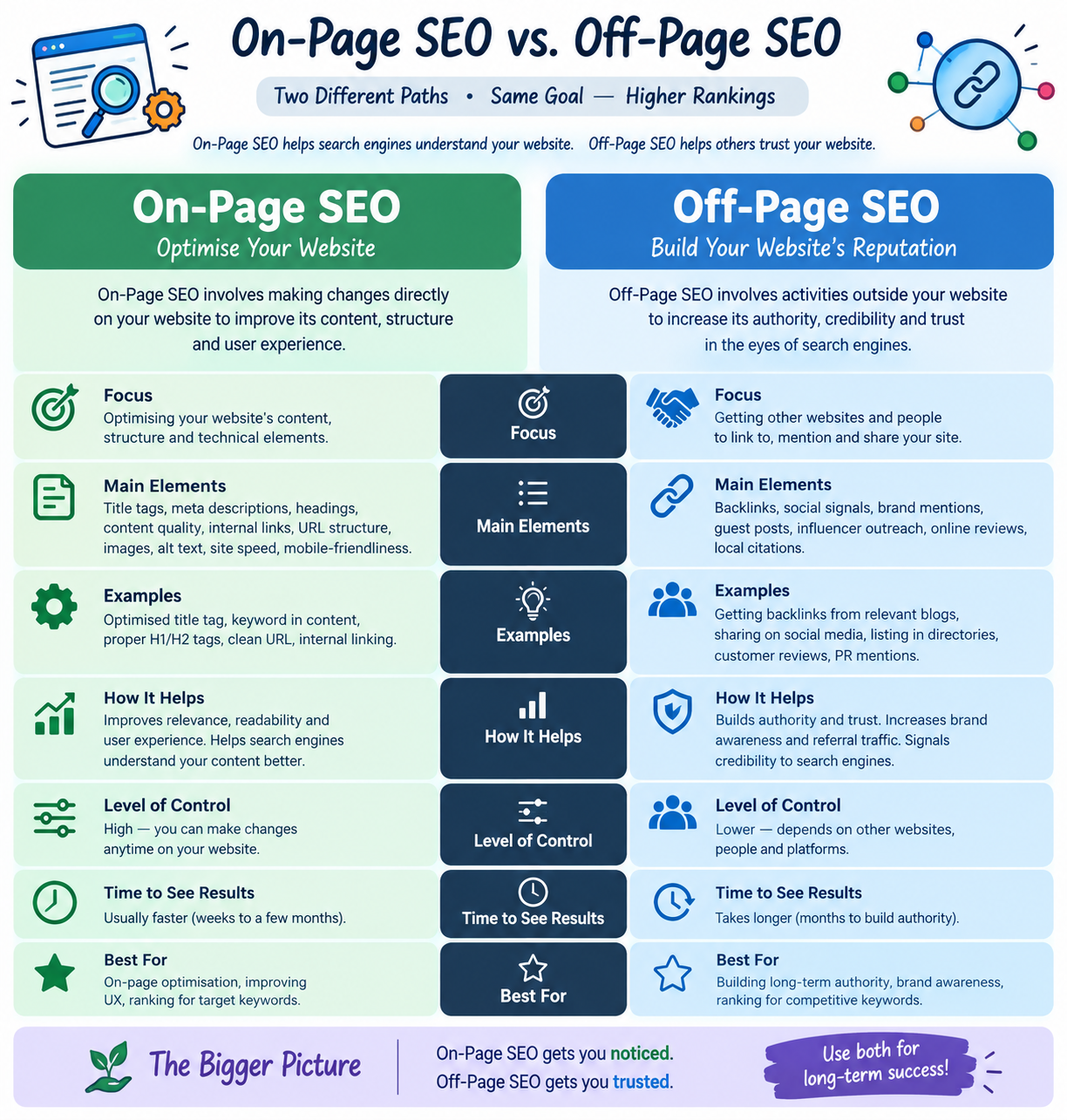
On-page SEO and off-page SEO are two core parts of a complete SEO strategy. They work together, but they focus on different areas of search optimization.
On-page SEO deals with the elements that can control directly on the website. This includes web content, headings, keywords, title tags, meta descriptions, internal links, URLs, images, page structure, and other elements that help search engines understand and evaluate a page.
Off-page SEO, in contrast, focuses on signals that come from outside website. Its purpose is to build your website’s reputation, trust, and visibility across the wider web. Backlinks are an important part of this, but off-page SEO can also include brand mentions, digital PR, citations, reviews, and content promotion.
Key Differences Between On-Page and Off-Page SEO
| Factor | On-Page SEO | Off-Page SEO |
| Main focus | Optimizing your website | Building authority outside your website |
| Where it happens | On your own website | On other websites and online platforms |
| Main goal | Help search engines understand and rank your pages | Build trust, authority, and reputation |
| Level of control | Mostly under your control | Depends on external websites and audiences |
| Content | Creating and optimizing useful content | Promoting content so others discover and reference it |
| Keywords | Using relevant keywords naturally in content and HTML elements | Keywords are less central; relevance and context of external references matter more |
| Links | Internal links connecting your own pages | Backlinks from other websites |
| Common activities | Title tags, headings, content optimization, internal linking, image optimization | Link earning, digital PR, brand mentions, citations, reviews |
| Main signals | Content quality, relevance, structure, usability | Backlinks, mentions, reputation, and external references |
Yes. I’d keep the same educational structure, but make the wording more natural, add a little more SEO depth, and avoid relying on the original article’s specific statistics or example. A table is useful here for separating the main ways off-page signals can help.
Why Does Off-Page SEO Matter for Search Engine Rankings?
Ranking well in search results is not only about how well optimize website. Search engines also look at signals from outside website to understand its reputation, relevance, and authority.
For example, if several relevant and trustworthy websites reference content, link to your pages, or mention your brand, it can provide additional context about your website. These signals can support ability to compete for valuable search queries.
Off-page SEO matters for several reasons:
- Build website authority and trust
- Earn quality backlinks
- Increase brand visibility
- Drive referral traffic
- Strengthen online reputation
- Support higher search rankings
Here’s a shorter version that keeps the important information and sounds more natural:
Improve E-E-A-T
Google’s Search Quality Rater Guidelines highlight Experience, Expertise, Authoritativeness, and Trustworthiness (E-E-A-T) when evaluating content quality. While E-E-A-T is not a single ranking factor, building these qualities can help establish your website as a credible source.
Off-page SEO can support E-E-A-T by building reputation beyond website. Industry mentions, expert interviews, podcasts, webinars, guest contributions, reviews, and links from reputable websites can demonstrate expertise and strengthen your authority.
The focus should be on earning genuine recognition rather than creating artificial signals. A strong reputation, supported by relevant mentions and trustworthy sources, can improve how users and google perceive website.
Effective Off-Page SEO Strategies
Off-page SEO includes the activities you carry out outside your website to build authority, earn trust, increase visibility, and attract relevant traffic. While backlinks remain an important part of off-page SEO, a strong strategy also includes content promotion, digital PR, brand mentions, reviews, and relationship building.
The most effective approach is to focus on earning recognition naturally rather than trying to manipulate search rankings. Below are some practical off-page SEO strategies and how you can use them.
Content Marketing
Content marketing is an important part of off-page SEO because useful content can attract attention and encourage other websites and people to reference work.
The process starts with creating original, useful, and audience-focused content that answers real questions or provides information people want to share. Once published, promote it through relevant channels such as industry communities, social platforms, email outreach, digital PR, and professional networks.
Content Marketing Platforms for Off-Page SEO
-
Medium: Publish informative articles and industry insights.
-
LinkedIn: Share professional content, research, and industry updates.
-
YouTube: Publish educational videos and tutorials.
-
Quora: Answer relevant questions and share useful information.
-
Reddit: Participate in relevant discussions and provide genuine value.
-
Pinterest: Share infographics, guides, and visual content.
Guest Posting
Guest posting is the practice of writing and publishing useful content on another relevant website. It can help reach a new audience, build industry relationships, earn relevant backlinks, and strengthen your brand’s authority.
The key is to focus on relevance and value, rather than publishing on as many websites as possible. A well-written article on a respected website within industry is generally more valuable than publishing low-quality content across unrelated sites.
Guest posting can help you:
- Reach an audience that may not know your brand yet
- Earn relevant referral traffic
- Build relationships with publishers and industry professionals
- Demonstrate your expertise on a specific subject
- Increase brand visibility and recognition
- Earn editorially relevant backlinks when the publisher chooses to include them
To find opportunities, look for websites that regularly publish contributions from external authors. Anyone can use Google search operators to narrow your search by combining your topic or niche with phrases such as “write for us”, “guest post”, “contribute”, or “become a contributor”.
Webinars and Podcasts
Appearing on industry podcasts or hosting webinars can help showcase business knowledge, connect with a relevant audience, and strengthen brand’s online presence. These platforms can also lead to brand mentions, referral traffic, and relevant backlinks when hosts, participants, or other websites reference work.
Podcasts are particularly useful for building personal and brand authority because they allow you to discuss industry topics, answer questions, and share practical experience. Webinars provide a similar opportunity while allowing you to give deeper explanations, demonstrate expertise, and interact directly with your audience.
To maximize their SEO and marketing impact:
- Collaborate with relevant experts: Invite industry professionals or appear on established podcasts to reach new audiences and build credibility.
- Choose relevant topics: Focus on questions, problems, and trends that your target audience actually cares about.
- Promote each session: Share webinars and podcast appearances through social media, newsletters, communities, and your website.
- Earn useful mentions: Provide valuable insights or original data that publishers and participants may reference in their own content.
- Repurpose the material: Turn recordings into blog posts, short videos, expert quotes, FAQs, social posts, or infographics to extend their reach.
- Build relationships: Stay connected with hosts, speakers, and participants. Long-term relationships can lead to future collaborations, interviews, mentions, and content opportunities.
User-Generated Content (UGC) (Forums Like Reddit & Quora)
Participating in relevant discussions on platforms such as Reddit and Quora can help businesses build visibility, demonstrate expertise, and connect with people who are actively looking for answers. When done properly, forum participation can also bring referral traffic and increase brand awareness.
The goal is not to drop links or promote your business in every conversation. Instead, focus on being genuinely helpful. Answer questions with useful information, share practical examples, explain complex topics clearly, and contribute to discussions where have relevant knowledge.
Best practices for UGC include:
- Give useful, detailed answers
- Avoid unnecessary self-promotion
- Share relevant resources
- Stay consistent
- Follow community rules
- Focus on the audience
Repurposing Content
Content repurposing means taking useful information have already created and adapting it into different formats for other platforms. Instead of creating completely new content every time, it can reuse existing ideas to reach people who prefer different types of content.
For example, a detailed blog post can be turned into a video, podcast, social media post, infographic, or presentation. This can extend the lifespan of content, increase its reach, and create more opportunities for people to discover and share brand.
To Repurpose Content Effectively:
- Turn blog posts into videos: Explain key points with visuals and narration.
- Create podcast episodes: Expand on your blog topics through audio discussions.
- Share social media posts: Convert key takeaways into LinkedIn posts, X threads, or Instagram carousels.
- Create infographics: Present data, tips, or processes visually.
- Make slideshows: Turn important points into simple presentation-style content.
Social Media
Social media can support off-page SEO by increasing brand visibility, content reach, referral traffic, and online recognition. Although social signals such as likes and followers are not direct Google ranking factors, active social profiles can help more people discover your content and create opportunities for natural mentions and links.
Google can also show social content in search results for certain queries, while local businesses can add links to their social profiles through their Google Business Profile.
Influencer Marketing
Influencer marketing can support off-page SEO by helping brand reach a relevant audience and build credibility outside the website. Working with trusted influencers and industry experts can lead to brand mentions, referral traffic, content shares, and natural backlinks.
The most effective approach is to work with influencers whose audience closely matches target market. A smaller niche influencer with strong engagement can often be more valuable than someone with a large but unrelated following.
How to Use Influencer Marketing for Off-Page SEO:
- Partner with relevant influencers: Choose creators with an engaged niche audience.
- Create useful content: Collaborate on reviews, videos, interviews, or guest posts.
- Earn mentions and links: Encourage natural references to your website or content.
- Build trust: Use genuine expert recommendations to strengthen your brand reputation.
Link Building
Link building is one of the most important parts of off-page SEO. It involves earning links from other websites to pages own site. These links can help search engines discover content while also acting as signals of relevance and credibility, especially when they come from reputable websites within your industry.
However, successful link building is not about collecting as many links as possible. The quality, relevance, context, and editorial nature of a backlink matter more than the raw number of links. A relevant link from a trusted industry website can be much more valuable than a large number of unrelated or low-quality links.
A few effective off-page link-building strategies include:
Here’s a more detailed version in the same natural, professional style:
Digital PR
Digital PR is the practice of earning online media coverage, brand mentions, and authoritative backlinks by creating newsworthy stories and building relationships with journalists, publishers, and industry websites. Unlike traditional PR, digital PR places more emphasis on online visibility and creating content that people and publications have a reason to reference.
A successful digital PR campaign usually starts with something genuinely interesting or useful, such as original research, surveys, industry data, expert commentary, reports, or unique insights. The goal is to give journalists and publishers a strong reason to cover your story rather than simply asking them to promote your website.
A few effective ways to implement digital PR include:
Effective digital PR tactics include:
- Publish original research: Create surveys, studies, reports, or useful statistics.
- Offer expert insights: Provide relevant quotes and opinions to journalists.
- Use newsjacking: Share timely insights on trending or breaking topics.
- Create link-worthy content: Develop data, tools, guides, or visuals that publishers want to reference.
- Personalize outreach: Pitch relevant stories to journalists and publications rather than sending mass emails.
Brand Mentions
Brand mentions are references to a business, website, product, or person on other websites, even when they do not include a backlink. While unlinked mentions do not pass link equity, they can still help build brand awareness, credibility, and online reputation.
Brand mentions can support off-page SEO by:
- Building credibility: References from relevant and trusted sources can strengthen your brand’s reputation.
- Increasing visibility: More mentions can help people discover your brand across the web.
- Driving traffic: Mentions on popular websites can generate referral visits, even without a link.
- Supporting authority: Consistent recognition across relevant sources can reinforce your presence within a topic or industry.
To increase brand mentions:
- Build relationships with bloggers and influencers.
- Monitor mentions with tools like Google Alerts.
- Ask relevant sites to add a link where appropriate.
- Create content worth mentioning and sharing.
Broken Link Building
Broken link building is an off-page SEO technique where web owners find broken or inactive links on relevant websites and suggest web-own useful content as a replacement. It benefits both sides: the website owner can fix a poor user experience, while you may earn a relevant backlink.
Steps to implement:
- Find broken links: Use tools such as Moz Link Explorer or Ahrefs Link Checker to identify relevant broken backlinks or pages.
- Check relevance: Make sure your content genuinely matches the topic and purpose of the broken link.
- Contact the site owner: Politely explain the broken link and suggest your resource as a replacement.
- Provide useful content: Make sure your page offers equal or greater value than the original resource.
HARO and Journalist Requests
Platforms that connect journalists with industry experts can help businesses gain media exposure, brand mentions, and relevant backlinks. By responding to journalist requests with useful expert insights, you may earn coverage on reputable news websites and industry publications.
Best practices include:
- Give valuable answers: Provide clear, original, and well-supported insights.
- Respond quickly: Journalists often work with short deadlines.
- Stay relevant: Only respond to requests that match your expertise.
- Build relationships: Keep track of successful contributions and maintain professional media contacts.
Local SEO
Local SEO helps businesses improve their visibility in search results for customers in a specific area. It is especially useful for restaurants, shops, hotels, clinics, and local service providers that depend on nearby customers.
Off-page local SEO focuses on signals outside the website, such as reviews, local citations, business directories, and mentions from relevant local websites.
Local Reviews
Customer reviews can influence how people perceive a business and are an important part of local search visibility. Positive, genuine reviews on platforms such as Google and relevant industry directories can build trust and encourage potential customers to choose business.
Ways to generate better local reviews:
- Ask happy customers for honest reviews.
- Respond professionally to both positive and negative feedback.
- Keep business profiles accurate and up to date.
- Make it easy for customers to leave a review.
- Never buy or create fake reviews.
- Use genuine customer feedback to strengthen reputation.
Here’s a more detailed but still concise version, matching the style of your Local SEO section:
Local Citations
Local citations are online mentions of business, usually including its name, address, and phone number (NAP). They can appear on business directories, map platforms, review sites, local websites, blogs, and industry-specific platforms.
Consistent and accurate citations make it easier for customers to find your business and help search engines understand that your business information is reliable. Citations can be structured, such as listings on Google, Yelp, or Apple Maps, or unstructured, such as a business mention in a local news article or blog post.
Ways to build and manage local citations:
- Keep your business name, address, and phone number consistent across platforms.
- List your business on relevant local and industry-specific directories.
- Claim and update profiles on platforms such as Google, Yelp, and Apple Maps.
- Find and correct duplicate or outdated listings.
- Use tools such as Moz Local to monitor and manage citations efficiently.
- Prioritize trusted, relevant directories instead of creating listings on low-quality sites.
Here’s a more concise, original version with the same structure and enough detail for an SEO guide:
Event Marketing
Event marketing uses online and offline events to increase brand visibility, build industry relationships, and create opportunities for mentions, referrals, and backlinks. Conferences, webinars, workshops, meetups, and community events can all support off-page SEO by putting your brand in front of relevant audiences.
Speaking Engagements
Speaking at conferences, webinars, panels, and industry events can establish expertise while creating opportunities for your website to be mentioned on event pages, speaker profiles, or related coverage.
To get more from speaking opportunities:
- Apply for relevant panels, conferences, and expert sessions.
- Ask organizers to include your website in your speaker profile.
- Share useful presentations, research, or resources with attendees.
- Connect with speakers, journalists, and industry professionals after the event.
Sponsorships and Partnerships
Sponsoring relevant events or partnering with organizations can expand reach and generate brand mentions, referral traffic, and relevant backlinks.
Effective approaches include:
- Sponsor relevant industry or community events.
- Partner with local organizations for joint campaigns.
- Collaborate with complementary businesses on events or content.
- Look for co-branding and media opportunities that naturally mention brand.
Best Off-Page SEO Tools
Off-page SEO tools help improve a website’s authority, backlink profile, brand visibility, and reputation across the web. They support activities such as backlink analysis, link building, competitor research, digital PR, brand monitoring, and local SEO.
The following table explains the main features, uses, and benefits of popular off-page SEO tools.
| Tool | Main Purpose | Key Features | How It Helps in Off-Page SEO | Best For |
|---|---|---|---|---|
| 1. Ahrefs | Backlink analysis and link building | Site Explorer, referring domains, anchor text analysis, competitor backlink reports, broken backlink research | Identifies websites linking to competitors, discovers link-building opportunities, and helps monitor backlink growth. | Backlink research and competitor analysis |
| 2. Semrush | Backlink auditing and competitor research | Backlink Analytics, Backlink Audit, Backlink Gap, authority metrics, link monitoring | Helps compare backlink profiles, discover relevant referring domains, identify potentially harmful links, and find new link-building opportunities. | Backlink audits and competitive link building |
| 3. Moz Link Explorer | Backlink profile analysis | Domain Authority (DA), linking domains, inbound links, anchor text, Spam Score | Helps evaluate linking websites, compare competitors’ link profiles, and identify potential backlink opportunities. | Link quality assessment and competitor research |
| 4. Google Search Console | Monitor website performance and links | Links report, top linking sites, top linked pages, search performance, indexing reports | Shows a sample of websites linking to your site and identifies pages that attract backlinks. It also helps monitor organic search performance. | Free backlink monitoring and website performance |
| 5. Google Alerts | Monitor online mentions | Keyword alerts, brand name tracking, competitor mentions, email notifications | Helps discover new brand mentions, industry discussions, and potential unlinked brand mentions that may lead to backlink opportunities. | Brand monitoring and link prospecting |
| 6. BuzzStream | Manage link-building outreach | Contact database, email templates, personalized outreach, follow-ups, campaign tracking | Organizes communication with bloggers, publishers, journalists, and website owners to build relationships and earn relevant backlinks. | Outreach management and digital PR |
| 7. Majestic | Analyze backlink quality and history | Trust Flow, Citation Flow, referring domains, backlink history, link profile analysis | Helps compare backlink profiles and assess the strength and quality signals of websites before pursuing link-building opportunities. | Detailed backlink intelligence |
| 8. Hunter | Find professional email addresses | Domain Search, Email Finder, Email Verifier, contact discovery | Helps find and verify professional contact details for relevant publishers, website owners, and outreach prospects. | Finding contacts for link building |
| 9. Pitchbox | Automate link-building campaigns | Prospect discovery, email sequences, contact discovery, follow-ups, campaign reporting | Helps manage outreach at scale, discover guest-post opportunities, pursue broken links, and track backlink acquisition campaigns. | Large-scale link building and agency campaigns |
| 10. Google Business Profile | Improve local business visibility | Business information, reviews, photos, opening hours, location details, customer interactions | Helps businesses manage their presence on Google Search and Maps, maintain accurate business details, and build trust through customer reviews. It supports local SEO rather than serving as a dedicated backlink tool. | Local SEO and reputation management |
| 11. Brand24 | Track brand mentions and online reputation | Web monitoring, social listening, sentiment analysis, reach analysis, alerts | Helps discover conversations about a brand, monitor competitors, identify PR opportunities, and find websites or publications discussing a business. | Brand reputation and digital PR |
| 12. Similarweb | Analyze competitors and market traffic | Website traffic estimates, engagement metrics, traffic sources, competitor comparisons, search intelligence | Helps identify competitors, understand referral traffic patterns, research competing websites, and discover potential partnership or promotion opportunities. | Competitor research and market analysis |
| 13. Screaming Frog | Crawl websites and audit SEO elements | Website crawling, response codes, redirects, broken links, page titles, metadata | Supports off-page SEO by checking backlink target pages, identifying broken URLs, and finding redirect issues that may affect link equity. | Technical audits supporting link building |
| 14. SEO Spider | Website crawling and technical analysis | URL crawling, broken-link detection, redirect analysis, canonical checks, metadata extraction | Helps identify technical problems on your own website and review linking pages during backlink audits. | Technical SEO and link maintenance |
Important note: Screaming Frog SEO Spider is the full name of the tool listed in rows 13 and 14. These are not two separate tools, so you can combine them into one entry in your final article.
Which off-page SEO tools should you use first?
| SEO Task | Recommended Tools |
|---|---|
| Backlink analysis | Ahrefs, Semrush, Moz Link Explorer, Majestic |
| Competitor backlink research | Ahrefs, Semrush, Moz Link Explorer |
| Finding link-building contacts | Hunter, BuzzStream, Pitchbox |
| Digital PR and brand mentions | Google Alerts, Brand24, BuzzStream |
| Local SEO | Google Business Profile |
| Competitor traffic research | Similarweb |
| Free backlink monitoring | Google Search Console |
| Broken-link and redirect checks | Screaming Frog SEO Spider |
Recommendation: For a practical off-page SEO workflow, start with Google Search Console for your own website’s link data, use Ahrefs or Semrush for competitor backlink research, and use Hunter or BuzzStream to manage outreach. Choose paid tools based on your budget and the size of your campaigns.
Frequently Asked Questions
What is off page seo strategy?
Off-page SEO strategy is a plan for activities outside your website—such as link building, digital PR, brand mentions, reviews, local citations, and content promotion to build authority, trust, visibility, and referral traffic and support better search rankings.
What is off-page SEO in digital marketing?
Off-page SEO in digital marketing refers to activities outside website that help build authority, trust, brand visibility, and search rankings. Common activities include link building, digital PR, brand mentions, social media promotion, online reviews, local citations, and influencer or industry outreach.
Is off-page SEO still relevant?
Off-page SEO is still important, but modern off-page SEO is about earning authority and trust—not simply collecting backlinks.
What Does “Off-Page” Mean?
Off-page SEO refers to all the activities performed outside your website to improve its search engine visibility, authority, credibility, and reputation. It focuses on building trust and recognition through external signals such as backlinks, brand mentions, social media engagement, online reviews, and digital PR. These activities help search engines understand how other websites and users perceive your website.
What Is the Difference Between On-Page SEO and Off-Page SEO?
On-page SEO and off-page SEO are two important parts of search engine optimization, but they focus on different areas. On-page SEO involves optimizing elements within your website, such as content, title tags, meta descriptions, headings, internal links, URLs, and images, to improve relevance and user experience. In contrast, off-page SEO focuses on activities outside your website, such as acquiring quality backlinks, building brand mentions, digital PR, and earning online reviews, to improve website authority, credibility, and reputation.
| On-Page SEO | Off-Page SEO |
|---|---|
| Focuses on website optimization. | Focuses on external website activities. |
| Improves content relevance. | Builds website authority and reputation. |
| Includes title tags and meta descriptions. | Includes backlinks and brand mentions. |
| Uses internal linking. | Uses external link building. |
| Improves user experience. | Builds online credibility. |
| Mostly controlled directly by website owners. | Depends partly on external websites and audiences. |
What’s the Difference Between On-Site and Off-Site SEO?
On-site SEO and on-page SEO are often used interchangeably because both focus on optimizing elements within a website. However, on-site SEO can be used as a broader term that includes content optimization, technical SEO, website structure, internal linking, page speed, and user experience.
Off-site SEO focuses on external activities that improve a website’s authority and online reputation, including link building, digital PR, brand mentions, and online reviews.
In simple words:
-
On-site SEO: Everything you optimize within your website.
-
Off-site SEO: Activities performed outside your website to build authority and credibility.
What Tools Are Best for Off-Page SEO?
Several SEO tools help professionals analyze backlinks, monitor referring domains, identify link-building opportunities, track brand mentions, and evaluate competitors’ off-page SEO strategies.
| SEO Tool | Main Purpose |
|---|---|
| Ahrefs | Backlink analysis, referring domains, competitor link research. |
| Semrush | Backlink audits, link-building opportunities, competitor analysis. |
| Moz Link Explorer | Domain Authority (DA), backlink analysis, spam score. |
| Majestic SEO | Trust Flow, Citation Flow, and backlink analysis. |
| Google Search Console | Monitor backlinks reported by Google and website search performance. |
| BuzzSumo | Content research, brand mentions, and influencer discovery. |
| Google Alerts | Monitor brand mentions and relevant online references. |
One Comment