
What is Topical authority in SEO?
Topical authority in SEO refers to the depth of knowledge and relevance a website demonstrates about a particular subject. It develops when a website consistently publishes accurate, useful, and well-connected content covering the main topic and its related subtopics.
For example, a website focusing on Search Engine Optimization (SEO) can build comprehensive topic coverage by publishing detailed guides about keyword research, technical SEO, on-page SEO, link building, search intent, and content optimization.
These articles should answer different user questions and connect through relevant internal links. This helps visitors explore related information and gives search engines additional context about the website’s content and subject focus.
Building topical authority is not about publishing hundreds of articles or repeating the same keywords. It is about creating a useful collection of content that demonstrates genuine knowledge, covers relevant search intent, and provides information that readers can trust.
Why It Matters for SEO and AI?
Topical authority plays an important role in SEO by helping websites build credibility and maintain visibility across search engines. Websites that consistently publish high-quality, relevant, and well-researched content can build stronger subject coverage and become more resilient to search engine algorithm updates.
It also supports visibility in AI-powered platforms, as answer engines such as ChatGPT and Google AI Overviews may reference information from reliable and comprehensive sources when generating responses. Additionally, covering a subject in depth helps demonstrate Experience, Expertise, Authoritativeness, and Trustworthiness (E-E-A-T), which strengthens user confidence and a website’s overall credibility.
What Is Topical Authority?
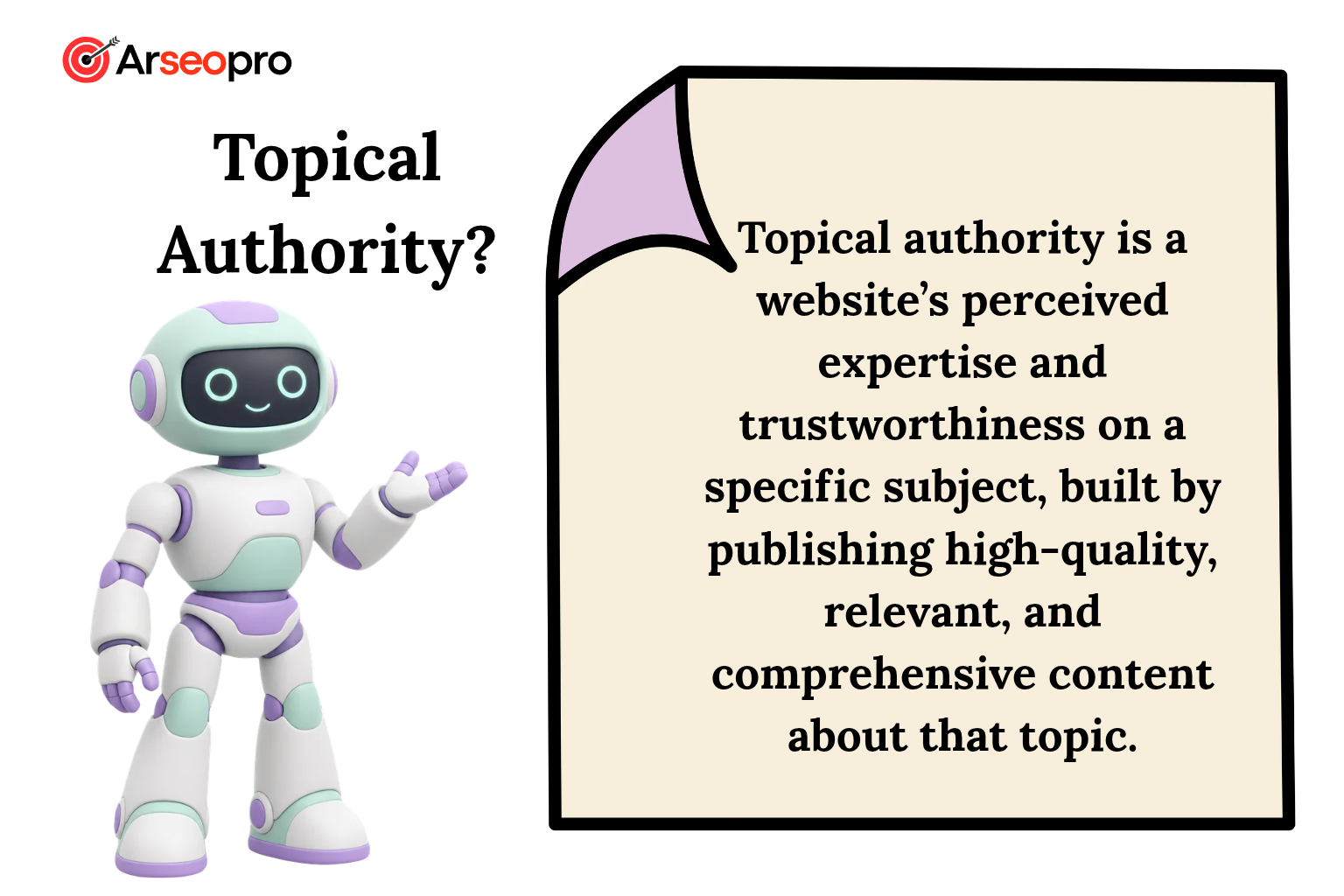
For example, a website that focuses on SEO will not limit its content to an article about “what is SEO.” It would also cover related areas such as keyword research, technical SEO, on-page SEO, link building, semantic SEO, local SEO, SEO analytics, search intent, crawling, indexing, and content optimization. This broader coverage gives search engines more context about the website’s subject matter and the relationships between different concepts.
Topical authority is built through comprehensive and connected content. Individual articles should not exist as isolated pieces.
Rather then, they should form a logical content structure in which a broad topic is supported by more detailed subtopics. Internal links can connect these pages, allowing users and search engines to move between closely related information.
Why Does Topical Authority Matter in SEO?
It really matters because it has the power to gain ranking in Google. Search engines does not rely on keywords or domain authority. They rely on deep knowledge of a particular subject for users’ needs.
Helps Google Understand Your Expertise
Topical authority helps Google understand how much knowledge and expertise a website has about a particular subject. When a website consistently publishes high-quality, relevant, and detailed content around one topic, it builds a strong connection between its pages.
By covering a subject from different angles and answering related user questions, a website shows search engines that it provides useful and reliable information about that topic. This can improve its chances of ranking for relevant search queries.
Helps You Rank for More Keywords
Topical authority helps a website rank for a wider range of relevant keywords related to its main topic. When a website covers a subject in depth, it naturally includes primary keywords, secondary keywords, and semantically related terms.
By publishing interconnected content that answers different user queries, a website can appear in search results for multiple related keywords. This increases its search visibility and creates more opportunities to attract organic traffic.
Building Content Relevance
Building Content Relevance means creating content that matches your audience’s needs, interests, search intent, and goals. To build relevant content, first understand audience’s problems, interests, and search behaviour.
Choose 3–4 main topics related to your business and create detailed articles around them.
Research relevant keywords and understand what users want to find before writing.
Provide clear, useful, and informative answers with relevant examples, images, and videos where needed. Also, update older articles regularly by correcting outdated information and adding fresh details. This helps keep web content useful for readers and relevant to search engines.
Supports Long-Tail Keyword Rankings
Topical authority helps a website rank for more long-tail keywords, which are specific and detailed search phrases. When a website covers a topic in depth, it naturally answers different questions related to that subject. This helps search engines understand the content better and match it with specific user searches. As a result, the website gets more opportunities to appear in search results, attract relevant visitors, and increase organic traffic.
Improves User Experience
Topical authority improves user experience by providing visitors with complete, relevant, and well-organized information about a topic. When a website covers a subject in depth and connects related articles through internal links, users can easily find answers to their questions without searching multiple websites.
This makes it easier for visitors to explore related information, understand the topic, and find what they are looking for. As a result, users can have a better experience and are more likely to spend time exploring the website.
Strengthens Overall SEO Strategy
Topical authority strengthens your overall SEO strategy by building your website’s expertise and relevance around a particular subject.
When regularly publish high-quality content, target related keywords, and connect articles through internal links, search engines can better understand your website’s content. It also helps improve keyword visibility, attract relevant organic traffic, and build trust with your audience. This creates a strong foundation for long-term SEO growth.
Topical Authority vs Domain Authority
Topical Authority and Domain Authority (DA) are related to SEO authority, but they measure very different points.
| Topical Authority | Domain Authority |
| Focuses on expertise in a specific topic. | Focuses on the overall strength of a website’s backlink profile. |
| Built through comprehensive, relevant content. | Built mainly through high-quality backlinks. |
| Shows how well a website covers a particular subject. | Estimates how well a website may compete in search results. |
| Uses related content, topic clusters, entities, and internal links. | Uses factors such as referring domains and backlinks. |
| Helps search engines understand a site’s topic relevance. | Helps SEO professionals evaluate link-based authority. |
| Can be developed by consistently covering a topic in depth. | Usually increases as a website earns more authoritative backlinks. |
| There is no single official Google Topical Authority score. | DA is a third-party metric, commonly associated with Moz. |
| Example: A website extensively covering digital marketing. | Example: A website with backlinks from many trusted industry websites. |
How to gain Topical Authority
1. Choose a Specific Topic & Conducting thorough keyword and entity research
Start with main topic and cover it deeply, for example: SEO (Search Engine Optimization).
Use tools like SEMrush, Aherf, Google keyword Research tools to identify the main questions mostly user search. Also find connected entities and their relation which is related to the topic.
2. Create a Pillar Page
Create a comprehensive page covering the main topic. A pillar pages has enough information of topic and full concept of user search views.
3. Build Topic Clusters
Create supporting articles around different subtopics.
For example:
- What Is Digital Marketing?
- SEO
- Content Marketing
- Social Media Marketing
- Email Marketing
- PPC Advertising
- Affiliate Marketing
- Influencer Marketing
- Digital Marketing Strategy
4. Cover Related Subtopics
Don’t focus only on your primary keyword. Cover closely related concepts, questions, entities, and user needs.
5. Match Search Intent
Create content based on what users actually want to know, Instead of focussing on keywords. Find keywords intent without following the words needs to focusses on Match Search Intent.
Common search intents include:
- Informational
- Navigational
- Commercial
- Transactional
6. Publish High-Quality Content
Focus on:
- Accurate information
- Original insights
- Clear explanations
- Useful examples
- Good content structure
- Updated information
7. Demonstrate Experience and Expertise
Show why the information can be trusted through first-hand experience, expert insights, reliable sources, author information, and accurate content where appropriate.
8. Keep Content Updated
Review important pages regularly and update outdated statistics, examples, links, recommendations, and information.
9. Build Relevant Backlinks
Earn backlinks from relevant and trustworthy websites. Links are not the same thing as topical authority, but they can strengthen the credibility and visibility of your content.
Example of Building Topical Authority for an SEO Website
Consider a website that publishes educational content about Search Engine Optimization. Instead of publishing random articles about different digital marketing topics, it can focus on SEO and organize its content into related topic clusters.
Main pillar topic: Search Engine Optimization
The pillar page can explain the fundamentals of SEO, including how search engines work, why SEO matters, and the major areas of optimization.
Supporting topic cluster: On-Page SEO
- What Is On-Page SEO?
- Title Tag Optimization
- Meta Description Optimization
- Heading Tag Optimization
- Image SEO
- Internal Linking
Supporting topic cluster: Technical SEO
- What Is Technical SEO?
- XML Sitemap
- Robots.txt
- Canonical Tags
- Website Crawling and Indexing
- Core Web Vitals
Supporting topic cluster: Content SEO
- What Is Content Optimization?
- What Is Search Intent?
- Keyword Research
- Semantic SEO
- Topical Authority
- Content Gap Analysis
Each supporting article should answer a specific question in detail and link to other relevant articles where appropriate. The main SEO guide should also link to these supporting resources.
This creates a connected content structure instead of a collection of unrelated blog posts. It helps visitors explore the subject and makes it easier for search engines to discover and understand relationships between the website’s pages.
How to Implement a Topic Cluster Architecture
A topic cluster is a group of closely related pages that work together to provide comprehensive coverage of a broader subject. At the center is a pillar page, which covers the main topic broadly. Around it are cluster pages, each focusing on a specific subtopic, question, or search intent. These pages are connected through relevant internal links.
1. Map Your Core Topics and Subtopics
Start by identifying the broad topics your website wants to be known for. These become pillar topics.
Then break each broad topic into smaller, closely related subtopics.
For example:
Pillar Topic: SEO
- What Is SEO?
- Keyword Research
- On-Page SEO
- Technical SEO
- Off-Page SEO
- Local SEO
- Semantic SEO
- SEO Analytics
- SEO Tools
You can break these down even further. For example:
Technical SEO
- XML Sitemap
- Robots.txt
- Canonical Tags
- Crawl Budget
- Core Web Vitals
- JavaScript SEO
- Duplicate Content
- Website Architecture
This creates a topic map that shows what content you need and how different subjects are connected.
It also prevents your content strategy from becoming a collection of unrelated articles.
2. Create a Strong Pillar Page
The pillar page should provide a comprehensive overview of the main topic.
It should explain the major concepts without trying to answer every question in extreme detail. Instead, it should link readers to more specific cluster pages for deeper information.
For example:
Pillar Page:
Complete Guide to SEO
It could introduce:
- Keyword Research
- On-Page SEO
- Technical SEO
- Link Building
- Local SEO
- Semantic SEO
Each section can link to a dedicated, detailed article.
3. Develop Detailed Cluster Content
Create individual pages for important subtopics within the pillar.
Each cluster page should have a clear purpose and distinct search intent.
For example: SEO → Technical SEO → Core Web Vitals
The Core Web Vitals article should focus specifically on Core Web Vitals rather than repeating the entire Technical SEO guide.
This creates depth within the overall topic while keeping individual pages focused.
4. Build a Strategic Internal Linking Structure
Internal linking is one of the most important parts of a topic cluster.
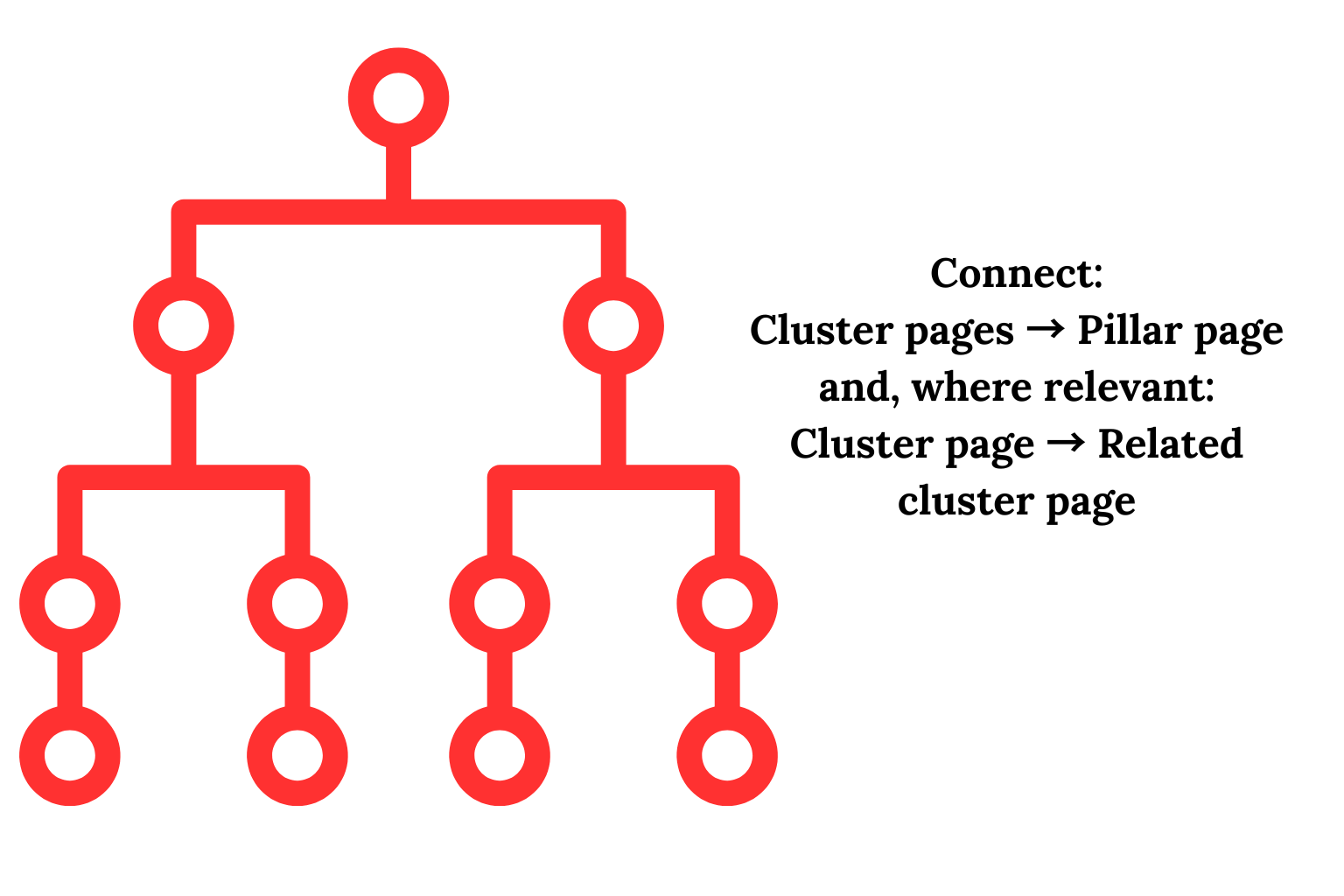
For example:
Technical SEO
→ Core Web Vitals
→ Page Speed
→ JavaScript SEO
→ Crawl Budget
The links should be contextually relevant rather than added simply to increase the number of internal links.
Good internal linking helps users discover related information and improves search engines crawl and understand the relationships between your pages.
5. Use Descriptive Anchor Text
Use anchor text that clearly communicates what the linked page is about.
Instead of:
Click here to learn more.
Use:
Learn more about technical SEO.
This gives users clearer navigation and provides additional context about the destination page.
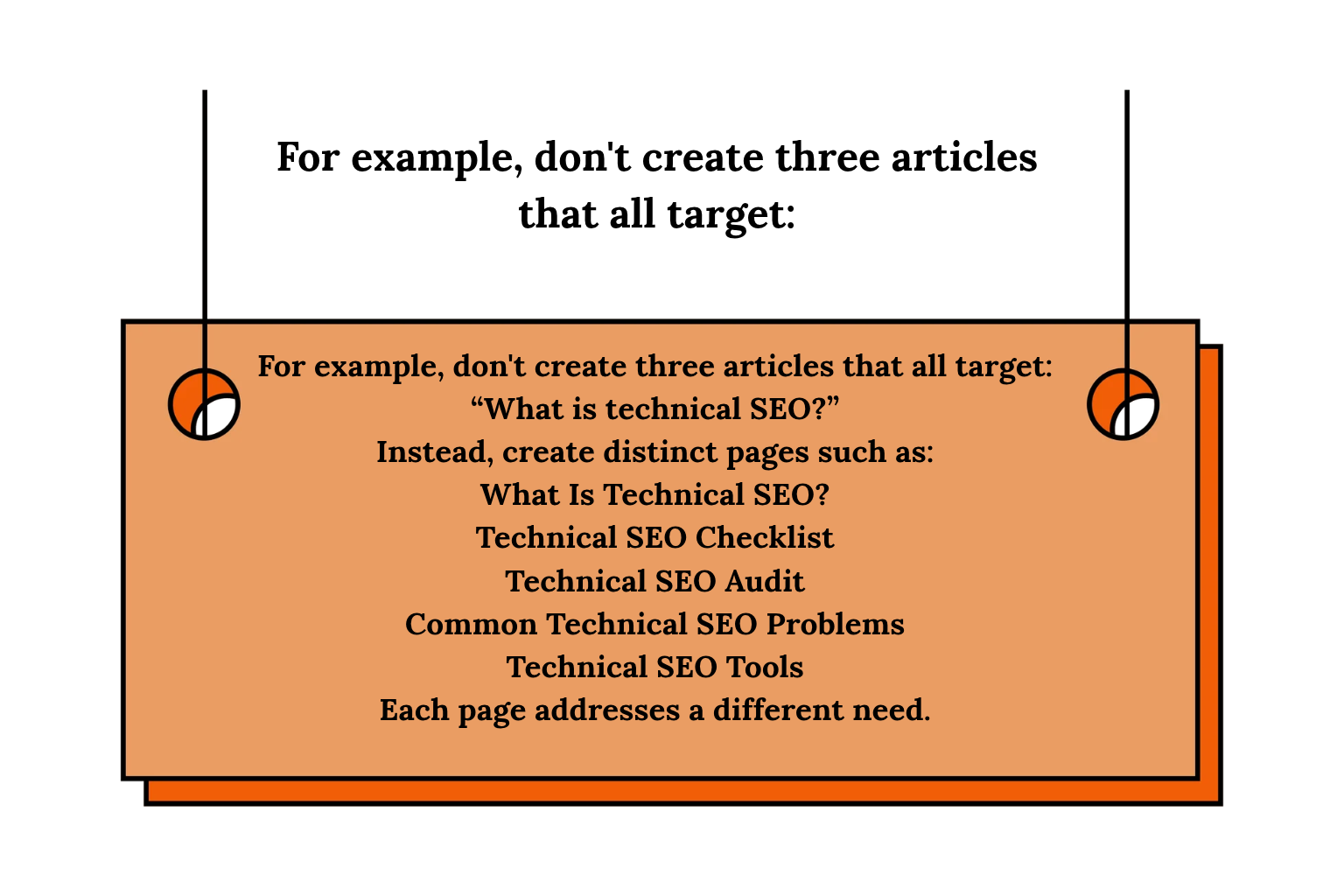
6. Avoid Keyword Cannibalization
When creating multiple pages around the same topic, make sure each page has a different primary purpose or search intent.
7. Add Information Gain
Information Gain is a useful content-quality concept: instead of simply repeating information that already exists across search results, aim to provide additional value or genuinely useful information.
This can come from:
- Original research
- First-hand experience
- Unique examples
- Original data
- Expert opinions
- Case studies
- Experiments
- New analysis
- Updated statistics
- Practical processes
- Real-world comparisons
For example, if the top-ranking pages all explain what Core Web Vitals are, simply rewriting those definitions adds little value.
A stronger article could include original test results, before-and-after performance data, practical troubleshooting steps, or expert analysis.
The goal is not to make content different merely for the sake of being different. The goal is to give users something useful that existing content does not adequately provide.
8. Keep the Cluster Updated
Topic clusters should be treated as an evolving content system.
Regularly review:
- Outdated information
- Broken internal links
- Missing subtopics
- New search queries
- Changes in user intent
- New developments in the industry
- Opportunities to improve existing content
If a new important subtopic emerges, add it to the appropriate cluster rather than creating an unrelated article.
9. Measure the Performance of the Cluster
Don’t evaluate every article in isolation. Look at how the entire topic cluster performs.
Monitor:
- Organic traffic
- Impressions
- Clicks
- Rankings
- Internal-link engagement
- Conversions
- New keywords
- Pages receiving backlinks
This helps identify which parts of the cluster are performing well and where additional content or optimization may be needed.
How Topical Authority Influences AI Search and LLMs
AI-powered search has changed how search engines discover, interpret, and present information. Traditional search systems relied heavily on matching queries with relevant words and phrases. Modern AI systems and large language models (LLMs) go further by analyzing context, entities, relationships, meaning, and the overall relevance of a source.
This makes topical authority increasingly important. A website that consistently demonstrates comprehensive knowledge of a subject can provide AI systems with more context to understand what the website covers and how its information relates to other concepts.
1. Search Is Moving Beyond Simple Keyword Matching
Modern search systems do not depend only on whether a webpage contains the exact words used in a query. They can analyze the meaning and context behind a search.
This is where topical authority becomes valuable. Comprehensive coverage helps establish clear relationships between the main subject and its supporting concepts.
2. Entity Relationships Provide Context
AI-powered search increasingly works with entities—distinct people, places, organizations, products, concepts, and other identifiable things—and the relationships between them.
For example, the entity Paris can be connected with:
- France
- Eiffel Tower
- Louvre Museum
- Seine River
- French cuisine
- Hotels
- Public transportation
- Tourism
- European travel
A website that consistently explains these related entities and their relationships provides a richer semantic context.
3. Topic Clusters Give AI Systems More Context
A well-designed topic cluster creates multiple connected pages around a central subject.
For example:
Pillar:
Complete Guide to Digital Marketing
Cluster pages:
- SEO
- Content Marketing
- Email Marketing
- Social Media Marketing
- PPC
- Influencer Marketing
- Conversion Rate Optimization
Each page addresses a different part of the broader subject while internal links establish relationships between them.
This structure gives AI systems more contextual information about the subject being covered. It also makes it easier to distinguish between a website that briefly mentions a topic and one that has developed substantial coverage around it.
4. Topical Authority Can Support AI-Generated Answers
AI search systems often need to combine information from multiple sources before generating an answer.
A website with several high-quality pages covering different aspects of the same subject can provide multiple relevant information points.
For example, a travel website may have separate resources covering:
- Destination attractions
- Travel costs
- Transportation
- Best time to visit
- Accommodation
- Local activities
- Travel restrictions
- Itineraries
When these pages are accurate, well-connected, and genuinely useful, they provide a stronger information ecosystem for search systems to interpret.
However, topical authority does not guarantee that an LLM will cite a website. AI systems consider many factors, including relevance, source quality, accuracy, freshness, authority, and the specific context of the query.
5. Topical Coverage Can Help With AI Overviews
Google’s AI Overviews can generate summaries by combining information from multiple web sources.
Comprehensive topical coverage can increase the number of relevant pages a website has that potentially satisfy different parts of a user’s query.
For example, a website covering “Japan travel” might have detailed resources about:
- Tokyo
- Kyoto
- Osaka
- Japanese transportation
- Japan travel costs
- Japanese food
- Cultural etiquette
- Best time to visit Japan
- Japan itineraries
This creates a broader knowledge base around the subject.
However, being included in an AI Overview is not simply a matter of having the most articles. Google evaluates the usefulness and relevance of individual pages and sources for particular queries.
6. LLMs Benefit From Clear Relationships Between Concepts
LLMs process language by analyzing relationships between concepts and their surrounding context.
For this reason, content should not be created as isolated keyword-targeted pages. It should explain:
- What a concept means
- How it relates to other concepts
- Why it matters
- When it applies
- What problems it solves
- How it differs from related concepts
For example, an article about technical SEO can naturally explain its relationship with:
Crawling → Indexing → Rendering → Website Architecture → Core Web Vitals → Search Performance
This creates a more meaningful information structure than repeatedly inserting the phrase “technical SEO.”
7. Original Information Can Increase Content Value
AI systems have access to large amounts of similar information. Publishing another article that simply rewrites existing content may provide limited additional value.
A stronger approach is to contribute original information, such as:
- First-hand experience
- Original research
- Surveys
- Experiments
- Unique datasets
- Expert analysis
- Case studies
- Practical testing
- Original examples
This is often discussed in SEO through the concept of information gain—providing useful information beyond what is already commonly available.
8. Consistency Across the Website Matters
Topical authority is weakened when a website publishes large amounts of unrelated content without a clear relationship to its main subjects.
A website focused primarily on SEO may build stronger topical relevance by consistently covering:
SEO → Keyword Research → Technical SEO → Semantic SEO → On-Page SEO → Link Building → Local SEO → SEO Analytics
rather than publishing unrelated articles simply because those topics have high search volume.
The objective is to create a coherent body of knowledge, not merely a large number of pages.
9. Structured Content Helps AI Understand Information
Clear content organization can make information easier for both users and search systems to interpret.
Useful practices include:
- Clear headings and subheadings
- Logical content hierarchy
- Descriptive internal links
- Consistent terminology
- Relevant entities
- Structured data where appropriate
- Direct answers to specific questions
- Tables and lists where they improve comprehension
- Strong contextual relationships between related pages
These elements help communicate what each page is about and how it fits within the broader topic.
10. Topical Authority Is Not the Same as “Training an LLM”
An important distinction is that building topical authority does not automatically mean an LLM will permanently learn a website and remember it in its model weights.
AI search systems can retrieve information from the web, use search indexes or retrieval systems, and combine information from different sources when generating answers.
Therefore, the practical SEO goal is not simply:
“Get an LLM to learn the website.”
The goal is to create authoritative, accessible, well-structured, relevant information that AI-powered search systems can discover, interpret, evaluate, and potentially reference.
Measure the Impact of Topical Authority
Measuring topical authority is not based on a single metric or score. Instead, it involves monitoring multiple SEO signals over time to determine whether a website is gaining visibility, relevance, traffic, and competitive strength within its target topic.
A successful topical authority strategy should gradually improve the performance of related pages and increase the website’s presence across searches connected to the topic.
1. Track Rankings Across Clusters
Rankings should be evaluated across the entire topic cluster, rather than focusing on one article at a time.
For example, a website targeting technical SEO may have a pillar page along with supporting pages about:
- Technical SEO audits
- Crawl budget
- XML sitemaps
- Robots.txt
- Canonical tags
- Core Web Vitals
- JavaScript SEO
The performance of these pages can be monitored collectively.
If multiple pages begin ranking for relevant queries and their positions improve over time, it can indicate that the website is developing stronger topical relevance.
It is also useful to monitor newly ranking keywords, featured snippets, SERP features, and the number of queries for which the entire cluster receives visibility.
2. Analyze Organic Traffic
Organic traffic provides another important indication of whether topical coverage is generating results.
Tools such as Google Search Console and Google Analytics can help identify:
- Organic clicks
- Search impressions
- Click-through rate
- Landing pages
- Search queries
- New users
- Engaged sessions
- Conversions
Instead of looking only at traffic to the pillar page, performance should be evaluated across the whole topic cluster.
For example, if the pillar page receives more traffic while supporting articles also begin attracting visitors from new search queries, the cluster may be gaining broader search visibility.
3. Monitor Search Impressions and Query Coverage
Search impressions show how frequently pages appear in search results.
A growing number of impressions across related queries can indicate that search engines are showing the website for a broader range of searches.
It is particularly useful to look for:
- More related queries
- More long-tail keywords
- Increasing impressions across cluster pages
- New keywords entering the top 10 or top 20
- Increasing visibility for different search intents
This provides a more complete picture than tracking one primary keyword.
4. Measure Organic Engagement
Traffic alone does not show whether visitors find the content useful.
Engagement metrics can help determine whether users are actually interacting with the content after arriving from search.
Useful signals include:
- Engaged sessions
- Average engagement time
- Pages viewed
- Scroll depth, when available
- Returning visitors
- Conversions
- Internal-link interactions
Strong engagement across several related pages can indicate that the content is satisfying users’ information needs.
However, engagement metrics should be interpreted in context because a short visit is not automatically a sign of poor content—for example, a user may find a simple answer quickly.
5. Measure Share of Voice
Share of voice (SOV) measures how visible a website is in search results for a defined group of relevant keywords compared with competitors.
For example, an SEO tool might track 500 keywords related to technical SEO and calculate how much of the available search visibility belongs to each competing website.
If a website’s share of voice increases over time, it means its visibility within that search space is improving relative to competitors.
This can help answer questions such as:
Is the website becoming more visible within its target topic?
Are competitors still dominating important queries?
Which subtopics have the largest visibility gaps?
6. Monitor Keyword Coverage
Topical authority should result in broader keyword coverage, not just higher rankings for one keyword.
A website may initially rank for a small number of queries around a subject. As its content becomes more comprehensive, it may begin appearing for:
Primary topics → Related topics → Long-tail queries → Questions → Different search intents
Tracking this expansion helps determine whether the website is gaining visibility across the wider topic.
7. Evaluate Internal-Link Performance
Internal linking is an important component of topic cluster architecture.
Regularly review whether:
- Important pages receive relevant internal links
- Cluster pages link back to the pillar page
- Related pages are connected logically
- Important pages are not isolated
- Internal anchor text accurately describes the destination
A well-connected cluster makes it easier for both users and search engines to navigate the site’s content relationships.
8. Compare Performance With Competitors
Topical authority should also be evaluated against competitors.
Compare:
- Number of ranking keywords
- Search visibility
- Share of voice
- Content coverage
- Backlink profiles
- Ranking pages
- SERP features
- Missing subtopics
This can reveal content gaps where competitors have useful coverage that the website does not yet provide.
9. Track Conversions and Business Outcomes
Higher rankings and traffic are valuable, but they are not the final goal for most websites.
Measure whether topical growth contributes to meaningful outcomes such as:
- Leads
- Sales
- Newsletter subscriptions
- Affiliate clicks
- Downloads
- Bookings
- Enquiries
A topic cluster that generates qualified traffic and conversions is more valuable than one that produces traffic without meaningful results.
10. Measure Progress Over Time
Topical authority develops gradually, so it should be measured over months rather than a few days.
Frequently Asked Questions
What is topical authority in SEO?
Topical authority refers to a website’s demonstrated depth and relevance on a particular subject through useful, comprehensive, and connected content.
How many articles are needed to build topical authority?
There is no fixed number. The number depends on the subject, its important subtopics, the audience’s needs, and the quality of the available content.
Is topical authority a Google ranking factor?
Topical authority is not a single, publicly defined Google score. Comprehensive and helpful content may support search visibility, but rankings depend on multiple systems and signals.
What is the difference between topical authority and domain authority?
Topical authority describes a website’s depth and relevance on a subject. Domain Authority (DA) is Moz’s third-party metric that estimates a website’s ability to rank, based largely on link-related data.
Do topic clusters help SEO?
Topic clusters organize related content around a broader subject. Relevant internal links help users navigate the content and help search engines discover and understand related pages.
Does topical authority help with AI search?
Comprehensive, accurate, well-structured content can make a website a useful source for relevant queries. However, topical authority alone does not guarantee inclusion in AI Overviews or citations by AI systems.
One Comment